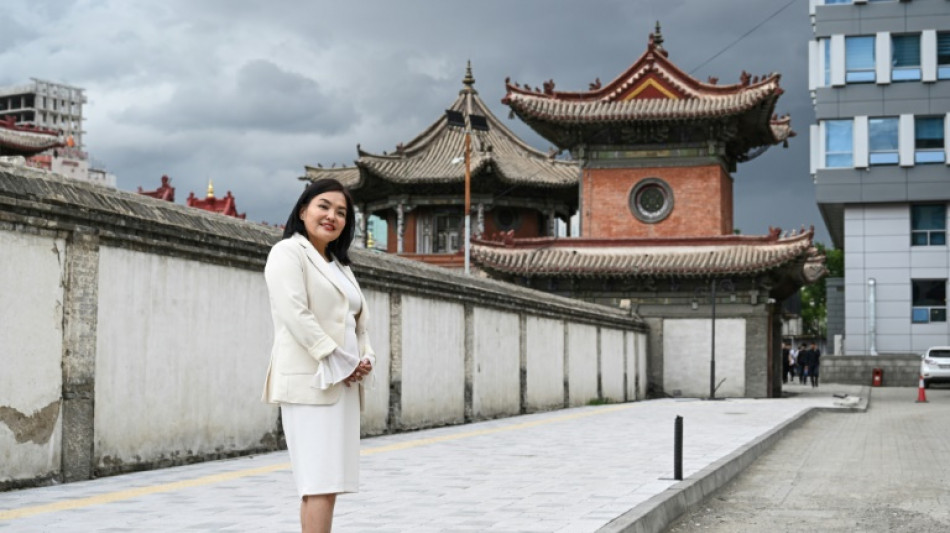
Women 'changing the game' in Mongolia's patriarchal politics / Photo: HECTOR RETAMAL - AFP

 Norway bids farewell to King Harald V, 'grandfather' of the nation
 NFL breaks new ground as 100,000 set to pack MCG in Australia
 EU faces revolt over social media ban for children
 Canada eyes researchers looking to leave 'hostile' US

 Tiafoe escapes Michelsen to reach US Open semi-finals
 Carney touts Canada 'pivot' away from US as Trump levels new threat

 Pounding waves open up sinkhole in swanky Malibu
 LIV Golf files for bankruptcy protection

 Argentina launches legal action against oil firms for Falklands drilling

 Haaland double powers Man City to victory over Porto

 Sabalenka survives Noskova to return to US Open semi-finals
 'South Park' changes name in dig at Trump
 OpenAI says AI solved one of math's hardest problems in days
 Nearly 1,100 flights cancelled after UK air traffic control glitch
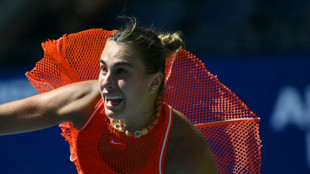 Sabalenka holds off Noskova to keep US Open three-peat bid alive

 Rein in social media not children, say over 130 groups, experts
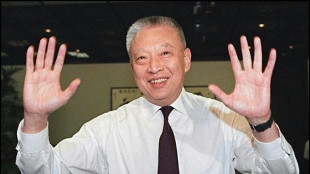 Hong Kong's first post-colonial leader Tung Chee-hwa dies aged 89
 Rangers captain Shankland sidelined for up to four months
 NY failed to disclose what it knew on 'toxic air' after 9/11
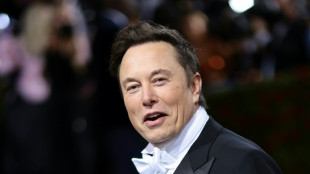 What we learned from 'lacerating' four-hour Musk documentary

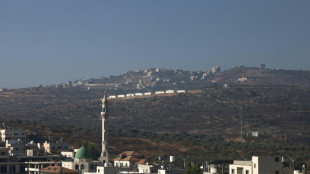 UK, France, Canada to ban imports from Israeli settlements
 Pakistan's drastic squad upheaval 'news' to skipper Babar Azam
 Hurricane Lowell lashes Hawaii's western islands
 Argentina files lawsuit against oil firms operating off Falklands
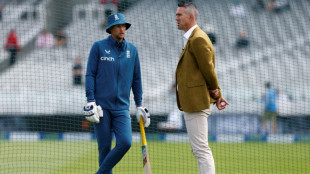 Root wants Pietersen to pull no punches on England return
Women candidates are pushing for greater representation in Mongolia's male-dominated politics, raising their voices for change and inspiring girls to follow in their footsteps.
Mongolians go to the polls in parliamentary elections on Friday, with the ruling Mongolian People's Party widely expected to retain a majority it has held for eight years.
But for the first time in almost a decade, parties are required by law to ensure that 30 percent of their candidates are women, in a country where politics is overwhelmingly dominated by men.
As a result, more women than ever before are running this year, in a new voting system that balances proportional lists with district candidates elected directly by the people.
"The era we are living in demands the quota," Dorjzodov Enkhtuya, a 51-year-old former TV anchor running for the main opposition Democratic Party, told AFP in capital city Ulaanbaatar.
"There are almost no women in decision-making positions," she said.
"We are changing the game."
- Strict patriarchal norms -
In Mongolia, gender inequalities are especially acute in the vast countryside, where nomadic life is governed by strict patriarchal norms.
But even in rural areas, attitudes are slowly shifting.
In 2022, the government appointed Enkhbat Bolormaa as the country's first-ever woman governor in the western province of Khovd.
The decision sparked national debate -- provincial governors in Mongolia are typically required to participate in traditional ceremonies usually reserved for men.
"There were public discussions about whether a woman can be a governor," Khurelbaatar Baasanjargal, a 42-year-old lawyer and ruling party candidate, told AFP.
"But our first female governor has been doing everything that male governors can do," she said.
"This was like a different world, especially for rural people."
- 'A dirty game' -
As is the case everywhere, many of the problems that plague urban life disproportionately impact women.
Women running for office have campaigned on the platform that, ultimately, women's issues are Mongolia's issues.
Children falling sick from air pollution mean that more often than not, working mothers must stay home to care for them.
Dire city planning means there are fewer places for youngsters to play.
Stubbornly high inflation makes doing the weekly shop a lot harder -- and it's a job women are usually left to handle.
But in a quiet suburb of Ulaanbaatar, surrounded by dozens of purple and yellow balloons bearing her party's colours, 41-year-old candidate Baatarjav Munkhsoyol told AFP that women have to work extra hard to be heard in politics.
"Elections are a game of money and an enormous expense -- smear campaigns are common," said Munkhsoyol, a candidate for the minor centre-right anti-corruption HUN party.
"It takes strong will and courage to run in an election if you are a woman," the former NGO worker added.
Endemic corruption -- a problem that analysts and Transparency International say has worsened since 2016 -- also puts women off, Munkhsoyol said.
"The reason why men are more involved in politics is due to gender stereotypes and traditional mindsets," she said.
"But these men are corrupt," she said. "Women see politics as a dirty game and prefer to stay away."
- 'Women protect women' -
The country's institutions have seen some progress: the Mongolian government says that almost two thirds of civil servants are women.
The 30 percent quota is, in itself, an improvement on the status quo ante, with a goal of raising it to 40 percent in the next vote.
Mongolia has long had a quota for women in polls, and it has been revised several times.
But beyond the realm of politics violence against women remains a major problem.
The United Nations Development Programme has said that two thirds of women in Mongolia have experienced some form of physical, sexual, emotional, or economic abuse.
"Gender-based violence is one of the main barriers that today's women of all ages face," said Enkhtuya, who wants the quota for women candidates in polls to rise from 30 to 50 percent.
"Women will do more to protect women," she said.
"That's why it's time for change."
Baasanjargal rose to prominence successfully campaigning for a ban on child horse racing.
She told AFP she had met an elderly woman in far-eastern Dornod province who told her she had long suffered under an abusive husband.
"She told me she was very happy that now we talk about the human rights of women," she said.
"She said she might have suffered less if there had been a conversation about providing human rights for women."
But, she said, her travels to the countryside had also seen her work to encourage two 10-year-old girls to dream big and pursue whatever careers they wanted.
"I told them that women can do all jobs," she said.
"They smiled and looked at each other. That's why I decided to stay in politics, to be an example for other women."
W.Moreno--AT