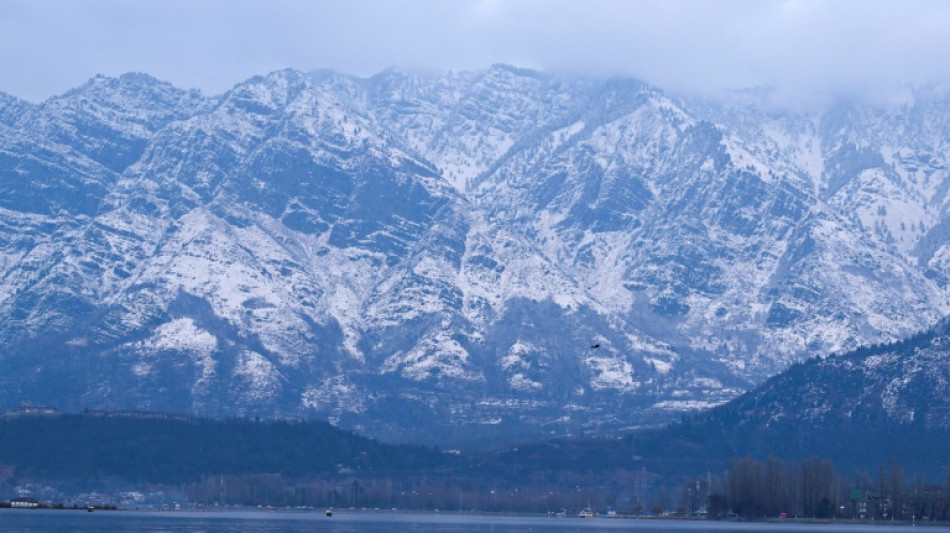
Low snow on the Himalayas threatens water security: study / Photo: TAUSEEF MUSTAFA - AFP/File

 Iran, US trade blows as Hormuz impasse deepens

 The round-the-clock monitors protecting Bhutan from glacier risk

 'Hell': Father of surfers killed in Mexico testifies at trial

 Travellers in UK face more chaos after air traffic control glitch

 Crude pushes towards $100 on Mideast flare-up, fanning inflation fears

 Record rain forces Asian Games athletes to evacuate accommodation

 Amusing or addictive? The algorithms powering our social feeds

 Norway bids farewell to King Harald V, 'grandfather' of the nation

 NFL breaks new ground as 100,000 set to pack MCG in Australia

 EU faces revolt over social media ban for children
 Canada eyes researchers looking to leave 'hostile' US

 Tiafoe escapes Michelsen to reach US Open semi-finals

 Sabalenka edges Noskova, keeps US Open treble bid alive

 Real Madrid win Champions League opener as Haaland stars for Man City

 Gambian leader vows power boost after violent blackout protests

 Newcastle battle past Millwall to reach League Cup fourth round
 Mourinho's Real Madrid make winning start against Inter Milan

 Villa take 'big step forward' with win over Brugge

 Yaya Toure hails 'new era' for African coaches ahead of Champions League bow

 Lawes and Marchant told to prove themselves in quest for England recalls

 Smithsonian secretary to retire as Trump exerts control over institution

 Atletico have work to do to reach home Champions League final: Simeone

 Villa end goal drought to beat Brugge in Champions League opener

 McIlroy says 'we'll keep our heads down and play' in event of Trump golf visit

 Sabalenka holds of Noskova to reach US Open semi-finals

Millions of people dependent on Himalayan snowmelt for water face a "very serious" risk of shortages this year after one of the lowest rates of snowfall, scientists warned Monday.
Snowmelt is the source of about a quarter of the total water flow of 12 major river basins that originate high in the region, the report said.
"This is a wake-up call for researchers, policymakers, and downstream communities," said report author Sher Muhammad, from the Nepal-based International Centre for Integrated Mountain Development (ICIMOD).
"Lower accumulation of snow and fluctuating levels of snow pose a very serious increased risk of water shortages, particularly this year."
Snow and ice on the Himalayas are a crucial water source for around 240 million people in the mountainous regions, as well as for another 1.65 billion people in the river valleys below, according to ICIMOD.
While snow levels fluctuate each year, scientists say climate change is driving erratic rainfall and shifting weather patterns.
The report measured "snow persistence" -- the time snow remains on the ground -- with levels dropping almost a fifth below normal this year across the wider Hindu Kush and Himalaya region.
"This year's snow persistence (18.5 percent below normal) is the second-lowest in the past 22 years, narrowly trailing the record low of 19 percent set in 2018," Muhammad told AFP.
- 'Significant changes' -
As well as Nepal, the inter-governmental ICIMOD organisation includes member countries Afghanistan, Bangladesh, Bhutan, China, India, Myanmar and Pakistan.
The report warned that ICIMOD "observations and projections indicate significant changes in the timing and intensity of stream flows", with snow a key part.
"Snow plays a particularly important role in ensuring seasonal water availability," it added.
The organisation has been monitoring snow in the region for over two decades, noting that 2024 marked a "significant anomaly".
The Ganges river basin, which flows through India, had the "lowest snow persistence" that ICIMOD has recorded, 17 percent below average, worse than the 15 percent in 2018.
The Helmand river basin in Afghanistan recorded its second-lowest snow persistence levels, 32 percent below normal.
The Indus river basin was down 23 percent below normal levels, while the Brahmaputra river basin, which ends in Bangladesh, had snow persistence "notably below normal" at 15 percent.
Miriam Jackson, senior cryosphere specialist at ICIMOD, urged authorities to "take proactive measures to address possible drought situations".
R.Lee--AT