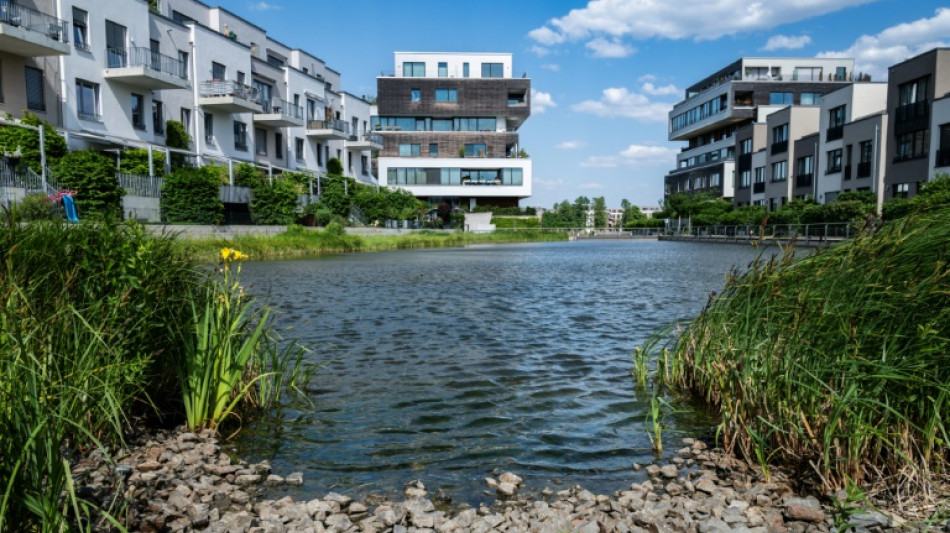
From swamp to sponge: Berlin harnesses rain in climate shift / Photo: John MACDOUGALL - AFP

 'Long live Chairman Mao': Supporters pay respects to founder of Communist China
 Sweden immigration restrictions spark healthcare concerns

 EU to help cities tighten screws on Airbnb, holiday rentals

 'Our year': Kane and Bayern primed for Champions League tilt
 Australian World Cup star Volpato fined over positive cocaine test

 Sabalenka edges Noskova to keep US Open treble bid alive
 Pegula outlasts Navarro to set US Open semi with Sabalenka

 From trenches to catwalk: Ukraine's amputee soldiers hit the runway
 UK airports face more disruption after air traffic control glitch

 ECB meets, weighing a tricky balance between savers and spenders

 Pakistan police counter drone attacks with Ukraine-style nets

 Russia torments Kyiv with new 'horror' jet drones

 Iran attacks US base in Jordan as Hormuz impasse deepens
 New Apple CEO to face first test with foldable iPhone launch

 BrYet Announces AIFA Approval of First-In-Kind cGMP Manufacturing Line for ML-016, Enabling Imminent Clinical Supply to Australia

 Sabalenka edges Noskova, keeps US Open treble bid alive

 Real Madrid win Champions League opener as Haaland stars for Man City
 Gambian leader vows power boost after violent blackout protests

 Newcastle battle past Millwall to reach League Cup fourth round
 Mourinho's Real Madrid make winning start against Inter Milan

 Villa take 'big step forward' with win over Brugge

 Yaya Toure hails 'new era' for African coaches ahead of Champions League bow

 Lawes and Marchant told to prove themselves in quest for England recalls

 Smithsonian secretary to retire as Trump exerts control over institution
 Atletico have work to do to reach home Champions League final: Simeone

In two years' time, a massive hole in the heart of Berlin will become the German capital's biggest reservoir, capturing an increasingly precious resource -- water.
Once a swamp centuries ago, Berlin has gone from a city trying to keep its abundant groundwater from overflowing to one scrambling to keep its forests green.
"Before, the aim was to evacuate rainwater to be able to cross the city without having to put on rubber boots," Stephan Natz, the spokesman for Berlin's water management services, told AFP from the edge of the crater, 20 metres (66 feet) deep.
But in 2018, the city adopted a "paradigm change" and is now finding ways to store rainwater to both combat drought and prevent flash floods.
In essence, it is applying the sponge city concept, which emerged as a theory in the 1970s and which has found favour in growing urban centres across the United States, China and Europe, as climate change makes weather systems more mercurial and more intense.
"The distribution of rain is now more erratic, that is to say, droughts are followed by strong rains and an ever-growing warming, which is in turn increasing evaporation," said Natz.
Berlin's 150-year-old sewage drainage system was not built to cope with today's heavy deluges.
"In case of heavy rain, the waters are mixing and flooding the Spree river, sparking the deaths of fish and pollution that is visible," said Natz.
At the same time, Berlin has faced severe water shortages in recent years as drought conditions in the capital leave the ground too dry to absorb sudden and strong rainfall.
As a result, the capital's groundwater has still not returned to its normal level after five years of drought, according to the Leibniz Institute of Freshwater Ecology and Inland Fisheries.
"There is now a realisation of the value of water in Berlin. It's one of the driest places in Germany," said Darla Nickel, the director of the agency that manages rainwater in the capital.
- Race against time -
In a symbol of the ongoing transformation, the giant water reserve under construction is smack in the middle of the capital -- fewer than two kilometres (1.2 miles) away from the Brandenburg Gate.
The reservoir, 40 metres in diameter, will collect almost 17,000 cubic metres of water -- or five times the capacity of an Olympic-size pool.
It will store the rainwater before sending it to a treatment plant.
Besides the mega reservoir, Berlin is now requiring new housing projects to have a rainwater collection strategy.
Quartier 52, built five years ago in the southwest of the city, offers a model.
Three large ponds have been dug around the housing estate, offering residents a scenic walk on sunny days while serving as catchment when it rains.
Rainwater is "collected on green roofs and then in these ponds," said Nickel.
"The water evaporates and in turn creates a more agreeable atmosphere."
The pavements are also gently sloping, allowing water to run down into the ground.
"You see that it can be really simple," said Nickel.
The challenge would be to replicate such measures across the city.
"We have advanced much more slowly with existing buildings than with new constructions," said Nickel.
In all, about 30 projects are ongoing under the sponge city plan, including at the central Berlin Gendarmenmarkt area, usually a tourist magnet.
The city is also asking residents to install water collectors or plant green roofs, dangling an exemption of fees for management or purification of rainwater.
Officials are aware it will take several generations for Berlin to become a real sponge.
"We'll see if climate change gives us enough time," said Natz.
J.Gomez--AT