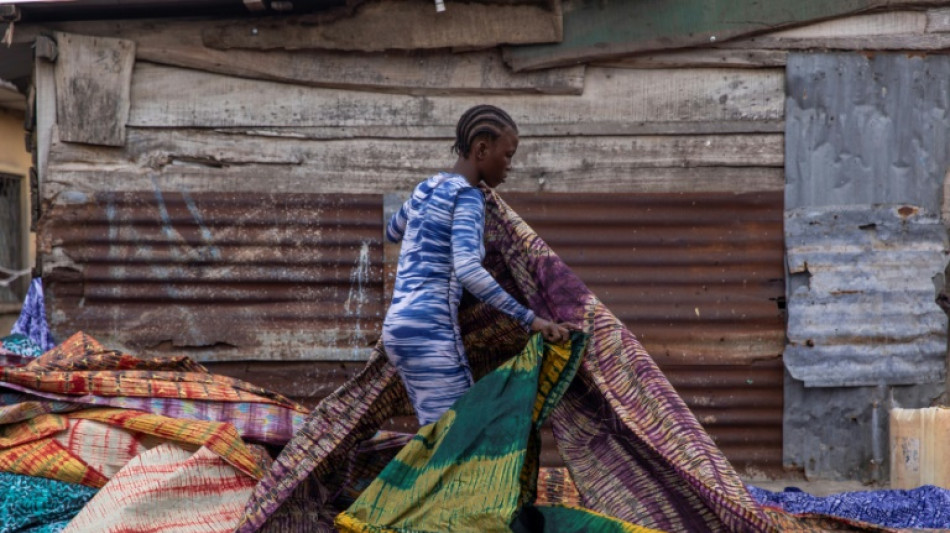
Nigeria's dyed cloth traders feel heat from China, inflation / Photo: TOYIN ADEDOKUN - AFP

 'Long live Chairman Mao': Supporters pay respects to founder of Communist China
 Sweden immigration restrictions spark healthcare concerns
 EU to help cities tighten screws on Airbnb, holiday rentals

 'Our year': Kane and Bayern primed for Champions League tilt
 Australian World Cup star Volpato fined over positive cocaine test

 Sabalenka edges Noskova to keep US Open treble bid alive

 Pegula outlasts Navarro to set US Open semi with Sabalenka

 From trenches to catwalk: Ukraine's amputee soldiers hit the runway
 UK airports face more disruption after air traffic control glitch

 ECB meets, weighing a tricky balance between savers and spenders

 Pakistan police counter drone attacks with Ukraine-style nets

 Russia torments Kyiv with new 'horror' jet drones

 Iran attacks US base in Jordan as Hormuz impasse deepens

 New Apple CEO to face first test with foldable iPhone launch

 BrYet Announces AIFA Approval of First-In-Kind cGMP Manufacturing Line for ML-016, Enabling Imminent Clinical Supply to Australia

 Sabalenka edges Noskova, keeps US Open treble bid alive

 Real Madrid win Champions League opener as Haaland stars for Man City
 Gambian leader vows power boost after violent blackout protests

 Newcastle battle past Millwall to reach League Cup fourth round

 Mourinho's Real Madrid make winning start against Inter Milan

 Villa take 'big step forward' with win over Brugge

 Yaya Toure hails 'new era' for African coaches ahead of Champions League bow

 Lawes and Marchant told to prove themselves in quest for England recalls

 Smithsonian secretary to retire as Trump exerts control over institution

 Atletico have work to do to reach home Champions League final: Simeone

Despite the rain pelting Balogun market in Lagos, Ajoke takes her time choosing the tie-dye fabric known as adire that she wants to give as a gift.
The popular textile traditionally dyed with indigo is emblematic of the culture of the Yoruba people, one of Nigeria's majority ethnic groups.
The cloth is typically used for traditional outfits often worn by Nigerians for special occasions, weddings and parties.
The 21-year-old customer slides her fingers over different brightly coloured fabrics to distinguish traditional Nigerian cotton from polyester versions made in China.
"It's not expensive," Ajoke remarked, picking up a Chinese-made fabric with purple patterns.
It costs 3,300 naira (around $2.20), half the price of a locally produced fabric.
As Africa's most populous nation grapples with high inflation that has left many struggling, Chinese counterfeit adire products have become an attractive option.
But the imported textiles are challenging the long-established clothing industry in Nigeria, producers and traders say.
The southwestern city of Abeokuta -- nicknamed the Capital of Adire -- is home to nearly 2,000 merchants and producers, according to government data.
Somodale Akomo Amosa, 86, president of the city's sprawling adire market, said she had watched helplessly as Chinese competition began about 10 years ago.
"Her income has decreased over the years. She has only sold five fabrics in 10 days," one of Amosa's daughters said.
- Competition and crisis -
Adire fabric is produced using the tie-dye technique.
Fabrics are knotted and folded by hand before being dyed to create colour gradients and shapes, said Tunde M. Akinwumi, a retired professor of African textile design and author of a book on adire.
Despite the difficulties, market chief Amosa rejects the idea of Nigerian adire producers using machines to help cut the costs of making their fabrics, as the Chinese do.
The process "would harm the tradition and originality of the products", said Amosa, one of the few adire traders who does not offer the cheaper products among their wares.
As well as competition from China, she blames the economic climate at home for preventing people from being able to buy the traditional cloth.
Nigeria is gripped by its worst cost-of-living crisis in years after President Bola Ahmed Tinubu introduced tough economic reforms when he came to power a year ago.
Ending a fuel subsidy and floating the currency are expected to reap benefits in the long term but the moves have hiked fuel and living costs and sharply devalued the naira.
Some fabrics traders like Christiana Morenikeji Ilesanmi feel they have no choice.
"You are selling more Chinese-made adire, because it's cheaper. We feel bad," said the 56-year-old, who buys from wholesalers in the megalopolis, Lagos.
"Everybody is buying it."
- Saving a 'craft' -
A few minutes' walk from the market, the main adire production centre in Abeokuta also feels the impact.
The number of visitors ordering directly from the centre is falling, a 55-year-old producer said.
"Before, lots of people came here to order dresses for weddings or special occasions, but it's not like that now," she said.
To help the industry, Nigeria's presidency announced in March that it would allocate 400 traders with some 200 store spaces at reduced rates in Abeokuta's vast adire market, under a national business aid project.
Olusegun Obasanjo, Nigeria's two-time former head of state, urged authorities last year to stop imports of counterfeit Chinese adire.
So far, no action has been taken.
In 2020, the national and state government in Ogun where Abeokuta is located launched a website to allow merchants to sell their "original and top-of-the-class" adire throughout the country as well as abroad.
For market president Amosa, keeping adire alive is a matter of pride and tradition.
"Adire production is a family inheritance to us, others have come to learn it from us," she said.
"It is our craft, it is my craft."
P.Smith--AT