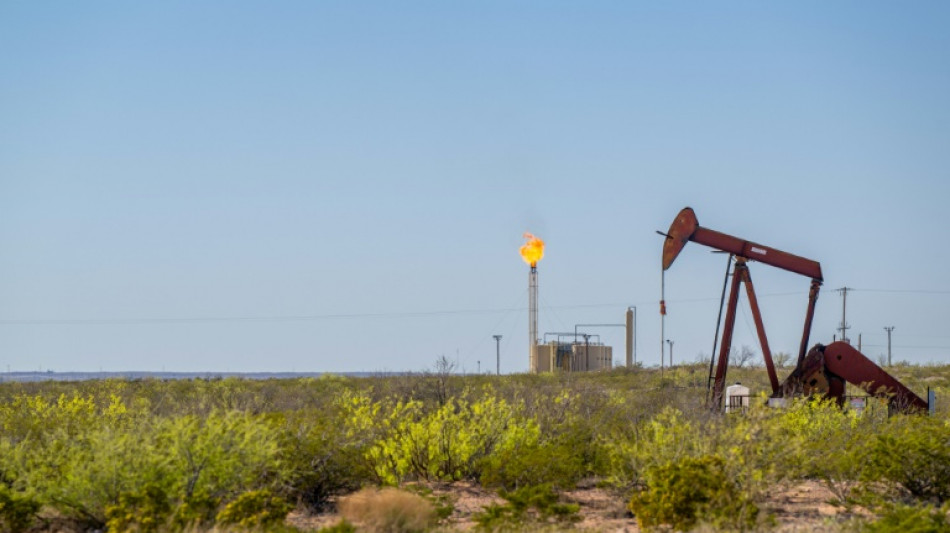
Oil and gas industry hops on generative AI bandwagon / Photo: Brandon Bell - GETTY IMAGES NORTH AMERICA/AFP/File

 'Long live Chairman Mao': Supporters pay respects to founder of Communist China

 Sweden immigration restrictions spark healthcare concerns

 EU to help cities tighten screws on Airbnb, holiday rentals

 'Our year': Kane and Bayern primed for Champions League tilt
 Australian World Cup star Volpato fined over positive cocaine test

 Sabalenka edges Noskova to keep US Open treble bid alive

 Pegula outlasts Navarro to set US Open semi with Sabalenka
 From trenches to catwalk: Ukraine's amputee soldiers hit the runway

 UK airports face more disruption after air traffic control glitch

 ECB meets, weighing a tricky balance between savers and spenders

 Pakistan police counter drone attacks with Ukraine-style nets

 Russia torments Kyiv with new 'horror' jet drones

 Iran attacks US base in Jordan as Hormuz impasse deepens

 New Apple CEO to face first test with foldable iPhone launch

 BrYet Announces AIFA Approval of First-In-Kind cGMP Manufacturing Line for ML-016, Enabling Imminent Clinical Supply to Australia

 Sabalenka edges Noskova, keeps US Open treble bid alive

 Real Madrid win Champions League opener as Haaland stars for Man City

 Gambian leader vows power boost after violent blackout protests

 Newcastle battle past Millwall to reach League Cup fourth round

 Mourinho's Real Madrid make winning start against Inter Milan

 Villa take 'big step forward' with win over Brugge

 Yaya Toure hails 'new era' for African coaches ahead of Champions League bow

 Lawes and Marchant told to prove themselves in quest for England recalls

 Smithsonian secretary to retire as Trump exerts control over institution

 Atletico have work to do to reach home Champions League final: Simeone

Away from the Microsoft and Googles of the world, a century-old industry -- oil and gas -- is hoping that generative artificial intelligence will make producing petroleum more efficient and easier on its workforce.
Long before the current craze surrounding generative AI (Gen AI), the energy sector employed traditional artificial intelligence through its use of data to identify oil and gas deposits.
But the industry sees even greater potential to save money, reduce accidents and lower greenhouse gases through Gen AI, which exponentially increases and diversifies the data that can be analyzed.
The new AI programs can also be employed broadly in the workforce instead of being limited to programmers and data analysts, as has been the case with traditional AI.
"Extracting this data from the copious amounts of data generated by drilling activities has historically posed a significant challenge for industry leaders," recently wrote Tim Hafke, content marketing specialist with AlphaSense. "That's where Gen AI comes in."
In recent years the downstream industry, which includes refineries that process crude oil into gasoline, has increasingly relied on so-called digital twins -- computer-modeled replicas of actual facilities.
They allow companies to run simulations to assess operational issues in real-life facilities, mitigate potential hazards and do predictive maintenance (PdM).
PdM uses historical and current data to project future performance and determine when parts should be taken down for maintenance or replaced.
Microsoft vice president Matthew Kerner sees this as an entry point to generative AI, a way "to explain why the predictive model is making that prediction" and provide context to better address the situation, he explained during a panel discussion at energy conference CERAWeek.
"Gen AI is useful as a bolt on to some other more predictive AI systems," Kerner said.
Next-generation chatbots similar to the world-famous ChatGPT can also be of help for employees on the ground, said Rob McGreevy, of industry software company Aveva, during the panel.
The data-filled chatbot could allow oil field or refinery workers encountering a problem to measure atmospheric conditions like humidity and operational performance like wellhead pressure to quickly diagnose the issue, McGreevy said.
Getting a detailed report in seconds allows for a quick fix -- saving time and money in the process.
- 'Less risk' -
During refinery maintenance, "you're putting people in dangerous situations to do work. If you can do those turnarounds faster, you're exposing yourself to less risk," said Matthew Babin, head of energy and natural resources at software company Palantir Technologies.
Gen AI can provide "context to people who are in the process of making a decision, even if it's outside their area of expertise," Babin said.
"So if I'm a reservoir engineer, I don't have to know about maintenance, but I do have to know about maintenance when I'm looking at how that resource is going to perform and what that costs my organization," Babin added.
Petroleum installations are regularly checked or taken offline for upkeep.
A Gen AI interface provides "access to a maintenance manual, so you can look at how maintenance for that piece of kit should be done," all laid out in plain English, thanks to a chatbot, McGreevy said.
Such a system could also facilitate the repair work itself, taking the guesswork out of such decisions.
For example, the technology would allow a company to use a computer model of a facility to determine if there is enough room to use a ladder or install scaffolding, McGreevey said.
McGreevy said it could also help new employees: "I think we can shorten dramatically the time it takes for people coming on board to be proficient to safely operate these facilities at scale."
Greater efficiencies linked to Gen AI also create a chance to reduce an oil facility's carbon footprint. But running the technology also requires huge amounts of electricity, mainly in data centers.
P.Hernandez--AT