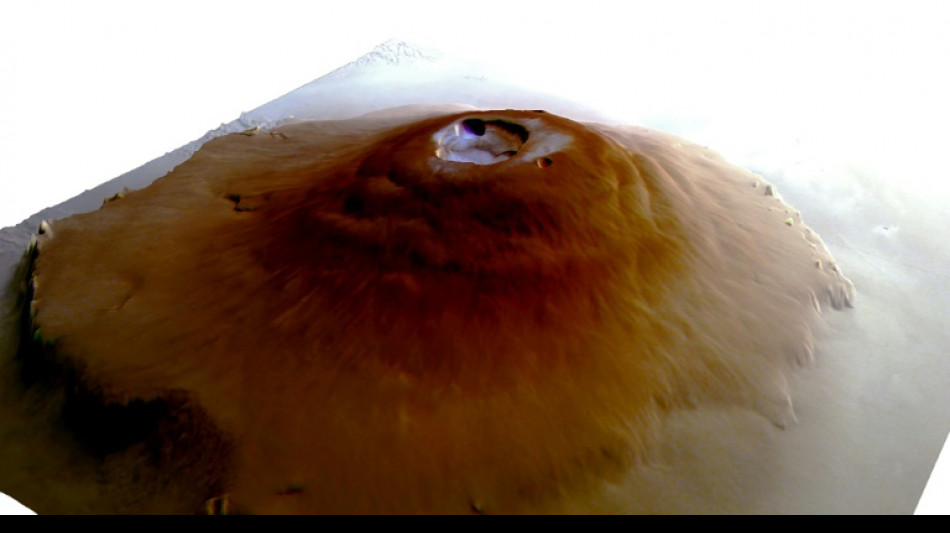
Frost discovered on top of giant Mars volcanoes / Photo: Adomas Valantinas - AFP

 'Long live Chairman Mao': Supporters pay respects to founder of Communist China

 Sweden immigration restrictions spark healthcare concerns

 EU to help cities tighten screws on Airbnb, holiday rentals

 'Our year': Kane and Bayern primed for Champions League tilt
 Australian World Cup star Volpato fined over positive cocaine test

 Sabalenka edges Noskova to keep US Open treble bid alive

 Pegula outlasts Navarro to set US Open semi with Sabalenka
 From trenches to catwalk: Ukraine's amputee soldiers hit the runway

 UK airports face more disruption after air traffic control glitch

 ECB meets, weighing a tricky balance between savers and spenders

 Pakistan police counter drone attacks with Ukraine-style nets

 Russia torments Kyiv with new 'horror' jet drones

 Iran attacks US base in Jordan as Hormuz impasse deepens
 New Apple CEO to face first test with foldable iPhone launch

 BrYet Announces AIFA Approval of First-In-Kind cGMP Manufacturing Line for ML-016, Enabling Imminent Clinical Supply to Australia

 Sabalenka edges Noskova, keeps US Open treble bid alive

 Real Madrid win Champions League opener as Haaland stars for Man City
 Gambian leader vows power boost after violent blackout protests

 Newcastle battle past Millwall to reach League Cup fourth round
 Mourinho's Real Madrid make winning start against Inter Milan

 Villa take 'big step forward' with win over Brugge

 Yaya Toure hails 'new era' for African coaches ahead of Champions League bow

 Lawes and Marchant told to prove themselves in quest for England recalls

 Smithsonian secretary to retire as Trump exerts control over institution

 Atletico have work to do to reach home Champions League final: Simeone

Early morning frost has been detected on the peaks of massive volcanoes on Mars, an unexpected discovery about the dispersal of water on Mars that could one day prove essential for human exploration, scientists said.
The early morning frost was spotted in images taken by the European Space Agency's Trace Gas Orbiter, according to a study published in the journal Nature Geoscience on Monday.
The immense volcanoes are in the Tharsis plateau, an elevated region nearly 5,000 kilometres (3,100 miles) wide near the Martian equator.
The volcanoes have been extinct for millions of years. Among them is the largest volcano in the solar system, Olympus Mons, which is almost three times taller than Mount Everest.
The discovery came by chance -- no one expected to find frost in this region.
"We thought it was impossible for frost to form around Mars's equator," lead study author Adomas Valantinas said in a statement.
Plenty of sunshine and a thin atmosphere mean the temperature is relatively warm up there, "unlike what we see on Earth, where you might expect to see frosty peaks," the researcher at Brown University in the United States said in a statement.
There is also little water in the atmosphere near the Martian equator, making condensation less likely.
"Other space probes have observed frost but in wetter regions -- notably the northern plains," study co-author Frederic Schmidt of France's Paris-Saclay University told AFP.
The Trace Gas Orbiter, which has been orbiting Mars since 2018, was able to take images when the first rays of the Sun crossed over the tops of the volcanoes.
"We saw a shiny, blue deposit there, a particular texture that we only see in the early morning and during the cold seasons," Schmidt said.
The layer of the ice is only the thickness of a hair -- and it does not last long.
But there is about 150,000 tonnes of water -- equivalent to 60 Olympic swimming pools -- in the daily frost at the summits of volcanoes Olympus Mons, Arsia Mons, Ascraeus Mons and Ceraunius Tholus, the ESA said.
- A touch of frost -
The researchers suggested the frost is caused by a micro-climate that forms inside the calderas of the huge volcanoes.
As wind whips up the sides of the volcanoes, it brings "relatively moist air from near the surface up to higher altitudes, where it condenses and settles as frost," study co-author Nicolas Thomas explained.
"We actually see this happening on Earth and other parts of Mars," said Thomas, who works on the Trace Gas Orbiter's imaging system.
Modelling how these frosts form "could allow scientists to reveal more of Mars's remaining secrets, including where water exists and how it moves between reservoirs," the ESA said.
This may prove crucial for planned missions that could see humans set foot on Martian soil.
"We could recover water from the frost for human consumption, or launch rockets from Mars by separating the oxygen and hydrogen molecules," Schmidt said.
Mapping the location of water on Mars -- which only exists as ice or vapour -- could also be key in the search for signs of extra-terrestrial life.
Liquid water is considered one of the essential ingredients for life on other planets.
Y.Baker--AT