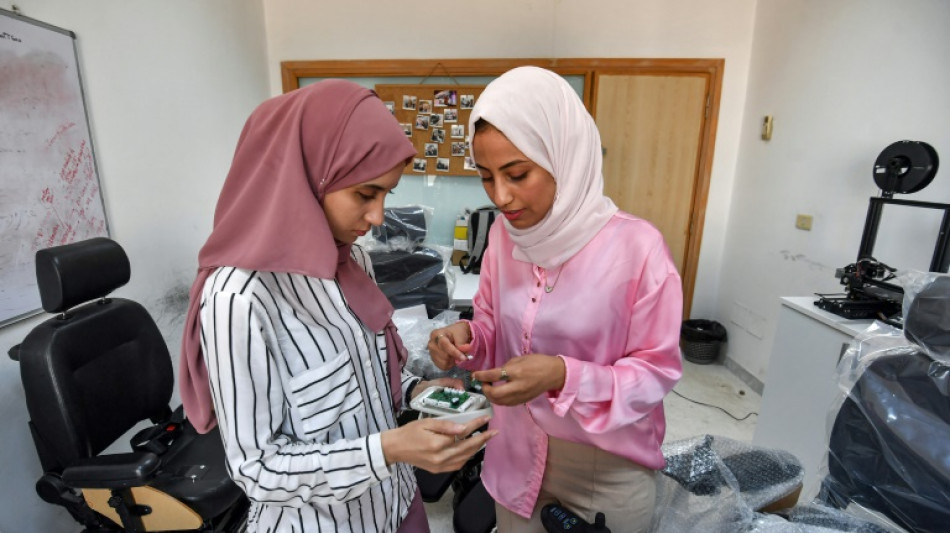
Tunisian all-women's team eye inventors' prize for smart wheelchair / Photo: FETHI BELAID - AFP

 'Long live Chairman Mao': Supporters pay respects to founder of Communist China

 Sweden immigration restrictions spark healthcare concerns
 EU to help cities tighten screws on Airbnb, holiday rentals

 'Our year': Kane and Bayern primed for Champions League tilt

 Australian World Cup star Volpato fined over positive cocaine test
 Sabalenka edges Noskova to keep US Open treble bid alive

 Pegula outlasts Navarro to set US Open semi with Sabalenka

 From trenches to catwalk: Ukraine's amputee soldiers hit the runway

 UK airports face more disruption after air traffic control glitch

 ECB meets, weighing a tricky balance between savers and spenders

 Pakistan police counter drone attacks with Ukraine-style nets

 Russia torments Kyiv with new 'horror' jet drones

 Iran attacks US base in Jordan as Hormuz impasse deepens

 New Apple CEO to face first test with foldable iPhone launch

 BrYet Announces AIFA Approval of First-In-Kind cGMP Manufacturing Line for ML-016, Enabling Imminent Clinical Supply to Australia

 Sabalenka edges Noskova, keeps US Open treble bid alive

 Real Madrid win Champions League opener as Haaland stars for Man City

 Gambian leader vows power boost after violent blackout protests

 Newcastle battle past Millwall to reach League Cup fourth round

 Mourinho's Real Madrid make winning start against Inter Milan

 Villa take 'big step forward' with win over Brugge

 Yaya Toure hails 'new era' for African coaches ahead of Champions League bow

 Lawes and Marchant told to prove themselves in quest for England recalls

 Smithsonian secretary to retire as Trump exerts control over institution

 Atletico have work to do to reach home Champions League final: Simeone

A smart wheelchair system built by a team of young Tunisian women engineers has reached the finals for a prestigious European inventors' prize, setting a hopeful precedent in a country embroiled in multiple crises.
Their project, Moovobrain, allows wheelchair users to move through a choice of touchpad, voice command, facial gestures or, most impressively, a headset that detects their brain signals.
It has been shortlisted from over 550 applicants for the final round of the Young Inventors Prize, launched by the European Patent Office in 2021.
This year marks "the first time a Tunisian and Arab team has reached the final" stage of the international competition, the EPO said in a statement.
The all-female team will compete against two other finalists, from the Netherlands and Ukraine, for the top prize on July 9 in Malta.
The inspiration for the Moovobrain app first came from co-founder Souleima Ben Temime, 28, whose uncle was "forced to use a wheelchair to move" after his upper body was paralysed.
"There was a clear and urgent need in front of me," she told AFP.
"I talked about it to my friends and we decided to use the digital health technologies ... to make a product that could benefit a lot of people."
- Success against odds -
The four inventors met at the Higher Institute of Medical Sciences in Tunis, where they began developing the Moovobrain prototype in 2017, before creating health-tech start-up Gewinner two years later.
The team's international success comes despite Tunisia's growing economic and political turmoil in recent years that has pushed thousands of Tunisians to seek a better life in Europe through perilous overseas journeys.
President Kais Saied, elected in October 2019, has launched a sweeping power grab since he sacked parliament in July 2021.
The political crisis has been compounded by a biting economic meltdown -- but that has not dampened the young women's spirits.
Rather, co-founder Khaoula Ben Ahmed, 28, is hopeful that reaching the finals in the Young Inventors competition will bring the team "visibility and credibility".
"It's not always easy to convince investors or wheelchair manufacturers that our solution is truly innovative and useful for people with reduced mobility," she said.
For them, even "asking to be turned towards the television", when they "cannot speak, no longer have any autonomy, can become very trying on a psychological level", added Ben Ahmed.
Alongside Ben Ahmed and Ben Temime, the other team members are Sirine Ayari, 28, and Ghofrane Ayari, 27, who are not related.
- 'Favourable ecosystem' -
The Young Inventors Prize -- which rewards "exceptional inventors under the age of 30" -- awards a first prize of 20,000 euros ($21,600), a second of 10,000 euros and a third of 5,000 euros.
The team says being women was "an advantage" because they were able to take part in competitions for female engineers and receive specialised funding.
More than 44 percent of engineers in Tunisia are women, according to the United Nations, and Ben Ahmed says the country has "a favourable ecosystem" for start-ups despite its challenges.
Their start-up Gewinner will very soon deliver the first four wheelchairs equipped with the new technology to an organisation for disabled people in Sousse, eastern Tunisia. They hope for feedback to improve the product.
Internationally, Gewinner is focusing on Europe and has already established a partnership with an Italian manufacturer in the short term.
The inventors say that even though each smart chair costs around 2,000 euros, they hope to ensure the technology is accessible to as many people as possible, including those in less well-off countries.
"In Tunisia, we have prepared 30 units, not with the idea that it will be the end user who will pay, but organisations supporting associations which will be able to sponsor the purchase of chairs or adaptation of our technology," said Ben Ahmed.
E.Flores--AT