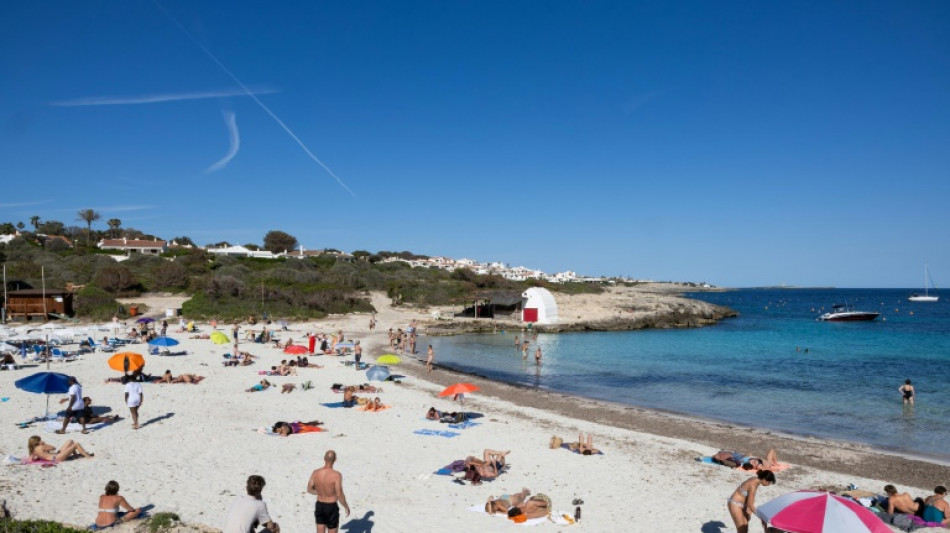
Tourism buoys southern Europe's 'Club Med' nations / Photo: Jaime REINA - AFP

 'Long live Chairman Mao': Supporters pay respects to founder of Communist China

 Sweden immigration restrictions spark healthcare concerns

 EU to help cities tighten screws on Airbnb, holiday rentals

 'Our year': Kane and Bayern primed for Champions League tilt

 Australian World Cup star Volpato fined over positive cocaine test

 Sabalenka edges Noskova to keep US Open treble bid alive

 Pegula outlasts Navarro to set US Open semi with Sabalenka

 From trenches to catwalk: Ukraine's amputee soldiers hit the runway

 UK airports face more disruption after air traffic control glitch

 ECB meets, weighing a tricky balance between savers and spenders

 Pakistan police counter drone attacks with Ukraine-style nets

 Russia torments Kyiv with new 'horror' jet drones

 Iran attacks US base in Jordan as Hormuz impasse deepens

 New Apple CEO to face first test with foldable iPhone launch

 BrYet Announces AIFA Approval of First-In-Kind cGMP Manufacturing Line for ML-016, Enabling Imminent Clinical Supply to Australia

 Sabalenka edges Noskova, keeps US Open treble bid alive

 Real Madrid win Champions League opener as Haaland stars for Man City

 Gambian leader vows power boost after violent blackout protests

 Newcastle battle past Millwall to reach League Cup fourth round
 Mourinho's Real Madrid make winning start against Inter Milan

 Villa take 'big step forward' with win over Brugge

 Yaya Toure hails 'new era' for African coaches ahead of Champions League bow

 Lawes and Marchant told to prove themselves in quest for England recalls

 Smithsonian secretary to retire as Trump exerts control over institution

 Atletico have work to do to reach home Champions League final: Simeone

Derided as "Club Med" nations during the European debt crisis 15 years ago, the economies of Spain, Greece and Portugal are now outperforming their northern peers thanks to a rebound in tourism.
The three nations had to endure harsh austerity measures in the early 2010s imposed by their European Union partners, who were quick to blame their fiscal laxity and lack of competitiveness for their economic woes.
But "the situation has changed" since the Covid-19 pandemic ended, said Zsolt Darvas, an economist at Bruegel, a Brussels-based think tank.
"Today, those countries are growing faster than the European Union average, they are no longer seen as black sheep."
Spain's gross domestic product (GDP) expanded by 2.5 percent last year, while Portugal's economy grew by 2.3 percent and Greece by 2.0 percent.
That compares to growth of 0.4 percent for the entire 27-member European Union, which was weighed down by Germany's 0.3 percent contraction, making it the world's worst-performing major economy in 2023.
The International Monetary Fund expects the three nations to continue to outperform this year, although at a more modest pace.
It sees growth this year of 2.4 percent in Spain, 1.7 percent in Portugal and 2.0 percent in Greece.
Spain's economy is taking off "like a rocket", Spanish Prime Minister Pedro Sanchez said recently. The country is "the locomotive" of job creation in the EU, he added on Thursday.
- 'Great efforts' -
Economists say this turnaround is largely due to a strong rebound in tourism, which reached record levels last year following the lifting of pandemic travel restrictions.
The sector is key for the three nations, accounting for almost 25 percent of Greece's economy, and 12 percent in both Portugal and Spain.
The trio of nations are also benefiting from the EU's massive pandemic recovery fund, whose mix of grants and loans in exchange for structural reforms will largely go to southern countries.
Spain -- the biggest beneficiary of the fund after Italy -- has so far received 38 billion euros, Greece 15 billion euros and Portugal eight billion euros.
The three nations have also made "great efforts to improve their economic attractiveness" with structural reforms that have boosted their competitiveness and improved their labour markets, said Darvas.
The reforms have helped draw foreign investment, especially in renewable energy and cloud computing.
Amazon's cloud computing division AWS announced last month it would invest over 15 billion euros to expand its data centres in Spain.
Many automakers such as Volkswagen and Stellantis, whose brands include Peugeot, Fiat and Jeep, have chosen to assemble their new electric vehicles in Spain, Europe's second largest automobile producer after Germany.
- Challenges remain -
The growth spurt in the three countries, however, is partly catching up after the steep falls in GDP during the financial crisis. Greece's GDP for example plunged 25 percent.
Economists warn they still face challenges.
While they have all seen joblessness fall, the unemployment rate in Greece and Spain sits above 11 percent, way above the EU average of 5.9 percent.
And former European economic and monetary affairs commissioner Olli Rehn told AFP that "deficits and debt levels remain large in some cases" even though "divergences between euro area countries have decreased compared to 10 years ago".
Portugal swung to a budget surplus of 1.2 percent of GDP last year while Greece's public deficit declined to 1.6 percent in 2023 from 2.5 percent in the previous year. The EU average is 3.5 percent.
This has helped its 10-year borrowing rate to drop to 3.5 percent from 13 percent during the financial crisis.
Darvas said the "convergence" of southerrn European nations with northern ones "is likely to continue" but at a "slower pace". Spain, Portugal and Greece still have "work to do," he added.
A.Ruiz--AT