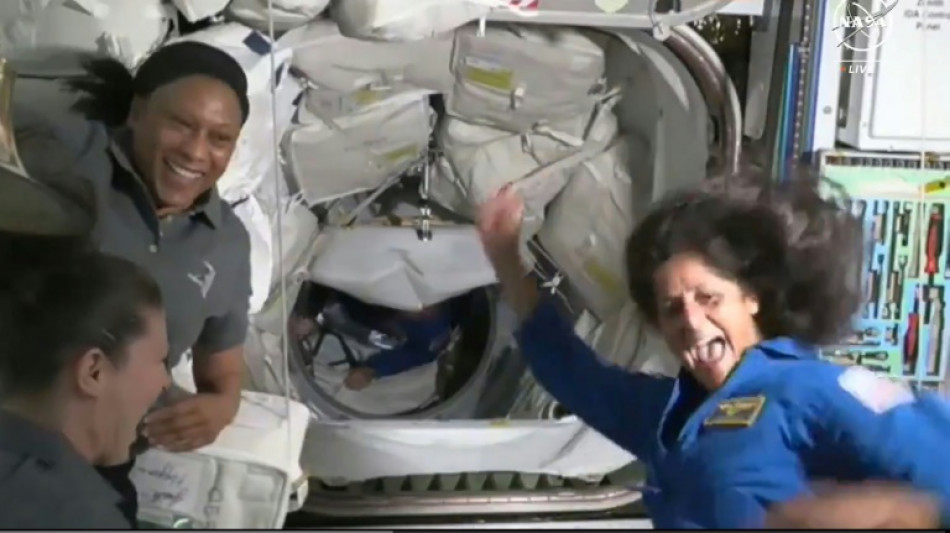
Boeing Starliner crew aboard ISS after challenging docking / Photo: Handout - NASA/AFP

 'Long live Chairman Mao': Supporters pay respects to founder of Communist China

 Sweden immigration restrictions spark healthcare concerns
 EU to help cities tighten screws on Airbnb, holiday rentals
 'Our year': Kane and Bayern primed for Champions League tilt
 Australian World Cup star Volpato fined over positive cocaine test
 Sabalenka edges Noskova to keep US Open treble bid alive
 Pegula outlasts Navarro to set US Open semi with Sabalenka
 From trenches to catwalk: Ukraine's amputee soldiers hit the runway

 UK airports face more disruption after air traffic control glitch
 ECB meets, weighing a tricky balance between savers and spenders
 Pakistan police counter drone attacks with Ukraine-style nets
 Russia torments Kyiv with new 'horror' jet drones

 Iran attacks US base in Jordan as Hormuz impasse deepens

 New Apple CEO to face first test with foldable iPhone launch
 BrYet Announces AIFA Approval of First-In-Kind cGMP Manufacturing Line for ML-016, Enabling Imminent Clinical Supply to Australia

 Sabalenka edges Noskova, keeps US Open treble bid alive

 Real Madrid win Champions League opener as Haaland stars for Man City
 Gambian leader vows power boost after violent blackout protests

 Newcastle battle past Millwall to reach League Cup fourth round
 Mourinho's Real Madrid make winning start against Inter Milan

 Villa take 'big step forward' with win over Brugge

 Yaya Toure hails 'new era' for African coaches ahead of Champions League bow

 Lawes and Marchant told to prove themselves in quest for England recalls

 Smithsonian secretary to retire as Trump exerts control over institution
 Atletico have work to do to reach home Champions League final: Simeone

A Boeing Starliner capsule carrying its first ever astronauts docked with the International Space Station on Thursday after overcoming unexpected challenges arising from thruster malfunctions and helium leaks.
The spaceship dubbed "Calypso" rendezvoused with the orbital lab at 1:34 pm ET (1734 GMT) over the southern Indian Ocean, allowing crewmates Butch Wilmore and Suni Williams to enter a while later.
"We're ready to get to work," declared Wilmore, while Williams performed a little dance to celebrate the arrival, the third stay aboard the ISS for both of the ex-Navy test pilots.
Docking was delayed by more than an hour after some of Starliner's thrusters that provide fine maneuvering initially failed to kick in, forcing the astronauts to perform a "hot fire" to activate them.
"I would say Starliner made us work a little harder to get docked," Steve Stich, program manager for NASA's Commercial Crew Program, later told reporters, explaining that ground teams now had to work to understand the issues that had emerged during flight.
Wilmore and Williams are the first crew to fly Starliner, which Boeing and NASA are hoping to certify for regular rides to the ISS -- a role SpaceX has been fulfilling for the past four years.
The spaceship blasted off from Florida atop a United Launch Alliance Altas V rocket on Wednesday following years of delays and safety scares -- as well as two recently aborted launch attempts that came as astronauts were already strapped in and ready to go.
- Leaks and thruster problems -
Prior to launch, it was known that there was one helium leak affecting Starliner.
While non-combustible, the helium provides pressure to the propulsion system. But it was determined the leak was too small to cause much of an impact.
During the flight, however, two more leaks emerged, and another was discovered after docking for a total of four.
That makes it more likely that a common issue is at play, rather than a one-off fault like a bad rubber seal.
Engineering teams believe there is more than enough helium left in reserve, and Starliner won't leak anymore while docked to the ISS.
But the issue will have to be monitored and further studied in other Starliners under construction at Boeing's factory, said Mark Nappi, vice president and program manager of Boeing's Commercial Crew Program.
And while four of the five thrusters that failed were subsequently revived, it's not fully understood what triggered the fault in the first place, said Stich.
Teething issues with new spaceships aren't uncommon, he stressed. The Space Shuttle program in its early days faced its share of problems, as did SpaceX's Dragon program in the early 2010s, when that vessel was a cargo-only spaceship.
- Select club of spaceships -
Starliner is just the sixth type of US-built spaceship to fly NASA astronauts, following the Mercury, Gemini and Apollo programs in the 1960s and 1970s, the Space Shuttle from 1981 to 2011, and SpaceX's Crew Dragon from 2020.
The United States was left reliant on Russian Soyuz rockets to go to the ISS between 2011 and 2020.
Boeing's program faced setbacks ranging from a software bug that put the spaceship on a bad trajectory on its first uncrewed test, to the discovery that the cabin was filled with flammable electrical tape after the second.
A successful mission would help dispel the bitter taste left by the years of safety scares and delays, and provide Boeing a much-needed reprieve from the intense safety concerns surrounding its passenger jets.
During their roughly weeklong stay on the orbital outpost, Wilmore and Williams will continue to evaluate the spacecraft systems, including simulating whether the ship can be used as a safe haven in the event of an emergency on the ISS.
After undocking, Starliner will reenter the atmosphere, with the crew experiencing 3.5G as they slow down from 17,500 miles (28,000 kilometers) per hour to a gentle parachute- and airbag-assisted touchdown in the western United States.
W.Moreno--AT