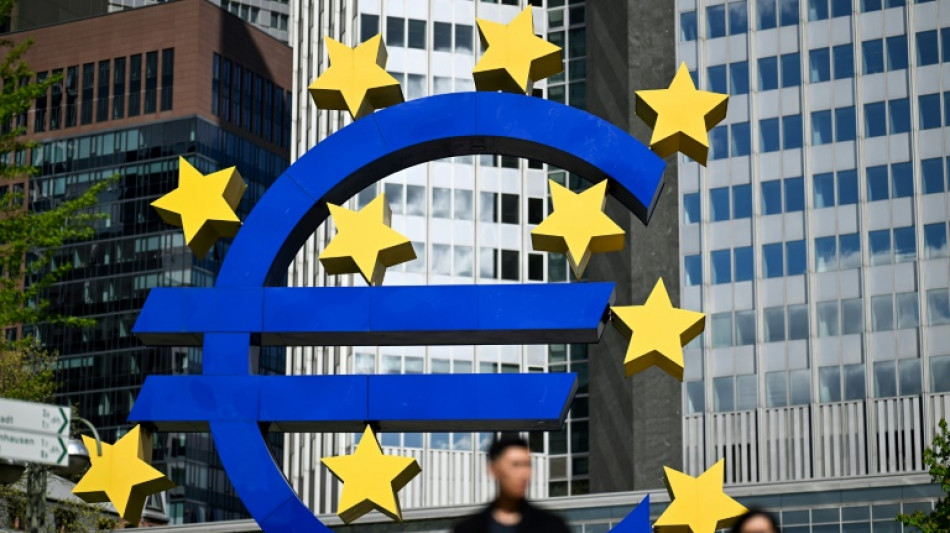
ECB starts cutting rates, but warns on inflation / Photo: Kirill KUDRYAVTSEV - AFP/File

 'Long live Chairman Mao': Supporters pay respects to founder of Communist China

 Sweden immigration restrictions spark healthcare concerns

 EU to help cities tighten screws on Airbnb, holiday rentals

 'Our year': Kane and Bayern primed for Champions League tilt

 Australian World Cup star Volpato fined over positive cocaine test

 Sabalenka edges Noskova to keep US Open treble bid alive
 Pegula outlasts Navarro to set US Open semi with Sabalenka

 From trenches to catwalk: Ukraine's amputee soldiers hit the runway

 UK airports face more disruption after air traffic control glitch

 ECB meets, weighing a tricky balance between savers and spenders

 Pakistan police counter drone attacks with Ukraine-style nets

 Russia torments Kyiv with new 'horror' jet drones

 Iran attacks US base in Jordan as Hormuz impasse deepens

 New Apple CEO to face first test with foldable iPhone launch

 BrYet Announces AIFA Approval of First-In-Kind cGMP Manufacturing Line for ML-016, Enabling Imminent Clinical Supply to Australia

 Sabalenka edges Noskova, keeps US Open treble bid alive

 Real Madrid win Champions League opener as Haaland stars for Man City

 Gambian leader vows power boost after violent blackout protests

 Newcastle battle past Millwall to reach League Cup fourth round

 Mourinho's Real Madrid make winning start against Inter Milan

 Villa take 'big step forward' with win over Brugge

 Yaya Toure hails 'new era' for African coaches ahead of Champions League bow

 Lawes and Marchant told to prove themselves in quest for England recalls

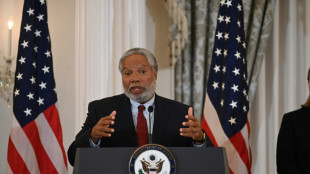 Smithsonian secretary to retire as Trump exerts control over institution

 Atletico have work to do to reach home Champions League final: Simeone

The European Central Bank made its first interest rate cut since 2019 Thursday, reducing borrowing costs from record highs, but gave few clues about its next move while warning of continuing inflation pressures.
The key deposit rate was lowered a quarter point to 3.75 percent, after the central bank had kept borrowing costs on hold since October.
After an unprecedented streak of eurozone rate hikes beginning in mid-2022 to tame runaway energy and food costs, inflation has been slowly coming down towards the ECB's two-percent target.
Thursday's cut, the first since September 2019, will provide a much-needed boost for the beleaguered eurozone economy.
The move marks the ECB diverging from the US Federal Reserve, which has also hiked rates aggressively but is not expected to start cutting for months due to stronger-than-expected data.
With Thursday's cut widely expected, all eyes are on what happens next, after recent inflation and growth data for the 20 countries that use the euro came in stronger than anticipated.
In an updated forecast, the Frankfurt-based institution hiked its inflation forecasts for this year and next. It no longer expects inflation to hit its two-percent target in 2025, as previously expected, but rather to come in at 2.2 percent.
It also raised its growth forecast for 2024, although lowered it slightly for next year.
While noting that "the inflation outlook has improved markedly", the ECB said in a statement that "domestic price pressures remain strong as wage growth is elevated, and inflation is likely to stay above target well into next year".
It reiterated typical language that it would "keep policy rates sufficiently restrictive for as long as necessary" to hit its inflation target, and that it would take a "data-dependent" approach to is decisions.
Decisions would be based on the inflation outlook, it said, while adding that the rate-setting governing council "is not pre-committing to a particular rate path".
- No rapid easing -
Thursday's cut is unlikely to herald the start of a rapid easing cycle.
ING economist Carsten Brzeski said "sticky inflation will limit the room for additional rate cuts and the ECB's statement also doesn't give away any hints at the future path of the ECB".
Investors will be keenly watching to see if ECB president Christine Lagarde provides any guidance about the pace of cuts going forward in her post-meeting press conference.
Despite consumer price rises having slowed from peaks of over 10 percent in late 2022, when Europe was rocked by an energy shock, bringing inflation down to the ECB's target is proving difficult.
Data last week showed that inflation in the 20 countries that use the euro rose in May, and faster than expected -- to 2.6 percent on year, up from April's 2.4-percent increase.
The eurozone economy also expanded faster than expected in the first quarter as it emerged from recession, although it is still slow compared to the robust growth of the US economy.
The chances of another cut at the ECB's next meeting in July are now viewed as low.
Instead, many analysts believe policymakers are hoping to reduce rates every other meeting -- so once a quarter, as the bank meets every six weeks -- at the same time as they release their regularly updated projections.
This view was strengthened by recent comments from Dutch central bank chief Klaas Knot, a member of the ECB's rate-setting governing council, who said rates would be reduced gradually with a focus on quarterly meetings.
In the United States, stronger-than-expected data pushed back expectations of when the Fed -- which holds its next meeting on June 11-12 -- will begin reducing borrowing costs, fuelling speculation the ECB might also stay its hand.
But eurozone rate-setters have stressed they plot their own course.
There are nevertheless concerns if the ECB cuts faster than its US counterpart, as this could lead to a depreciation of the euro and fuel inflation by pushing up the cost of imports into the eurozone.
A.Anderson--AT