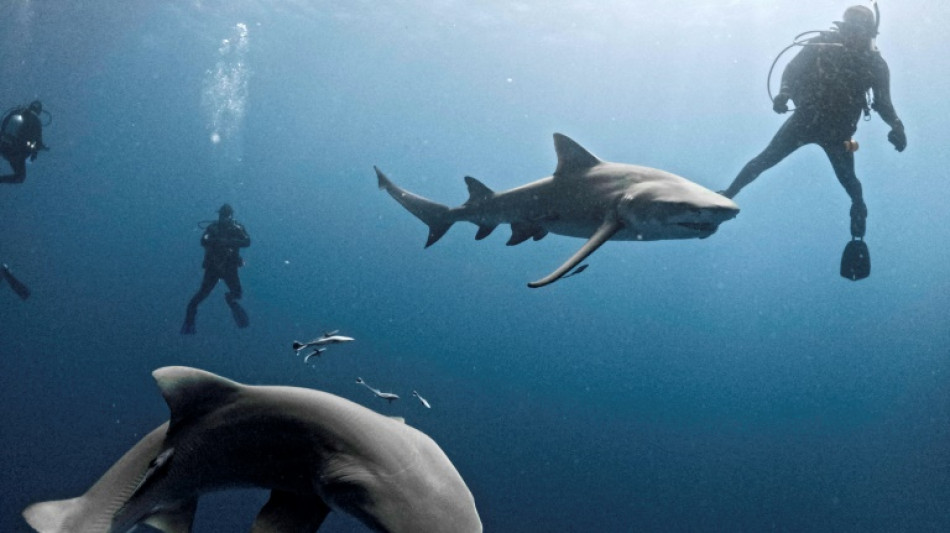
With bites rare, experts want sharks to shed scary reputation / Photo: Jesus OLARTE - AFP

 Klopp poised to replace Nagelsmann as Germany coach: reports

 More than 400 dead in DR Congo's spreading Ebola outbreak

 Hot spell roasts eastern US as holiday weekend approaches

 Superb Swiatek storms into Wimbledon last 32, Zverev waits
 Russian strikes kill 21 in biggest ever attack on Kyiv, mayor says

 Swiatek sees off Pliskova to race into Wimbledon third round

 Dollar down, stocks shine after disappointing US jobs data

 US job growth slows, posing questions for Trump before midterms

 Chanel eyes menswear with Charvet shirtmaker takeover

 Chanel eyes menswear with Charvet shirtmaker takevoer

 'I grabbed my child': Kyiv residents face devastation of biggest Russian barrage of war

 Former top jockey Dettori breaks ribs in car crash

 Rees-Zammit returns to wing as Wales face Fiji

 Renovations on historic Paris Opera house extended by three years

 Thailand denies viral claim Macron knelt before king

 Spain, Portugal eye World Cup last 16

 Russian strikes kill 17 in biggest ever attack on Kyiv, mayor says

 Uruguay veteran Cavani quits Boca Juniors
 West Ham's Fernandes joins Spurs

 Bones of contention: More research needed on 'd'Artagnan corpse'

 Coffee with a view: tourists flock to Starbucks overlooking North Korea

 German coalition agrees on reform package in key breakthrough

 France recall record try scorer Penaud for All Blacks Test

 Seoul's Kospi tanks as Asia tech firms suffer another blow

 'Outstanding' Love to start at fly-half for All Blacks against France

As the northern hemisphere edges toward spring and millions flock to the beach, headlines have dubbed the southeastern US state of Florida the world's most likely place to be bitten by a shark.
They're right, but, at the same time, shark bites are exceedingly rare overall -- a fact scientists wish more people knew, especially amid declining shark populations desperately in need of conservation.
"When the sharks in the water are targeting the fishes that they normally feed on, once in a while, people get in the way and the sharks make a mistake," said Gavin Naylor, coauthor of a recent report tallying last year's shark attacks.
According to data he gathered for the University of Florida's International Shark Attack File, Florida was home to a quarter of last year's shark attacks -- a scary statistic, if taken on its own.
And yet that only amounts to 16 unprovoked attacks, out of 69 total worldwide -- and millions of swimmers flocking to Florida's coast each year.
If sharks wanted to attack us, "people are very easy to target. They are a bit like floating sausages," Naylor told AFP.
"So we know that they must be avoiding them."
- Shark attack 'capital' -
Florida's subtropical latitude means many sharks move through the waters of its continental shelf, which are rich in nutrients and therefore in fish to feed them.
And miles of beaches attract huge numbers of tourists to the Sunshine State -- 135 million last year, according to Florida statistics.
Yet despite the long odds of a shark bite, the predators still carry an outsized reputation -- one probably not helped by their rows of razor sharp teeth, or fictional movies about killer sharks like "Jaws" and the decades-long US cable television phenomenon known as "Shark Week."
New Smyrna Beach, located in Volusia County -- home to half of Florida's shark bites last year -- is inauspiciously known as the "shark bite capital of the world."
Surfers often flock to its coast, where the murky waters reduce sharks' visibility, and increase the chance they will bite a human by mistake.
Bites are like an "airplane crash" -- shocking but rare, said New Smyrna Beach resident Bruce Adams, who remembers close encounters with sharks of his own during his surfing days.
"It's sensational, it sells a lot of T-shirts," he told AFP, lamenting the creatures' bad reputations.
- Swimming with sharks -
In fact, most of us have probably been in the water alongside sharks -- we just didn't know it, said report coauthor Joe Miguez.
"They don't really want anything to do with us," he told AFP.
Some humans meanwhile are seeking out sharks.
In Jupiter, some 90 miles (150 kilometers) north of Miami, Jonathan Campbell has done more than 500 dives with a coterie of enthusiasts, all there to swim with sharks.
"You see sharks in movies and they are scary monsters. But in the water, they are actually shy puppy dogs," he said.
In fact, amid crashing shark populations -- there has been a 70 percent worldwide decline since 1970, according to a recent study -- what the world might need is more sharks.
"We should be more focused on conserving these animals than just going out and saying that they're out to get us," said Miguez.
H.Gonzales--AT