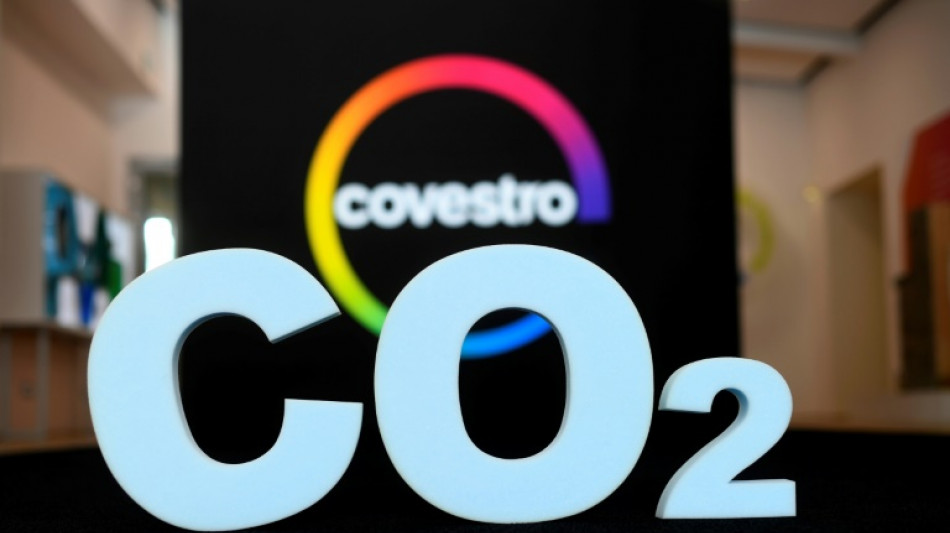
In climate push, German chemical maker swaps oil for sugar / Photo: INA FASSBENDER - AFP

 'I grabbed my child': Kyiv residents face devastation of biggest Russian barrage of war

 Former top jockey Dettori breaks ribs in car crash

 Rees-Zammit returns to wing as Wales face Fiji

 Renovations on historic Paris Opera house extended by three years

 Thailand denies viral claim Macron knelt before king

 Spain, Portugal eye World Cup last 16

 Russian strikes kill 17 in biggest ever attack on Kyiv, mayor says

 Uruguay veteran Cavani quits Boca Juniors

 West Ham's Fernandes joins Spurs
 Bones of contention: More research needed on 'd'Artagnan corpse'

 Coffee with a view: tourists flock to Starbucks overlooking North Korea

 German coalition agrees on reform package in key breakthrough

 France recall record try scorer Penaud for All Blacks Test

 Seoul's Kospi tanks as Asia tech firms suffer another blow

 'Outstanding' Love to start at fly-half for All Blacks against France

 Campbell back from four years in Wallabies wilderness to face Ireland

 Migrants pick up pieces back home after fleeing South Africa

 Farrell names Leinster-heavy Ireland side to face Wallabies
 Fearing Russian strike, Kyiv's Holodomor museum evacuates exhibits

 Germany's energy-hungry small firms struggle with green shift

 Pochettino says Balogun foul 'never' a red card as suspension looms

 Campbell back after four years in Wallabies team to face Ireland

 Kane saves England as USA, Belgium reach last 16

 Budding chefs cook up new career at China's BBQ academy

 One stitch at a time: Artist's mission to recreate the Bayeux Tapestry

At one of Europe's largest chemical complexes, German group Covestro is trialling the manufacture of a key product using sugar as a base material instead of oil, as the industry seeks to reduce its carbon footprint.
The pilot project involves producing "aniline", a chemical used in making foams -- used widely in mattresses and armchairs, as well as building insulation.
While large-scale, commercial production is probably years away, the experiment marks a small step in the chemical industry's battle to slash carbon emissions as Earth faces a dire climate emergency.
Of the 100 million barrels of oil produced worldwide every day, "a quarter goes directly into the chemical industry," said Walter Leitner, from Aachen University, which has been involved in the aniline project for a decade.
"The chemical industry needs to be completely rebuilt."
Plastics manufacturer Covestro -- a former division of chemical giant Bayer -- started trials at its complex in the western city of Leverkusen at the end of 2023, after laboratory tests.
In a 100-square-metre (1,080-square-foot) room, aniline, a transparent fluid, is extracted from a 600-metre network of intertwined pipes.
Using a process developed by University of Stuttgart researchers, fermented sugar is treated with chemicals to make the product.
Aniline is used as the base ingredient for chemical MDI, which is an essential material in manufacturing foams.
Traditionally, aniline has been obtained from crude oil derivatives like naphtha and benzene, but producing it emits large quantities of carbon dioxide, a key greenhouse gas.
Around six million tonnes of aniline are produced globally a year, around one million tonnes of it by Covestro.
So far, the pilot project in Leverkusen produces just a tiny part of this, extracting just half a tonne of aniline a day.
- Punishing energy costs -
Some experts are sceptical about such an approach.
The use of plant matter in manufacturing may cut out fossil fuels but whether it can lead to carbon neutrality "is often questionable", Jens Guenther, from Germany's Federal Environment Agency, told AFP.
This is particularly the case when it comes to the use of "so-called cultivated biomass like maize, sugar cane and sugar beet," he said.
Janine Korduan, from environmental NGO BUND, pointed out that industrial agriculture generates "CO2 and methane emissions through land conversion and the production of fertilisers and pesticides", and also leads to "major losses of biodiversity and high water consumption".
Nevertheless, Guenther said the use of plant matter in production processes would likely produce significantly lower greenhouse gas emissions than using fossil fuels, although opting for waste materials rather than crops produced in large-scale farming would be preferable.
Other German companies are experimenting in the area.
Chemical giant BASF is seeking to use organic waste, agricultural products or vegetable oils to produce basic chemicals like aniline.
There are many barriers to taking such projects further, however.
These range from the availability of the necessary organic matter, which is in great demand as the green transition gathers pace, to higher costs when compared to producing such chemicals with oil.
Scaling up the process will only be justified if it leads to "significant CO2 savings" in the manufacturing process, said Thorsten Dreier, a member of Covestro's management board who is overseeing the technology.
There will also need to be proof that money "can be made in a competitive environment, in order to finance research here", he said.
And for Germany, a major challenge will be persuading manufacturers to set up costly new sites for processing chemicals.
The energy-intensive chemicals sector in Europe's top economy has been facing a crisis since Moscow's invasion of Ukraine curtailed cheap Russian gas imports, sending power costs soaring.
Many companies are now more focused on shifting production to cheaper locations overseas, rather than expanding at home.
"Energy costs in Germany are currently three to four times higher than in the United States," while a bloated bureaucracy is also weighing on industry, warned Dreier.
R.Garcia--AT