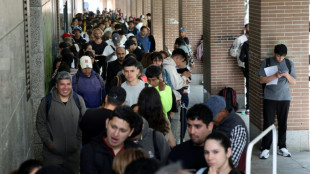
China consumer prices rise in February for first time in six months / Photo: STR - AFP/File

 'I grabbed my child': Kyiv residents face devastation of biggest Russian barrage of war

 Former top jockey Dettori breaks ribs in car crash

 Rees-Zammit returns to wing as Wales face Fiji

 Renovations on historic Paris Opera house extended by three years
 Thailand denies viral claim Macron knelt before king

 Spain, Portugal eye World Cup last 16

 Russian strikes kill 17 in biggest ever attack on Kyiv, mayor says

 Uruguay veteran Cavani quits Boca Juniors

 West Ham's Fernandes joins Spurs

 Bones of contention: More research needed on 'd'Artagnan corpse'

 Coffee with a view: tourists flock to Starbucks overlooking North Korea

 German coalition agrees on reform package in key breakthrough

 France recall record try scorer Penaud for All Blacks Test

 Seoul's Kospi tanks as Asia tech firms suffer another blow

 'Outstanding' Love to start at fly-half for All Blacks against France

 Campbell back from four years in Wallabies wilderness to face Ireland

 Migrants pick up pieces back home after fleeing South Africa

 Farrell names Leinster-heavy Ireland side to face Wallabies

 Fearing Russian strike, Kyiv's Holodomor museum evacuates exhibits

 Germany's energy-hungry small firms struggle with green shift

 Pochettino says Balogun foul 'never' a red card as suspension looms

 Campbell back after four years in Wallabies team to face Ireland
 Kane saves England as USA, Belgium reach last 16

 Budding chefs cook up new career at China's BBQ academy

 One stitch at a time: Artist's mission to recreate the Bayeux Tapestry

Chinese consumer prices rose in February for the first time since August, data showed Saturday, bucking a months-long stretch of deflation that compounded the country's myriad economic woes.
The world's second-largest economy posted some of its lowest growth in decades last year and is battling a prolonged property sector crisis and soaring youth unemployment.
But in a rare bright spot, official statistics Saturday showed the consumer price index rose 0.7 percent last month, according to Beijing's National Bureau of Statistics (NBS) -- the first increase since August.
The figure was higher than a 0.3 percent rise analysts surveyed by Bloomberg had expected and a sharp increase on the 0.8 fall seen in January, their sharpest drop in more than 14 years.
The positive data comes as senior officials meet in Beijing for the annual "Two Sessions" of China's parliament and its top political consultative body, in gatherings that have been dominated by the economy and national security.
On Tuesday, Premier Li Qiang told that gathering the country would seek five percent growth in 2024 -- an ambitious goal that he acknowledged would be "not be easy" given the headwinds facing the economy.
High among those issues has been deflation, which China entered last July for the first time since 2021.
Apart from a brief rebound in August, prices had not risen until last month.
Consumer prices traditionally see a boost during the Chinese New Year period, also known as Spring Festival, which fell in February this year.
"It was primarily food and service prices that rose more," NBS statistician Dong Lijuan said in a statement.
"During the Spring Festival period, consumer demand for food products grew, in addition to rainy and snowy weather in some regions affecting supply," Dong said.
- Demand remains weak -
China's sinking prices are in stark contrast with the rest of the world, where inflation remains a persistent bugbear, forcing central banks to ramp up interest rates.
While deflation suggests goods were cheaper, it poses a threat to the broader economy as consumers tend to postpone purchases, hoping for further reductions.
A lack of demand can then force companies to cut production, freeze hiring or lay off workers, while potentially also having to discount existing stocks -- dampening profitability even as costs remain the same.
Given the holiday factor, one analyst cautioned against seeing Saturday's figures as suggesting China was no longer struggling with deflation.
"I think it is too early to conclude that deflation in China is over," Zhiwei Zhang, president and chief economist at Pinpoint Asset Management, said.
"Domestic demand is still quite weak. Property sales of new apartments have not stabilised yet," he explained.
And producer prices continued to fall in February, dropping by 2.7 percent, the NBS said.
"Affected by the Spring Festival holiday and other factors, industrial production was in its traditional off season," Dong said.
Investors have called for much greater action from Beijing to shore up the flagging economy.
But despite calls for broader stimulus measures Beijing indicated this week it was unlikely to resort to big-ticket bailouts, setting a fiscal deficit-to-GDP target of three percent, similar to last year.
P.A.Mendoza--AT