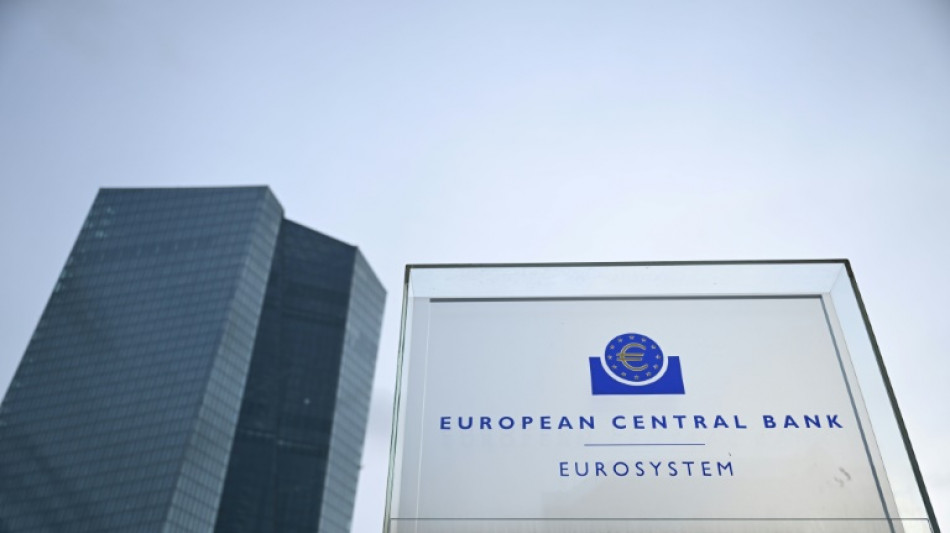
ECB keeps rates on hold with inflation still sticky / Photo: Kirill KUDRYAVTSEV - AFP

 'I grabbed my child': Kyiv residents face devastation of biggest Russian barrage of war

 Former top jockey Dettori breaks ribs in car crash

 Rees-Zammit returns to wing as Wales face Fiji
 Renovations on historic Paris Opera house extended by three years

 Thailand denies viral claim Macron knelt before king

 Spain, Portugal eye World Cup last 16

 Russian strikes kill 17 in biggest ever attack on Kyiv, mayor says

 Uruguay veteran Cavani quits Boca Juniors

 West Ham's Fernandes joins Spurs

 Bones of contention: More research needed on 'd'Artagnan corpse'

 Coffee with a view: tourists flock to Starbucks overlooking North Korea

 German coalition agrees on reform package in key breakthrough

 France recall record try scorer Penaud for All Blacks Test

 Seoul's Kospi tanks as Asia tech firms suffer another blow

 'Outstanding' Love to start at fly-half for All Blacks against France

 Campbell back from four years in Wallabies wilderness to face Ireland

 Migrants pick up pieces back home after fleeing South Africa

 Farrell names Leinster-heavy Ireland side to face Wallabies

 Fearing Russian strike, Kyiv's Holodomor museum evacuates exhibits

 Germany's energy-hungry small firms struggle with green shift

 Pochettino says Balogun foul 'never' a red card as suspension looms

 Campbell back after four years in Wallabies team to face Ireland

 Kane saves England as USA, Belgium reach last 16

 Budding chefs cook up new career at China's BBQ academy

 One stitch at a time: Artist's mission to recreate the Bayeux Tapestry

The European Central Bank froze interest rates again on Thursday as it held off from starting to cut borrowing costs amid concerns that sticky inflation is not easing as fast as hoped.
The Frankfurt-based institution's governing council held the benchmark deposit rate steady at a record four percent for a fourth straight meeting, as widely expected.
"Although most measures of underlying inflation have eased further, domestic price pressures remain high, in part owing to strong growth in wages," said the ECB in a statement.
The ECB embarked on a historic rate hiking cycle after the costs of everyday goods surged following Russia's invasion of Ukraine and amid pandemic-related supply chain woes.
Inflation, which peaked at over 10 percent in late 2022, has been steadily easing, hitting 2.6 percent in February, heading towards the ECB's two-percent target.
At the same time the outlook is bleak, with the eurozone narrowly dodging a technical recession in the second half of 2023, weighed down by a poor performance in its biggest economy, Germany.
On Thursday, the central bank released updated forecasts, with inflation expected to fall faster than previously thought and returning to two percent in 2025. It also predicted the 20-nation eurozone's economy would turn in weaker growth this year than previously thought.
Nevertheless, the ECB remains worried about completing the "last mile" to reach its inflation target, prompting it to keep rates at the same level they have been since October.
Announcing its latest decision, the bank reiterated that it was "determined to ensure that inflation returns to its two-percent medium-term target in a timely manner.
"Based on its current assessment, the governing council considers that the key ECB interest rates are at levels that, maintained for a sufficiently long duration, will make a substantial contribution to this goal."
Thursday's monetary policy decision, and press conference later by president Christine Lagarde, is being closely watched for clues on when the ECB will start cutting borrowing costs, with most investors now betting on a first move in June.
- Shifting drivers of inflation -
Analysts believe the drivers of inflation have shifted from energy costs, which surged after Russia invaded Ukraine in 2022, to inflation in the services sector and wage growth.
"Wage growth remains elevated with little sign of a rapid turnaround yet, fuelling the stickiness in services inflation," said Frederik Ducrozet, chief economist at Pictet Wealth Management.
Heightened geopolitical tensions in the Middle East have also added to worries that inflation could rebound.
Yemeni rebel attacks on Red Sea shipping have prompted shipping companies to avoid the vital trade route, while a spillover of the Israel-Hamas war could impact oil prices.
The US Federal Reserve, which holds its next rate-setting meeting on March 19-20, is also struggling with when to begin cutting rates, as a series of strong economic readings dim the prospects of early reductions.
For the ECB, there is little doubt that its next move will be a cut.
"There might be a hold, and hold, and a hold, and a hold, but the next move will be downward," Lagarde said at the end of January.
Speculation had risen at the end of last year that a cut could come as soon as March, as inflation started dropping heavily.
But these expectations evaporated as price rises proved stubborn, with underlying inflation -- stripping out volatile energy and food costs -- in particular not coming down as fast as hoped.
While observers are now betting on a first cut in June, they expect the process to move slowly.
"We expect the ECB to ease monetary policy in a gradual fashion, cutting rates by a cumulative 100 (basis points) in 2024," said Ducrozet.
F.Wilson--AT