Protectionism, taxes, fuel: The high cost of air travel in Africa / Photo: Michele Spatari - AFP/File

 'I grabbed my child': Kyiv residents face devastation of biggest Russian barrage of war

 Former top jockey Dettori breaks ribs in car crash

 Rees-Zammit returns to wing as Wales face Fiji
 Renovations on historic Paris Opera house extended by three years
 Thailand denies viral claim Macron knelt before king

 Spain, Portugal eye World Cup last 16
 Russian strikes kill 17 in biggest ever attack on Kyiv, mayor says
 Uruguay veteran Cavani quits Boca Juniors

 West Ham's Fernandes joins Spurs
 Bones of contention: More research needed on 'd'Artagnan corpse'
 Coffee with a view: tourists flock to Starbucks overlooking North Korea

 German coalition agrees on reform package in key breakthrough
 France recall record try scorer Penaud for All Blacks Test

 Seoul's Kospi tanks as Asia tech firms suffer another blow

 'Outstanding' Love to start at fly-half for All Blacks against France
 Campbell back from four years in Wallabies wilderness to face Ireland
 Migrants pick up pieces back home after fleeing South Africa
 Farrell names Leinster-heavy Ireland side to face Wallabies
 Fearing Russian strike, Kyiv's Holodomor museum evacuates exhibits
 Germany's energy-hungry small firms struggle with green shift

 Pochettino says Balogun foul 'never' a red card as suspension looms

 Campbell back after four years in Wallabies team to face Ireland
 Kane saves England as USA, Belgium reach last 16

 Budding chefs cook up new career at China's BBQ academy

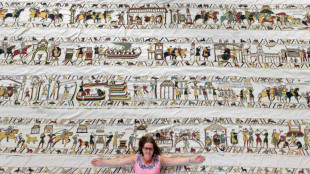 One stitch at a time: Artist's mission to recreate the Bayeux Tapestry

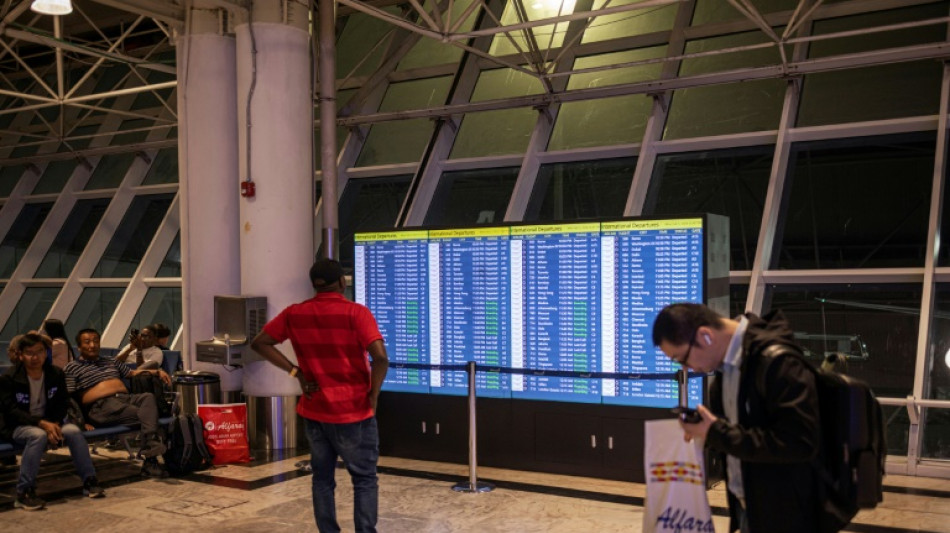
Travelling 1,000 kilometres (620 miles) by air between two capitals on the same continent does not seem like a challenge. But it can be one in Africa.
Take Libreville and Bangui for instance. The journey takes a minimum of nine hours, requires passengers to change planes and shell out $1,000 -- an example of the challenges facing Africa's aviation sector because of high taxes and protectionist policies.
In comparison, a flight between Paris and Madrid -- which crosses an equivalent distance -- takes two hours and costs five times less.
Unlike Europe, "travel on the continent is very difficult", said Moses Munga, a 27-year-old construction consultant on his way to Ghana from Nairobi.
Like Munga, who told AFP that work took him to West Africa several times a year, civil engineer Ahmed Mekewi said he was a frequent business traveller.
But he confided: "I would have difficulty travelling on my own."
"The cost of travelling in Africa is very challenging," the 29-year-old said.
Unlike Europe, which liberalised its aviation sector in the 1990s, Africa does not have "a unified... market", an expert in the sector told AFP.
"In Europe, Air France for example can make as many flights as it wants, to Germany, Belgium, Spain or Portugal. This freedom... does not exist within Africa" for African carriers, he said, requesting anonymity because of the nature of his work.
Restricted traffic rights granted by African governments to airlines limit the number of direct routes and the frequency of flights, and make journeys longer across the 54-nation continent, he added.
According to a study conducted in 2021 by the International Air Transport Association (IATA) for the African Union, out of the 1,431 possible connections between each of the bloc's member states, only 19 percent had a weekly direct flight.
- 'Protectionist mechanisms' -
"Protectionist mechanisms favouring local airlines such as charging foreign companies more for flying over or operating inside their territory... hampers competition and drives prices up," said Linden Birns, an aviation consultant based in South Africa.
As a result, "air traffic is so expensive in Africa (that) it isn't really growing. Routes are very thinly served," said Guy Leitch, aeronautical analyst and publisher of the South African magazine SA Flyer.
According to IATA, "Africa is the region where airfares are by far the highest".
In addition to government restrictions, the price of intra-African air travel is also affected by "very high" taxes and the cost of aviation fuel, said Robert Lisinge, head of the energy, infrastructure and services section at the United Nations Economic Commission for Africa (UNECA).
Africa's low refining capacity means that aviation fuel is largely imported and "often 30 percent more expensive than elsewhere, including in... oil-producing countries," said the expert source.
The Yamoussoukro Decision -- a 1999 treaty intended to pave the way for the liberalisation of Africa's aviation sector -- was followed by the Single African Air Transport Market (SAATM) project in 2018.
But such ambitions have struggled to take off.
"The whole idea is that if you liberalise the market, it will increase connectivity and it will reduce costs," Lisinge told AFP.
But bilateral air service agreements between countries mean that many companies are unable to operate flights "as many times as they want, using the planes of whichever capacity they choose", he added.
- Economic gains -
A 2014 IATA study covering 12 African nations said liberalisation would cause air traffic to jump 81 percent between these countries.
Removing market barriers between just a dozen countries would generate $1.3 billion in additional economic activity and help create 155,000 jobs, the study concluded.
For now, "regional travel across the continent is very challenging and makes business hard", said construction consultant Munga.
"Once you get a client and are drawing up your quotation, you must consider the costly cost of travel," he said, adding that high airfares sometimes made a contract too expensive for certain customers, forcing him to abandon business opportunities.
For UNECA's Lisinge, the continent stands to lose out on crucial economic gains unless air travel is made easier.
"Africa is a vast continent, connectivity by road is relatively poor," he pointed out.
"Air transport is necessary to move the perishable goods, the traders, the expertise that will be required for intra-African trade".
burs-ayv/dyg/sva/amu/ho/bp/mca
G.P.Martin--AT