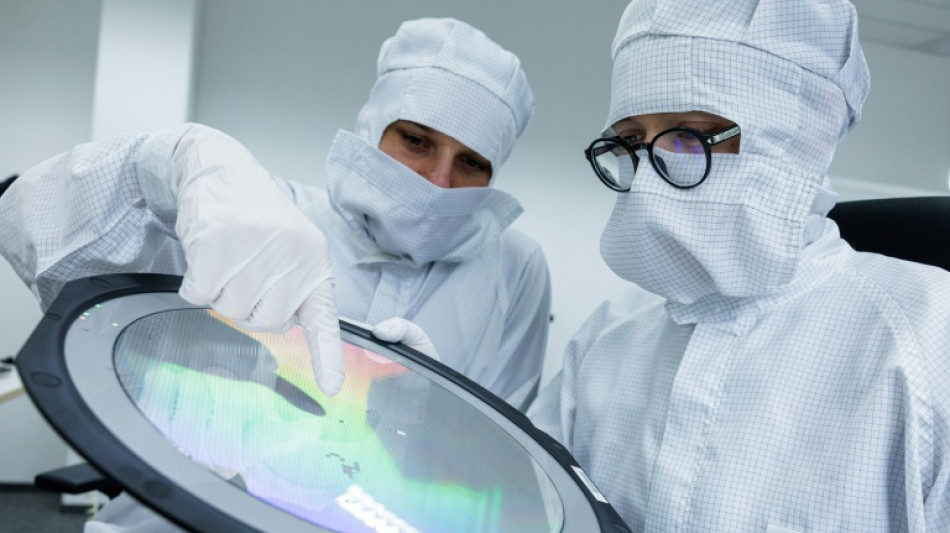
Far-right threatens to scare off German industry's new talent / Photo: JENS SCHLUETER - AFP

 Former Arsenal, Spain midfielder Cazorla retires

 German drone maker raises $1.2 bn as investors pile into defence

 French scramble to find air conditioners before next heatwave

 Japan deploys bear cameras in moutains as attacks surge

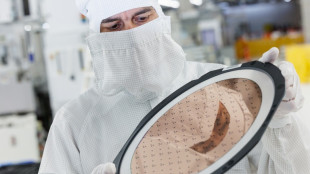 Germany's Infineon opens major chip plant as EU seeks tech autonomy

 Biggest ever Russian barrage on Kyiv kills at least 13

 EU top court upholds record 4.1 bn euro Google fine
 Italy name two debutants to face Japan in Nations Championship opener

 Wallabies' Schmidt rules out another coaching job
 India asks Meta to hold WhatsApp username rollout over fraud fears

 Deadly Russian barrage on Kyiv kills at least 13

 Next indirect US-Iran talks after Khamenei funeral: mediators

 Reviving Montenegro's 'ancient' olive tree

 Resource rich PNG leaving its Pacific people behind: World Bank

 Papal envoy presides over first Vietnam beatification rite
 LeBron James praises Balogun after 'Silencer' celebration

 Farrell names Leinster-heavy side to face Wallabies

 Most Asia markets down as tech firms take fresh blow

 South Korean school baseball team suspended over 'Tank Day' chants

 Ceuzany, Cape Verde's golden voice with volcanic emotion

 Balogun scores and sees red as US beat Bosnia 2-0

 EU top court to rule on record 4.1 bn euro Google fine

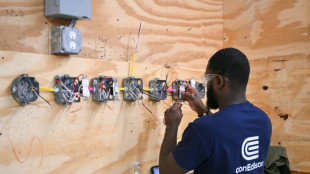 'Job forever': trade schools are all the rage in the AI era

 Celtics reportedly trading Brown to Sixers in NBA blockbuster

 IRS Form 2290 Filing Window Now Open for 2026-27 Tax Period; Stay HVUT Compliant with EZ2290

In its search for sorely needed talent, German chipmaker Infineon is looking as far as Guatemala, but the rise of the far-right at home risks making the move unappealing and harming the industry.
The semiconductor group has plans for a new five-billion-euro ($5.4-billion) factory in eastern Germany -- and it is not the only one.
Backed by huge government subsidies, US chipmaker Intel is planning a plant in the city of Magdeburg, while the Taiwanese giant TSMC will put down roots in Dresden.
For all the region's advantages -- a good position in the heart of Europe and an established industrial base -- its politics could yet be a drag.
In Saxony, which already hosts the biggest concentration of chipmakers in Europe, the far-right Alternative for Germany (AfD) party is polling over 30 percent ahead of European and regional elections later this year.
Success for the AfD risks "holding back our growth potential", Frank Boesenberg, the head of regional industry lobby group "Silicon Saxony", told AFP.
According to the group's estimates, chipmakers in Saxony will have 25,000 jobs to fill by 2030, while the local working-age population will shrink by 300,000.
"There are too few young people in the region," said Boesenberg. "We need immigration."
However, the anti-immigration politics of the AfD could put off potential recruits and damage the industry.
"A policy of isolation is a threat to prosperity," Infineon's CEO Jochen Hanebeck warned on professional social network LinkedIn.
- Relocation -
As it stands, the large majority of the industrial capacity to produce semiconductors -- used in everything from electric cars to smartphones -- is in Asia.
But recent supply disruptions and rising geopolitical tensions in the region have prompted a rethink in the United States and Europe about depending on imported chips.
The result has been a concerted effort to relocate supply closer to home, leading to a flood of investments into areas like Saxony.
About 68 percent of German managers fear the country could become less attractive to foreign workers if the far-right gains in strength, according to a poll by the IW Koeln think tank.
January's revelations by investigative outfit Correctiv that AfD members discussed a mass deportation plan at a meeting of extremists sparked a wave of protest in Germany.
But companies had been warning well before the controversy that the AfD poses a risk to business.
Stefan Traeger, the head of Jenoptik, a producer of optical components for chipmakers, told German weekly Spiegel in December that if the industry was no longer able to find "the right people", the impact could be felt on the bottom line.
- 'The biggest challenge' -
A lack of suitable workers was "the biggest challenge" facing Germany's industry, according to Economy Minister Robert Habeck.
The country will need a total of five million extra workers by 2030 to cover the shortfall in all sectors, according to IW Koeln.
At Infineon's new factory in Dresden, which should begin production in 2026, the group expects to hire 1,000 new workers.
Foreign workers will be an important "building block" on the way to achieving that target, Tom Geyer, Infineon's local head of human resources, told AFP.
The group's workforce in Dresden, who oversee highly automated industrial processes, already has representatives from a few dozen nationalities.
To find the potential new hires and bring them to Germany, Infineon has signed deals with training institutions in Guatemala and is organising language courses and help with housing for new arrivals.
But despite the far-reaching recruitment campaign, "it's a challenge in a competitive market to find trainees", said Geyer.
L.Adams--AT