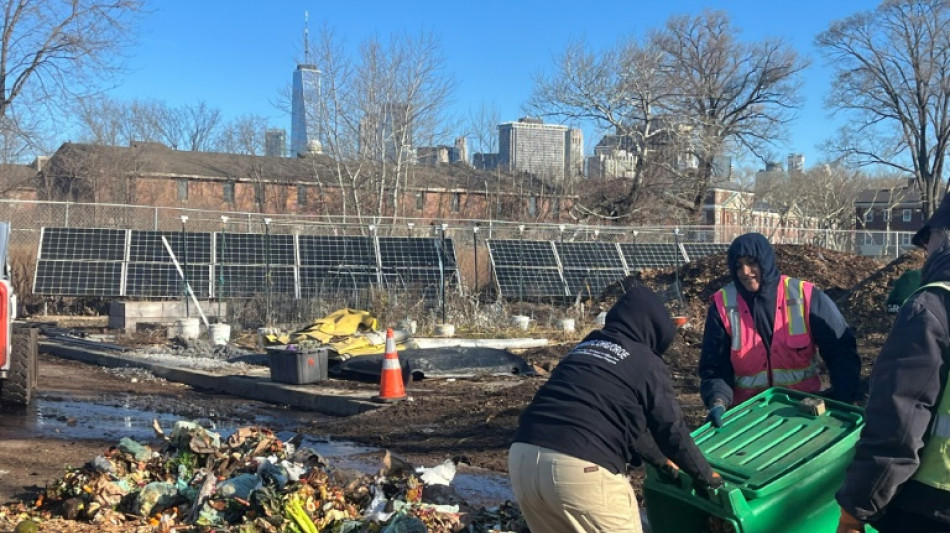
New York's new composting plan is ambitious - but controversial / Photo: Thomas URBAIN - AFP

 Former Arsenal, Spain midfielder Cazorla retires

 German drone maker raises $1.2 bn as investors pile into defence

 French scramble to find air conditioners before next heatwave

 Japan deploys bear cameras in moutains as attacks surge

 Germany's Infineon opens major chip plant as EU seeks tech autonomy

 Biggest ever Russian barrage on Kyiv kills at least 13

 EU top court upholds record 4.1 bn euro Google fine

 Italy name two debutants to face Japan in Nations Championship opener

 Wallabies' Schmidt rules out another coaching job

 India asks Meta to hold WhatsApp username rollout over fraud fears

 Deadly Russian barrage on Kyiv kills at least 13

 Next indirect US-Iran talks after Khamenei funeral: mediators

 Reviving Montenegro's 'ancient' olive tree

 Resource rich PNG leaving its Pacific people behind: World Bank

 Papal envoy presides over first Vietnam beatification rite
 LeBron James praises Balogun after 'Silencer' celebration

 Farrell names Leinster-heavy side to face Wallabies

 Most Asia markets down as tech firms take fresh blow

 South Korean school baseball team suspended over 'Tank Day' chants

 Ceuzany, Cape Verde's golden voice with volcanic emotion

 Balogun scores and sees red as US beat Bosnia 2-0

 EU top court to rule on record 4.1 bn euro Google fine

 'Job forever': trade schools are all the rage in the AI era
 Celtics reportedly trading Brown to Sixers in NBA blockbuster

 IRS Form 2290 Filing Window Now Open for 2026-27 Tax Period; Stay HVUT Compliant with EZ2290

New York has begun rolling out a large-scale organic waste collection program, but the landmark initiative has upset many of the local groups that previously handled composting, who say they now face critical funding cuts.
John Surico, a resident of the Queens borough, started separating his food scraps seven years ago.
At the time, he carried his organic waste -- which he stored frozen in his refrigerator -- across his neighborhood to a collection site.
"It was a commitment," he told AFP recently. "But now, all I have to do is go downstairs."
After Queens and Brooklyn, New York aims to equip the whole city with new brown and orange collection bins before the end of 2024.
From next year, sorting food waste will become mandatory, with a potential fine for failing to do so.
The stakes are high for a city that every day generates 11,000 tons of waste, of which a third is food and yard scraps.
Last year, organic waste only represented three percent of the total waste that was reclaimed, according to figures from the Department of Sanitation (DSNY).
Mayor Eric Adams, at the inauguration in early January of a much hyped extension to the city's largest composting facility, hailed the new initiative as "an incredible achievement."
The facility on Staten Island will now be able to process as much as 95,000 tons of organic waste per year, thanks to a new, accelerated treatment method -- aerated static pile composting -- that cuts decomposition time in half.
"We are becoming a national model in environmental stewardship," said Jenifer Rajkumar, a New York state assembly member for Queens.
The city will also be expanding its network of "smart bins," Bluetooth-enabled garbage cans on the sidewalks into which New Yorkers can dump organic waste at any hour.
- 'Human component' -
Volunteer groups and community organizations that were already active in composting have greeted the new rollout with skepticism.
That's partly because a large proportion of the food scraps collected will not be transformed into compost, but instead fed into a waste digester located in Brooklyn, producing domestic natural gas through methanization.
The other reason is tied to the removal of subsidies granted to existing composting organizations.
One of the largest such organizations, Big Reuse, had to lay off 16 of its 19 employees, remaining staff member Gil Lopez said. The nonprofit now risks losing its principal operating site in Queens.
Though multiple members of the city government argued for restoring municipal funding, "the mayor has not backed off," said Lopez.
Mill, a food waste management start-up, gave a $350,000 donation, but it only delayed the deadline by a few months.
"Nobody out there wants to fund community composting if the city doesn't make a commitment," said Marisa DeDominicis, co-founder of Earth Matter NY, an organization that allows Governors Island in the bay of New York to compost its own organic waste.
"I kind of have sympathy that if you're running a city, you have to look at the bottom line, but we have to take the human component into account in everything and anything. (...) It's about coming together around composting and sustainability," argued Andrea Lieske, of Earth Matter NY.
Local composting sites also work with numerous community gardens and other locations, providing logistics support and technical know-how.
The history of composting in New York also shows that the carbon footprint of waste management activities at the local level is significantly better than mass curb collection, where trucks sometimes travel tens of miles (kilometers) to their final destination.
As far as community goes, Big Reuse, like others, also works with children, students and businesses to raise awareness of the value of organic waste.
For Gil Lopez, "an actual movement in New York City is being completely denied service."
O.Gutierrez--AT