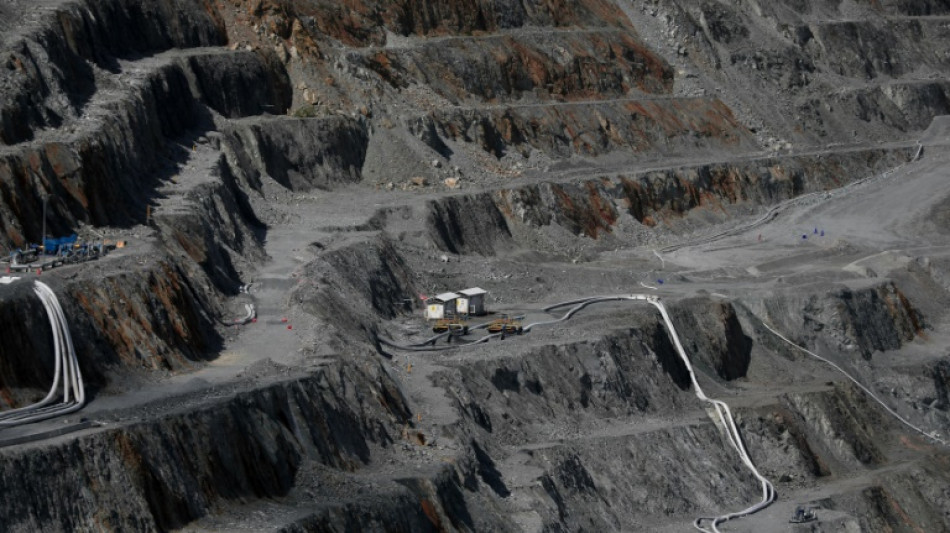
World resource extraction could surge 60% by 2060, UN warns / Photo: Roberto CISNEROS - AFP

 Former Arsenal, Spain midfielder Cazorla retires

 German drone maker raises $1.2 bn as investors pile into defence

 French scramble to find air conditioners before next heatwave

 Japan deploys bear cameras in moutains as attacks surge

 Germany's Infineon opens major chip plant as EU seeks tech autonomy

 Biggest ever Russian barrage on Kyiv kills at least 13

 EU top court upholds record 4.1 bn euro Google fine

 Italy name two debutants to face Japan in Nations Championship opener

 Wallabies' Schmidt rules out another coaching job

 India asks Meta to hold WhatsApp username rollout over fraud fears

 Deadly Russian barrage on Kyiv kills at least 13

 Next indirect US-Iran talks after Khamenei funeral: mediators
 Reviving Montenegro's 'ancient' olive tree

 Resource rich PNG leaving its Pacific people behind: World Bank

 Papal envoy presides over first Vietnam beatification rite
 LeBron James praises Balogun after 'Silencer' celebration

 Farrell names Leinster-heavy side to face Wallabies

 Most Asia markets down as tech firms take fresh blow

 South Korean school baseball team suspended over 'Tank Day' chants

 Ceuzany, Cape Verde's golden voice with volcanic emotion

 Balogun scores and sees red as US beat Bosnia 2-0

 EU top court to rule on record 4.1 bn euro Google fine

 'Job forever': trade schools are all the rage in the AI era

 Celtics reportedly trading Brown to Sixers in NBA blockbuster

 IRS Form 2290 Filing Window Now Open for 2026-27 Tax Period; Stay HVUT Compliant with EZ2290

Extraction of Earth's natural resources could surge 60 percent by 2060, imperilling climate goals and economic prosperity, the UN said Friday, calling for dramatic changes in energy, food, transport and housing.
Enormous expansion of infrastructure, energy demand and consumer consumption over the last half century, particularly in wealthier countries, has driven a tripling of the world's use of materials, according to the 2024 Global Resource Outlook by the UN Environment Programme's International Resource Panel.
And the hunger for natural resources -- everything from food to fossil fuels -- keeps growing by an average of more than 2.3 per cent per year, it said.
People in wealthy countries drive most of that demand, using six times more materials and responsible for ten times more climate impacts than those in low-income countries, according to the analysis.
Extraction and processing of the huge amount of resources accounts for over 60 percent of planet-warming emissions, the report said, as well as devastating ecosystems and harming human health.
Lead author Hans Bruyninckx said the current trajectory would cause the world to far exceed the temperature limits set out in the 2015 Paris Agreement, in which countries agreed to cap global warming "well below" two degrees Celsius and preferably at 1.5C.
"You've got resource use that is increasing, too much impact on Earth systems that is not tenable," he told AFP, adding that unequal access to resources across the world was also "untenable".
But he acknowledged that natural resources will be needed "to turn things around", both to boost development in poorer nations and to provide the minerals and metals needed for the energy transition.
The report follows an agreement by countries at UN climate negotiations last year in Dubai, to triple global renewable energy capacity this decade and "transition away" from polluting fossil fuels.
- 'Unprecedented scale and speed' -
Without sweeping change, the report warned, the exploitation of Earth's resources will continue, with computer modelling suggesting an increase by almost 60 per cent by 2060 from 2020 levels, from 100 to 160 billion tonnes.
"The only choice is to stabilise and balance the human relationship with the rest of nature," the report said.
"Weak, partial, fragmented or slow policies will not work. This can only be possible with far-reaching and truly systemic shifts in energy, food, mobility and the built environment implemented at an unprecedented scale and speed."
It said policy changes, focused on high-consumption countries, could reduce the projected growth in resource use by a third, slash greenhouse gas emissions 80 percent and improve health -- while still allowing economic growth.
Recommended actions, particularly in richer countries, include dietary changes that would reduce food waste and cut back on animal protein, more efficient transport systems, and denser housing using recycled building materials.
In developing countries where more resources are needed to improve lives, the report said the emphasis should be on maximising the benefits and minimising environmental and health impacts.
The report also called for the environmental costs of resource extraction to be priced into commodities and included in trade agreements.
"The economy is human made, it doesn't follow the laws of physics," Bruyninckx said.
"We made it in a certain direction, we can use the same government capacities to move it in a different direction."
G.P.Martin--AT