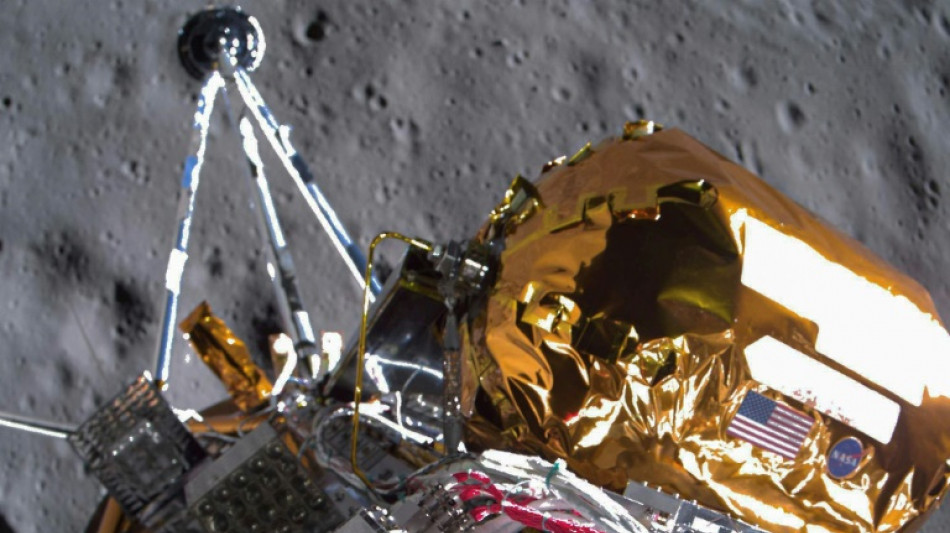
As mission ends, US lunar lander could still 'wake' back up / Photo: Handout - Intuitive Machines/AFP

 Biggest ever Russian barrage on Kyiv kills at least 13

 EU top court upholds record 4.1 bn euro Google fine

 Italy name two debutants to face Japan in Nations Championship opener

 Wallabies' Schmidt rules out another coaching job

 India asks Meta to hold WhatsApp username rollout over fraud fears

 Deadly Russian barrage on Kyiv kills at least 13

 Next indirect US-Iran talks after Khamenei funeral: mediators

 Reviving Montenegro's 'ancient' olive tree

 Resource rich PNG leaving its Pacific people behind: World Bank

 Papal envoy presides over first Vietnam beatification rite

 LeBron James praises Balogun after 'Silencer' celebration

 Farrell names Leinster-heavy side to face Wallabies

 Most Asia markets down as tech firms take fresh blow

 South Korean school baseball team suspended over 'Tank Day' chants

 Ceuzany, Cape Verde's golden voice with volcanic emotion

 Balogun scores and sees red as US beat Bosnia 2-0

 EU top court to rule on record 4.1 bn euro Google fine

 'Job forever': trade schools are all the rage in the AI era

 Celtics reportedly trading Brown to Sixers in NBA blockbuster

 Black Book Italy Provider Pulse Finds FSE 2.0 Faces Regional Interoperability, Diagnostic-Data and EHDS Readiness Test

 Kane saves England after DR Congo scare; Belgium comeback stuns Senegal

 Celtics to trade Jaylen Brown to 76ers for Paul George: report

 Streamex is making digital gold accessible

 Mixed US auto sales in Q2 amid high gas prices

 Pistons forward Harris reportedly headed to Spurs

The US spacecraft that touched down on the Moon last week and is currently running on solar power will soon be "put to sleep" once lunar night kicks in, mission officials said Wednesday.
But while the mission that saw the first ever Moon landing by a private company is coming to an end, Intuitive Machines CEO Steve Altemus told reporters that there are hopes to "wake it up" in about three weeks, when the Sun is out again.
The historic mission has been hailed as a success by Intuitive Machines and NASA, even as it ran into multiple problems along the way, including a landing that saw the uncrewed probe, named Odysseus, tip over upon reaching the surface.
"What we've gotten in terms of data on the vehicle is a tremendous amount of the guidance, navigation control data, all the propulsion data, all the performance data for the vehicle that will allow us to completely reconstruct the mission," Altemus told reporters at NASA's Kennedy Space Center, in Florida.
"What we're going to do is kind of tuck Ody in for the cold night of the moon, and see if we can't wake him up here when we get the solar noon," in about three weeks, he said.
Intuitive Machines officials weren't sure if the batteries, after going through the ensuing plunging nighttime temperatures, would be able to pass on the power generated by the probe's solar panels, but "why not try?" asked Altemus.
NASA is planning to return astronauts to the Moon later this decade, and paid Intuitive Machines around $120 million for the mission, as part of an initiative to delegate cargo missions to the private sector and stimulate a lunar economy.
Odysseus carries a suite of NASA instruments designed to improve scientific understanding of the lunar south pole, where the space agency plans to send astronauts under its Artemis program later this decade.
- Experiments on board -
Scientists have already begun to examine radio waves coming from Earth using one of the instruments onboard.
Another experiment was unable to analyze the amount of dust thrown up during the descent as planned, but was still able to be launched once the lander was on the ground.
While the solar panels were able to keep the batteries running successfully, they were not in the ideal position due the way the craft tipped over upon landing.
A photo Odysseus was able to take of itself showed some of the difficulties it faced landing, with at least one of the six legs broken and the engine kicking up lunar dust.
A failure in the lander's navigation system had complicated its final descent.
The craft is tilted about 30 degrees, Altemus said.
The mission "is a success from NASA's point of view," the space agency's chief, Bill Nelson, told reporters Wednesday.
The United States, along with international partners, want to eventually develop long-term habitats on the south pole, harvesting ice there for drinking water -- and for rocket fuel for eventual onward voyages to Mars.
Intuitive Machines has two more Moon missions planned this year, both part of NASA's Commercial Lunar Payload Services (CLPS) initiative, which works with the private sector.
In addition to being the first ever successful private lunar landing, Artemis also marks the first return by the United States to the Moon in five decades.
"People asked... 'We did it 50 years ago, why is it so hard?'" Altemus said.
Given the constraints involved -- cost targets, the quick schedule, technical challenges in landing on the south pole -- "We've fundamentally changed the economics of landing on the moon," he said.
"And we've kicked open the door for a robust thriving system in our economy in the future."
P.Smith--AT