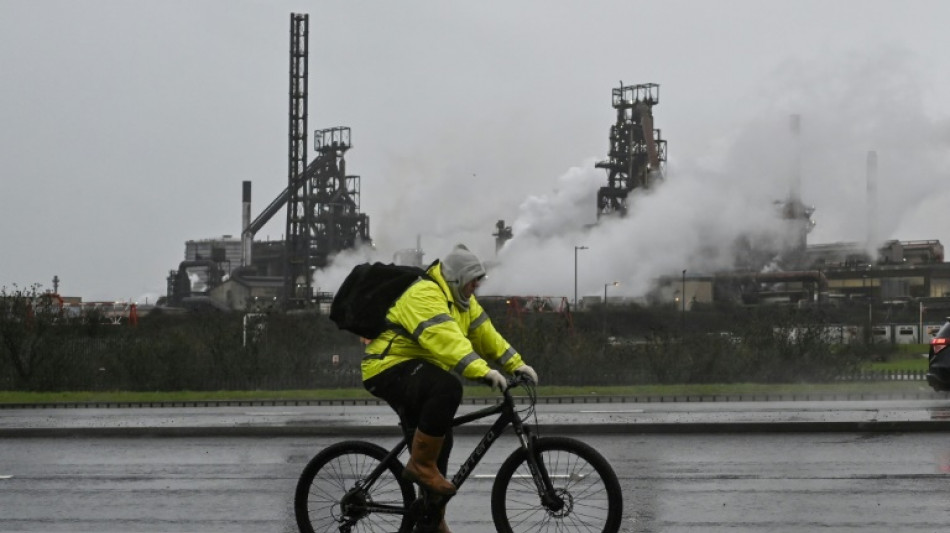
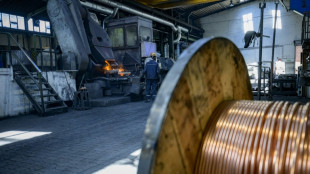
'I need to fight': UK steelworkers in fear as less pollution means less jobs / Photo: Justin TALLIS - AFP

 Biggest ever Russian barrage on Kyiv kills at least 13

 EU top court upholds record 4.1 bn euro Google fine

 Italy name two debutants to face Japan in Nations Championship opener

 Wallabies' Schmidt rules out another coaching job

 India asks Meta to hold WhatsApp username rollout over fraud fears

 Deadly Russian barrage on Kyiv kills at least 13

 Next indirect US-Iran talks after Khamenei funeral: mediators
 Reviving Montenegro's 'ancient' olive tree

 Resource rich PNG leaving its Pacific people behind: World Bank

 Papal envoy presides over first Vietnam beatification rite
 LeBron James praises Balogun after 'Silencer' celebration

 Farrell names Leinster-heavy side to face Wallabies

 Most Asia markets down as tech firms take fresh blow

 South Korean school baseball team suspended over 'Tank Day' chants

 Ceuzany, Cape Verde's golden voice with volcanic emotion
 Balogun scores and sees red as US beat Bosnia 2-0
 EU top court to rule on record 4.1 bn euro Google fine

 'Job forever': trade schools are all the rage in the AI era

 Celtics reportedly trading Brown to Sixers in NBA blockbuster

 Black Book Italy Provider Pulse Finds FSE 2.0 Faces Regional Interoperability, Diagnostic-Data and EHDS Readiness Test

 Kane saves England after DR Congo scare; Belgium comeback stuns Senegal

 Celtics to trade Jaylen Brown to 76ers for Paul George: report

 Streamex is making digital gold accessible

 Mixed US auto sales in Q2 amid high gas prices
 Pistons forward Harris reportedly headed to Spurs

In the dim light of a pub in the steel-producing Welsh town of Port Talbot, Jason Wyatt sips his beer, his voice laden with worry.
Last month, Tata Steel announced it would close its last two blast furnaces to make way for a less polluting electric arc furnace that requires far less labour.
For Wyatt, an electrical engineer at Tata Steel's foundry, the news that about 2,000 jobs would be cut from the 4,000 at the massive site was a crippling blow.
The news marked a spectacular fall from grace for Port Talbot, which was once one of the key centres of Britain's industrial revolution.
The sprawling steelworks, which are more than a century old, employed about 18,000 people at its peak in the 1960s.
- 'Morale is very low' -
"I don't know if I still have my job. And I'm just one among 4,000," Wyatt told AFP.
"Morale is very low and people are very upset."
Tata Steel claims to be losing one million pounds ($1.25 million) a day at Port Talbot. It said it had to align with the UK's carbon neutrality goals.
Like other steelmakers in Europe, the Indian conglomerate plans to transition from coal-dependent blast furnaces to an electric arc furnace that produces less pollution, uses recycled scrap -- and fewer workers.
While unions, employees and local politicians acknowledge the need for greener steel production, they oppose closing the existing furnaces within 18 months, before the electric furnace is operational.
The halt in production would mean abrupt job losses.
Like his colleagues, Wyatt is ready to "fight" for his job.
"There are no similar jobs elsewhere in the region," Wyatt, who proudly wears union badges on his coat next to the Tata Steel logo, told AFP.
"I'm in my 40s. I've got the mortgage, I've got the young kids. I need to provide for them (...) I need to fight for that."
As negotiations with Tata's management continue, workers and unions are marching across the country to garner public and parliamentary support.
The protest comes as Britain prepares to hold an election this year that polls say the opposition Labour Party will win.
Luke Davies, owner of the HeadQuarters hair salon, has spent his entire life in Port Talbot, where not so long ago, "there was everything one could need", including a beautiful beach, mountains and shops.
He already feels the impact of the looming closure of the furnaces.
"People are waiting a bit longer between appointments," he said as he applied highlights to a customer's hair.
"There are shops closing around us.
"I just worry where people are going to find jobs when they lost jobs in the steelworks."
- 'Other countries do better' -
David Rees, a Welsh Labour parliamentarian, is dismayed that the British government did not link £500 million ($635 million) in funding provided to Tata -- which has invested £1.25 billion in the project -- to job guarantees.
"We see other countries doing better," Rees said in front of the complex with its smoking chimneys.
"Germany, France, the United States, are moving to electric arc furnaces without closing their blast furnaces."
Welsh people have not forgotten the closure 20 years ago of the Ebbw Vale foundry in the centre of their province, plunging the once prosperous town into poverty.
In the United States, the transition to "green" steel has largely been completed, and employment has stabilised.
In France, unions are demanding job guarantees from ArcelorMittal in exchange for public aid to decarbonise its sites.
In Scunthorpe, northern England, British Steel also plans to close its blast furnaces and switch to electric arc furnaces, with a total investment of £1.25 billion. London is expected to contribute £300 million.
- 'Devastating' for the community -
Charlotte Brumpton-Childs, spokesperson for the GMB union, said that losing half of the Port Talbot steel mill's jobs would be "devastating" for the local community.
She criticises a "long decline, between Chinese steel dumping and higher energy costs here than in our European neighbours".
On Scunthorpe's high street, a poster outside the Lucky Tuppence candy store urges passersby to "support steelworkers".
Co-owner Steve Davies remembers "a boom town". Now, major brands have left, and "young people who have gone to university never come back".
Gareth Davies, a professor at Swansea University, believes Britain's exit from the European Union "clearly played a role" in the sector's difficulties, complicating exports and contributing to high inflation.
Port Talbot, like the Scunthorpe region, voted for Brexit in 2016.
But industrialists and unions are hopeful for the future of steel in the UK.
Frank Arkov, from the UK Steel Association, hailed the "biggest investment in the sector in the last 20 years" as a "clear sign that steel will remain in the UK for a long time".
M.O.Allen--AT