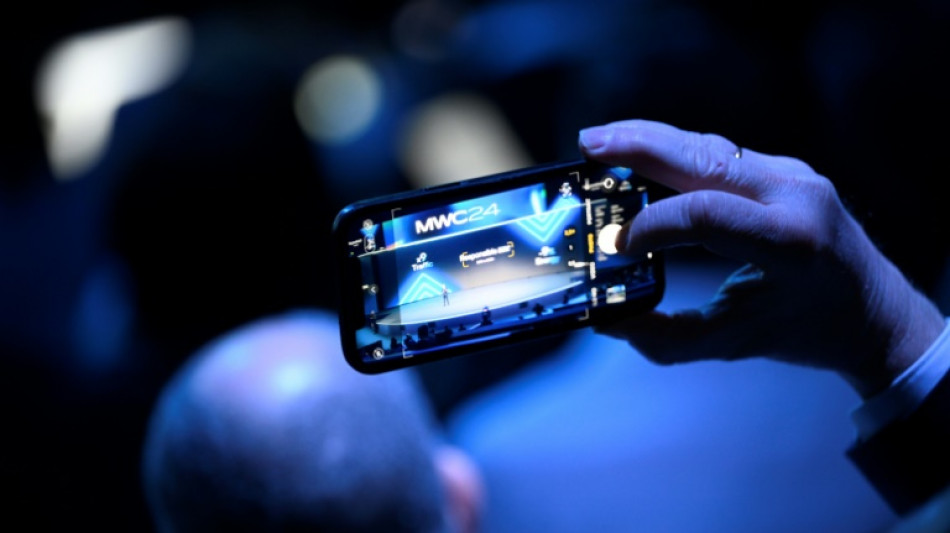
Smartphone makers charge ahead to make better batteries / Photo: Josep LAGO - AFP

 Biggest ever Russian barrage on Kyiv kills at least 13

 EU top court upholds record 4.1 bn euro Google fine

 Italy name two debutants to face Japan in Nations Championship opener

 Wallabies' Schmidt rules out another coaching job

 India asks Meta to hold WhatsApp username rollout over fraud fears

 Deadly Russian barrage on Kyiv kills at least 13

 Next indirect US-Iran talks after Khamenei funeral: mediators

 Reviving Montenegro's 'ancient' olive tree

 Resource rich PNG leaving its Pacific people behind: World Bank

 Papal envoy presides over first Vietnam beatification rite
 LeBron James praises Balogun after 'Silencer' celebration

 Farrell names Leinster-heavy side to face Wallabies

 Most Asia markets down as tech firms take fresh blow

 South Korean school baseball team suspended over 'Tank Day' chants

 Ceuzany, Cape Verde's golden voice with volcanic emotion

 Balogun scores and sees red as US beat Bosnia 2-0

 EU top court to rule on record 4.1 bn euro Google fine

 'Job forever': trade schools are all the rage in the AI era

 Celtics reportedly trading Brown to Sixers in NBA blockbuster

 Black Book Italy Provider Pulse Finds FSE 2.0 Faces Regional Interoperability, Diagnostic-Data and EHDS Readiness Test

 Kane saves England after DR Congo scare; Belgium comeback stuns Senegal

 Celtics to trade Jaylen Brown to 76ers for Paul George: report

 Streamex is making digital gold accessible

 Mixed US auto sales in Q2 amid high gas prices

 Pistons forward Harris reportedly headed to Spurs

A smartphone that can be charged in fewer than 40 minutes. Even better: a tiny nuclear battery that could keep it running for 50 years.
Facing consumers who are fed up with having to plug in their phones all the time, device makers are racing to develop more potent batteries that can charge faster and last longer.
Telecom firms highlighted some of the progress they've made at the industry's biggest annual show, the four-day Mobile World Congress (MWC), which got underway in Barcelona on Monday.
"All manufacturers are looking to have better performing batteries. There is a sense that it is an area that is lagging behind, that we have to move forward," Forrester Research analyst Thomas Husson told AFP.
As smartphone models have become increasingly similar, having a better battery is a way to "stand out from the crowd," he added.
Since the first smartphones hits the market in the 2000s, there have been several advances in the battery field, such as wireless charging, but there is still much room for improvement.
The growing popularity of power-hungry applications such as gaming and social media is fuelling demand for "mobile batteries with high battery capacity" and spurring the race for innovation among manufacturers, Allied Market Research wrote in a research note.
The majority of smartphones currently run on lithium-ion batteries that are made up of rare materials such as lithium, cobalt and manganese whose prices have soared and which degrade as time passes.
To get around this problem, manufacturers are exploring alternatives using lithium sulphur or graphene which may last longer and rely on less rare elements.
- AI needs -
Chinese handset maker Honor has developed a new higher capacity battery technology which uses silicon-carbon for its new AI-infused flagship Magic 6 smartphone, which it says can fully charge in less than 40 minutes and last longer than those of its main competitors.
It is the top smartphone battery in a ranking compiled by DXOMARK, a commercial website that scientifically assesses handsets.
As AI features use more energy "of course we need a powerful battery life," Honor CEO George Zhao said at the global launch of the phone in Barcelona on Sunday.
South Korean giant Samsung is reportedly developing a solid-state battery which can store more energy, charge faster and offers greater safety. It aims to launch it in 2027.
Its main rival Apple -- which last year overtook Samsung as the world's top seller of smartphones -- is developing its own battery technology with a view to introducing its designs into mobile devices, perhaps as soon as 2025, according to South Korean newspaper ET News.
Battery making had usually been outsourced but device makers are now increasingly seeking to "reduce their dependency on certain suppliers" as they are already doing with chips, said Husson.
- Nuclear charge -
Chinese startup Betavolt Technology unveiled a new nuclear battery in January which it said it can power a smartphone for 50 years without the need for recharging.
The Beijing-based company said the next-generation battery is the first in the world to realise the miniaturisation of atomic energy, placing nickel-63 isotopes into a module smaller than a coin.
The company, which is not attending the Barcelona event, did not say when the battery would be mass produced for commercial applications, saying only that it was in the pilot testing stage.
The improvements are sometimes required by legislators.
The European Union parliament approved new rules in June to make batteries more sustainable by imposing minimum levels of recycled content which they must use and be more durable.
"There is more money being spent on battery technology than ever before because of the electric vehicle development. So it is quite an exciting time for batteries," Ben Wood, chief of research at CCS Insight, told AFP.
"If someone could crack the battery problem, it would be a game changer. Imagine having a mobile phone that lasts two week, it would be amazing. But we are years and years away from that happening."
E.Rodriguez--AT