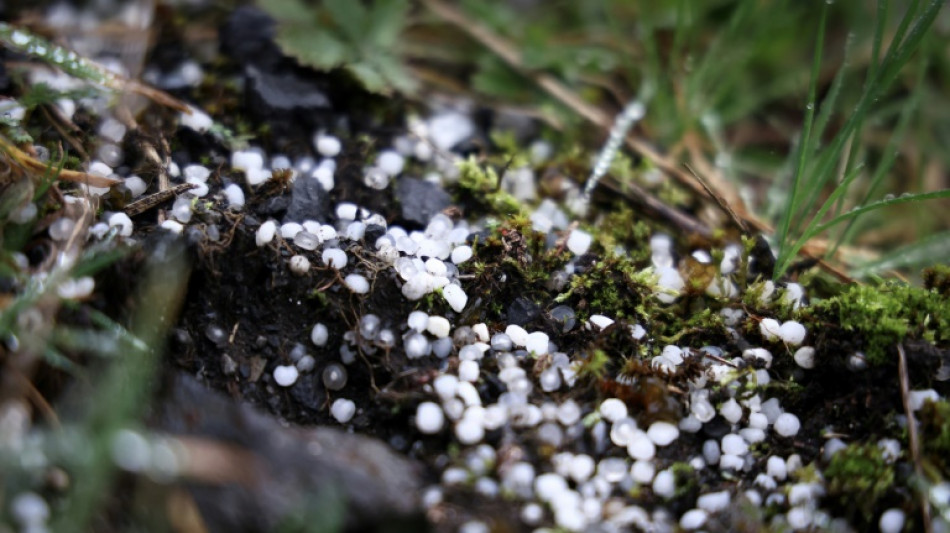
Plastic pellets blight Belgian town as EU weighs action / Photo: Kenzo TRIBOUILLARD - AFP

 Deadly Russian barrage on Kyiv kills at least 13

 Next indirect US-Iran talks after Khamenei funeral: mediators
 Reviving Montenegro's 'ancient' olive tree

 Resource rich PNG leaving its Pacific people behind: World Bank

 Papal envoy presides over first Vietnam beatification rite
 LeBron James praises Balogun after 'Silencer' celebration

 Farrell names Leinster-heavy side to face Wallabies

 Most Asia markets down as tech firms take fresh blow

 South Korean school baseball team suspended over 'Tank Day' chants
 Ceuzany, Cape Verde's golden voice with volcanic emotion

 Balogun scores and sees red as US beat Bosnia 2-0
 EU top court to rule on record 4.1 bn euro Google fine

 'Job forever': trade schools are all the rage in the AI era
 Celtics reportedly trading Brown to Sixers in NBA blockbuster
 InterContinental Hotels Group PLC Announces Transaction in Own Shares - July 02

 Belgium late show floors Senegal at World Cup

 Harry Kane: England's World Cup saviour

 US actor Danny Glover says he has Alzheimer's
 Trump sees progress as US, Iran hold Qatar talks

 Djokovic, Sinner into Wimbledon third round, Andreeva stunned

 Spurs agree club record £100 mn move for Newcastle's Tonali - reports
 Rain has final say in 1st England-India T20 as Sooryavanshi still awaits debut

 England refused to accept defeat in 'beautiful' DR Congo win, says Tuchel

 'Let the dogs in': Sabalenka wants Wimbledon to lift ban

 Oppressive heat broils US during World Cup, July Fourth

Buried in the soil, dotting riverbanks and bobbing along streams: a small Belgian town has waged a years-long fight against creeping pollution from plastic pellets -- which the EU now has in its sights.
A spectacular spill of microplastics on Spain's Galician coast cast a spotlight on the problem late last year, after a container filled with "nurdles" fell from a cargo ship and its contents washed ashore.
The images of locals sifting through the sand to weed out the tiny polluting pellets felt all too familiar in Ecaussinnes.
The small countryside town is home to Belgium's second largest petrochemical complex, and microplastic pollution has been a problem here for decades.
"We find them around industrial sites, in the waterways as far as eight kilometres (five miles) downstream," explained Arnaud Guerard, a local government official in charge of environmental matters.
"They burrow into riverbanks, and depending on rainfall they end up on agricultural land."
About the size of a lentil and made from fossil fuels, nurdles -- or pre-production plastic pellets -- are a little-known building block used to manufacture nearly all plastic products.
According to European Commission data, up to 184,000 tonnes of pellets per year -- the equivalent of 20 truckloads each day -- are dispersed into the environment across the 27-nation EU.
At the local level, Guerard blames pollution in Ecaussinnes on "dysfunction" in the industrial zone where the French giant TotalEnergies produces more than a million tonnes of the pellets per year.
Stored in huge silos, they are transported by three logistics firms based nearby, whose workers cart around huge open-topped bags filled with nurdles -- which Guerard says causes many to spill out.
- 'Chronic pollution' -
TotalEnergies says it has taken "numerous preventive steps" to rectify the situation: using a watertight pipeline to move pellets between sites, a giant blower to clear them from the outside of trucks, and regular cleanings and inspections.
Lucie Padovani, of the Surfrider Foundation environmental group, said the pellets are responsible for "insidious and chronic pollution throughout Europe, with spillage at every stage": production, road and maritime transport, and inappropriate storage.
Once out in nature, nurdles "are extremely hard to recover: they are non-biodegradable and will break down into even smaller micro-particles," said Natacha Tullis, of the Pew Charitable Trust.
"This has a pretty serious impact on the environment."
Nurdles can be ingested by aquatic life, creating a risk of invisible pollution that releases toxic chemicals right up the food chain, she says.
In Ecaussinnes, authorities have set up filtering dams on streams -- but at the risk of also killing amphibians.
After 16 years of complaints from local residents and accumulating evidence of pollution, the town tried first to set up a dialogue with the companies involved -- but ultimately resorted to legal action, which is ongoing.
- 'Not enough' -
"These companies don't admit their responsibility," said Guerard, who wants tougher regulation to tackle the problem.
"There's no reason this harm should be paid for by the community, when they have the means to act to prevent pollution."
In October the European Commission put forward a proposal aimed at reducing pellet spillage -- by forcing large companies to assess risks, and toughen both preventative and clean-up measures.
But advocates say the legislation -- which has yet to be negotiated by member states and lawmakers -- falls short as it stands.
"It won't be enough to stem pollution," said Padovani, who worries it does not apply to small and medium-sized businesses who make up much of the plastic manufacturing chain, nor to maritime transport.
The Belgian EU lawmaker Saskia Bricmont is among those pushing for tougher legislation.
"Initiatives taken on a voluntary basis are not enough," she told AFP. "We see that in Ecaussinnes, where there is no systematic clean-up, and no due diligence."
In the meantime, Bricmont hopes a separate law on environmental crimes, set for final approval from the European Parliament on Tuesday, could enable sanctions against the negligent behaviour behind the nurdle blight.
Ch.P.Lewis--AT