Stung by drought, Morocco's bees face disaster

 Rain halts India push after Dinusha century lifts Sri Lanka

 Dinusha hits century as Sri Lanka post 284 in first India Test

 Stocks steady as investors weigh US rate path
 Taiwan's leader says government to propose record defence spending for 2027
 Cambridge head slams 'feeding frenzy' over dead academic

 Ebola outbreak now DR Congo's deadliest ever

 Germany's coalition split over putting climate in constitution

 Ukraine badminton star: 'How can you feel normal when bombs are falling?'

 Rain brings respite as Belgium wrestles massive wildfire
 Most stocks rise as US data ease rate fears but fuel economic worries

 India take control of Galle Test as Sri Lanka slump to 99-5
 Australia's mushroom murderer appeals conviction

 The Nigerian fishing community being eaten up by the Atlantic

 Kushner to meet Netanyahu after talks with Hamas on Gaza plan
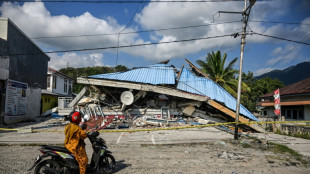
 Photos, memories all that remain for Colombia's bereaved after quake

 Sabalenka squeezes out win on sixth match point in Cincinnati
 Trump says US scaling back military drills with South Korea hours before start

 Jason Arday: UK academic who died amid plagiarism storm

 Sabbath cafe clash lays bare Israel faultlines

 NatureCell to Open the Era of "Medicine for Humanity (蒼生醫學)" with the World's First Commercialization of Amniotic Stem Cell Conditioned Medium

 FaZe Esports, a GameSquare Company, Wins Rainbow Six Championship at 2026 Esports World Cup

 Onemeta OTCQB (ONEI): August 17th 2026; Reports Over 500% Increase in Verbum Call Consumption amid new client intake, including Fortune 500 Companies, Producing $2.4M Positive Cash Flow During H1 2026

 Emerging Growth Research Releases Flash Report on First Phosphate; Reiterates Buy Rating and C$4.94 Price Target Following Nasdaq Uplisting

 Council for Innovation Promotion Names Coke Morgan Stewart President and CEO

 HM Exploration Commences Borehole & Surface EM Surveys at Lewis Pilley's

Morocco's village of Inzerki is proud to claim it has the world's oldest and largest collective beehive, but instead of buzzing with springtime activity, the colonies have collapsed amid crippling drought.
Beekeeper Brahim Chatoui says he has lost almost a third of his hives in just two months -- and he is not alone.
"At this time of year, this area would normally be buzzing with bees," said Chatoui, sweating under a blazing springtime sun. "Today, they're dying at a terrifying rate."
The North African kingdom has seen a dramatic spike in mass die-offs of the critical pollinators, a phenomenon called "colony collapse disorder".
Worldwide, experts say such sudden mass deaths of bees are often linked to the destruction of nature and the rampant use of pesticides.
But authorities in Morocco say these collapses are caused by the worst drought to hit the country in 40 years, which has decimated the plants on which bees rely for food.
- 'Unprecedented' spike -
The crisis is so acute that the government released 130 million dirhams ($13 million), to support beekeepers and investigate the cause of the bee deaths.
Morocco's National Food Safety Office, which carried out the investigation, ruled out disease as a reason.
Instead, it blamed the "unprecedented" spike in hive collapses on an intense drought driven by climate change.
Inzerki's unique collective beehive sits on a sunny hillside in the heart of the Arganeraie Biosphere Reserve, a UNESCO-protected 2.5-million-hectare region, some 415 kilometres (260 miles) southwest of the capital Rabat.
The complex is striking: A five-storeyed structure of wooden struts and dry mud stretch along a hillside, each compartment home to a cylindrical wicker hive, covered with a mix of earth and cow dung.
Experts say it is the oldest traditional, collective beehive in the world, dating back to 1850, but today it is under threat amid a changing climate.
"This year we hope for rain, because I have lost 40 hives so far," Chataoui said.
Bee expert Antonin Adam, who has studied the insects in southwestern Morocco, also blamed the collapse on the drought.
But he added the problem may have been exacerbated by "the bees' vulnerability to diseases, nomadic pastoral practices, intensive agriculture and the country's desire to increase its honey production".
That desire is clearly visible in agriculture ministry figures.
Honey output has risen by 69 percent in a decade, from 4.7 tonnes in 2009 to almost eight tonnes in 2019, generating revenues of over 100 million euros.
But it is not only Inzerki's apiary that is in trouble.
Mohamed Choudani, of the UAM beekeepers union, said the crisis was hitting bee populations across the country.
Last summer, Morocco's 36,000 beekeepers were managing some 910,000 hives, up by 60 percent since 2009, according to official figures.
But Choudani said that since last August, 100,000 colonies had been lost in the central region of Beni Mellal-Khenifra alone.
Bees and other pollinators are vital for the reproduction of more than three-quarters of food crops and flowering plants.
The UN's Food and Agriculture Organisation (FAO) say bees play an "essential role... in keeping people and the planet healthy", with the UN saying they "serve as sentinels for emergent environmental risks, signalling the health of local ecosystems".
- 'Exceptional legacy' -
For the villagers of Inzerki, the collapse of hives is an ecological and economic disaster -- but also a crisis for their unique heritage.
Chatoui, the beekeeper, said many Inzerki residents can't afford to revive the hives they have lost.
"Some families have decided just to give up on beekeeping completely," he said.
The hives at Inzerki are in trouble. Parts of the structure, recently listed as a national heritage site, are sagging.
Geographer Hassan Benalayat says the neglect is due to several factors on top of climate change, including the arrival of modern agriculture and a general exodus from the countryside.
Around 80 families in the village once kept bees. Today there are less than 20.
"It's urgent to keep this exceptional legacy alive," Benalayat said.
Chatoui and other villagers have set up an association to restore the structure, as well as planting herbs for the bees that are better able to tolerate hot and arid conditions.
"The situation is critical, but that doesn't mean I'm giving up," Chatoui said.
"The aim isn't to produce honey, but to protect the hives and make sure the bees survive until better days."
E.Rodriguez--AT