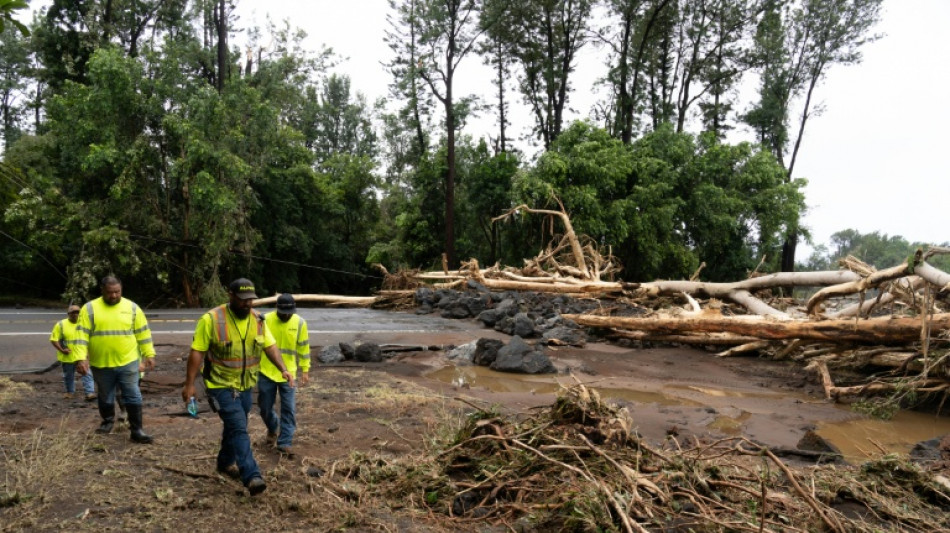
Hawaii recovery efforts begin as Lala downgraded, moves west / Photo: Jill K. Briggs - AFP

 Zach Hickerson Recounts Hayden Panettiere's Final Moments in New Interview

 Luxembourg Housing Petition Passes Threshold for Parliamentary Consideration

 Raheem Sterling Receives Suspended Sentence After Lamborghini Crash

 Audience to Choose the Set List at Luxembourg's First FAMIL Jukebox Night

 Luxembourg Pay Rise Delayed as Regional and World Headlines Develop

 Chennai Urbanist Sashna Develops 'Anniki' Card Game to Gamify Tamil Nadu History

 Transport Minister Defends Land Seizure Powers for Toronto-Quebec City High-Speed Rail

 UAE Weather Forecast: Scattered Showers and Fog Expected as Temperatures Drop
Clean-up efforts were underway on Sunday as Hurricane Lala, which was downgraded to a tropical storm, rolled past Hawaii's Big Island and dumped heavy rain across the US Pacific state.
Hawaii Gov. Josh Green told a news conference that officials are still investigating whether there had been any storm-related deaths.
"We're praying that there are essentially no fatalities. The question is a difficult one to answer in some ways," Green said.
He added that there was a "terrible car accident" that could have been storm-related, and "we often have a person found every couple days that may be houseless on the street, who may have passed away."
Hawaii Emergency Management Director Randy Collins also warned that there were still dangers to face in coming hours even though the storm had passed.
"Many casualties often happen after the disaster," Collins told reporters. "As people are cleaning things up, they're working with heavy equipment, chainsaws, generators. They're working around downed power lines and so forth. That's when the casualties come."
Lala was downgraded from a hurricane to a tropical storm in the early hours of Sunday, according to the National Hurricane Center.
The NHC said at 8:00 pm local time Sunday (0600 GMT Monday) that Lala "weakens as it continues westward away from the main Hawaiian islands."
The storm's outer bands were still lashing the Big Island and Maui with heavy rainfall and, while little change was expected over the next day, the center warned that Lala "could become a hurricane again by Wednesday."
Lala had strengthened into a Category 1 hurricane on Saturday, generating winds of up to 75 miles per hour (120 kilometers per hour).
Aside from the Big Island, tropical storm warnings had been issued for the state's seven other major islands: Maui, Molokai, Kahoolawe, Lanai, Oahu, Kauai and Niihau.
However, its "tropical storm warning for Kauai County, including the islands of Kauai and Niihau, has been discontinued," the NHC said.
It said "there are no coastal watches or warnings in effect" by Sunday evening.
A maximum storm total of 30 to 35 inches (76 to 89 centimeters) of rainfall had been expected over the windward Big Island.
- El Nino -
Lala did not make landfall, but Hawaii was still reckoning with the damage it brought.
The New York Times reported that parts of a major highway in the Big Island's southeast collapsed overnight, blocking road access to the town of Pahala that has the region's only hospital.
The state was last hit by a "major" hurricane -- meaning Category 3, 4, or 5 on the Saffir-Simpson scale -- in 1992, when Hurricane Iniki caused at least six deaths and billions of dollars in damage.
Hawaii was menaced by Hurricane Fausto last month, before the storm weakened and skirted north of the island chain.
The storm comes as a powerful El Nino has formed in the central equatorial Pacific Ocean.
Temperatures are already so high that the National Oceanic and Atmospheric Administration predicts a 69 percent chance of a "historic event that would exceed the strength of previous El Nino events dating back to 1950" when it peaks between October and December.
El Nino, a natural climate pattern when sea surface temperatures in the central and eastern Pacific Ocean become unusually warm, tends to promote hurricane activity in the Pacific while suppressing it in the Atlantic.
Human-caused climate change can amplify El Nino's impacts because a warmer ocean and atmosphere increase the availability of energy and moisture for extreme weather events, such as heatwaves and heavy rainfall.
B.Torres--AT


