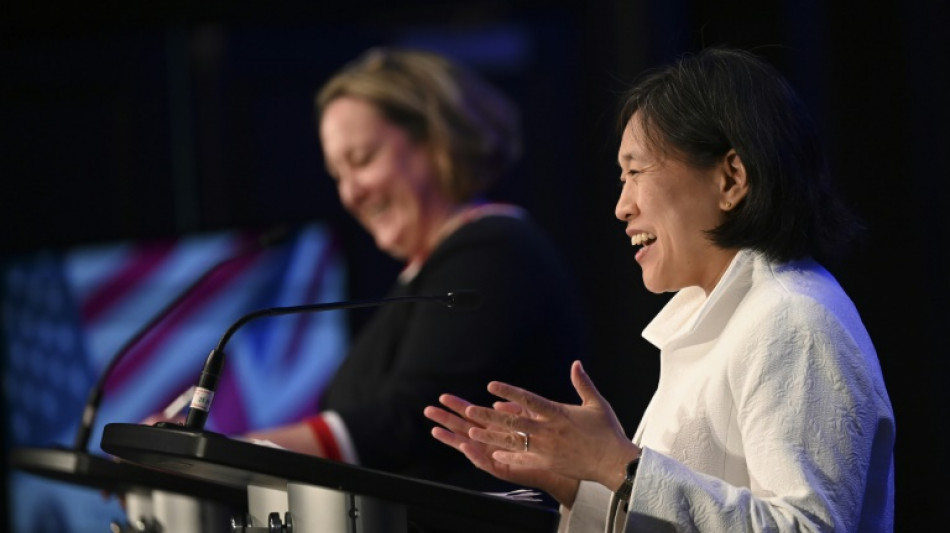
Tariffs have not forced China to change its ways, US trade chief says

 Rain halts India push after Dinusha century lifts Sri Lanka

 Dinusha hits century as Sri Lanka post 284 in first India Test

 Stocks steady as investors weigh US rate path

 Taiwan's leader says government to propose record defence spending for 2027

 Cambridge head slams 'feeding frenzy' over dead academic

 Ebola outbreak now DR Congo's deadliest ever

 Germany's coalition split over putting climate in constitution

 Ukraine badminton star: 'How can you feel normal when bombs are falling?'

 Rain brings respite as Belgium wrestles massive wildfire

 Most stocks rise as US data ease rate fears but fuel economic worries

 India take control of Galle Test as Sri Lanka slump to 99-5

 Australia's mushroom murderer appeals conviction

 The Nigerian fishing community being eaten up by the Atlantic
 Kushner to meet Netanyahu after talks with Hamas on Gaza plan

 Photos, memories all that remain for Colombia's bereaved after quake

 Sabalenka squeezes out win on sixth match point in Cincinnati

 Trump says US scaling back military drills with South Korea hours before start

 Jason Arday: UK academic who died amid plagiarism storm

 Sabbath cafe clash lays bare Israel faultlines

 NatureCell to Open the Era of "Medicine for Humanity (蒼生醫學)" with the World's First Commercialization of Amniotic Stem Cell Conditioned Medium

 FaZe Esports, a GameSquare Company, Wins Rainbow Six Championship at 2026 Esports World Cup

 Onemeta OTCQB (ONEI): August 17th 2026; Reports Over 500% Increase in Verbum Call Consumption amid new client intake, including Fortune 500 Companies, Producing $2.4M Positive Cash Flow During H1 2026

 Emerging Growth Research Releases Flash Report on First Phosphate; Reiterates Buy Rating and C$4.94 Price Target Following Nasdaq Uplisting

 Council for Innovation Promotion Names Coke Morgan Stewart President and CEO

 HM Exploration Commences Borehole & Surface EM Surveys at Lewis Pilley's

Rather than pressuring China to change its "unfair" trade practices, US Trade Representative (USTR) Katherine Tai said Wednesday the economy would better served by policies to encourage domestic manufacturing.
In a four-hour hearing before the House Ways and Means Committee, President Joe Biden's trade chief acknowledged that Washington's strategy of imposing massive tariffs on Beijing -- which began under former president Donald Trump -- has had little to no effect on its policies.
"That has not incentivized China to change," she said. "It is very clear to us, I think, collectively, that we can't keep doing what we have been doing."
Washington has accused Beijing of subsidizing its exports and wiping out industries both in the United States and Europe, forcing companies to transfer technology in exchange for doing business in China, and stealing intellectual property.
In 2020, the countries signed the "phase one" trade agreement under which Washington agreed to ease off tariffs the Trump administration imposed two years earlier, in exchange for China buying $200 billion in American exports through 2021.
However Beijing fell short of those targets when the Covid-19 pandemic struck, and Tai told lawmakers, "While we continue to keep the door open to conversations with China... we also need to acknowledge the agreement's limitations, and turn the page on the old playbook with China, which focused on changing its behavior."
- Making amends -
Since taking office in January 2021, Biden has resolved a number of trade disputes with US allies, including a deal announced last week to lift tariffs on British steel and aluminum that Trump imposed.
However there's been no similar breakthrough with China, despite Tai's renewed negotiations with its officials.
Last week, Washington agreed to extend tariff exemptions on 352 products imported from the Asian country after businesses complained the levies were driving up costs as the United States grapples with high inflation.
In her appearance before Congress, Tai stressed that the US strategy must now "expand beyond only pressing China" into abandoning trade practices Washington views as unfair.
The new approach must "include vigorously defending our values and economic interests from the negative impacts of the PRC's unfair economic policies and practices," she said, using the official term for the People's Republic of China.
"We can't just wait for China to change," she said, calling for "the reshoring and the rebuilding of our manufacturing base."
"That is the plan that we need to pursue going forward," Tai said.
China is aiming to grow its industries making products like electric cars and semiconductors, and Tai said the United States should make "strategic investments" to match them.
"We have seen what happened in the steel and solar industries when existing mechanisms were too slow or ill-suited to effectively address the distortions wrought by China's targeting of those sectors," she said.
The trade chief called on lawmakers to approve the Bipartisan Innovation Act, which has been approved by the House and Senate and is now in conference committee.
The measure would spend $52 billion on domestic semiconductor production and research as well as spurring manufacturing and strengthening supply chains.
Tai also credited the American Rescue Plan stimulus measure passed shortly after Biden took office last year with making "significant progress" in helping businesses grappling with the pandemic.
A.Ruiz--AT