Asti Spumante bubbles popped by Ukraine war

 'Nowhere to run': Indonesian quake survivors plead for help
 Belgium fire makes 'limited' spread overnight, more help on way
 Vingegaard brings curtain down on season
 Dickwella, Dinusha hit fifties as Sri Lanka fight back

 Bangladesh Test cricket reboot delivers in style with historic win

 Virgin moves closer to launching Eurostar rival in 2030
 Indian marble waste dump becomes unlikely tourist attraction

 Coach says Australia 'let standards slip' in shock Bangladesh loss

 Hawaii recovery efforts begin as Lala downgraded, moves west

 Food safety crackdown snares Mumbai's famed restaurants
 Trump says US scaling back military drills with Seoul hours before start
 Nearly 13,000 displaced after deadly Indonesian quake
 Axe hangs over Australian batters after Darwin 'disaster'

 Is this cave in Turkey where Homer wrote 'The Odyssey'?

 Winning back walls from gangs, artists fill El Salvador's towns with color
 Opening arguments expected in Tupac murder trial

 As machinery removes rubble, hopes for survivors from Colombian quake dwindle

 InterContinental Hotels Group PLC Announces Transaction in Own Shares - August 17

 HM Exploration Commences Borehole & Surface EM Surveys at Lewis Pilley's
 SEG Announces 2026 Interim Results

 Banyan Gold Intersects 13.03 g/t Au Over 14.2m at Powerline North, AurMac, Yukon, Canada
 Emerging Growth Research Releases Flash Report on First Phosphate; Reiterates Buy Rating and C$4.94 Price Target Following Nasdaq Uplisting
 Guardian Metal Resources PLC Announces Warrant Exercise

 Top-ranked Scheffler powers to PGA St. Jude Championship victory

 Jacquet scores on Liverpool debut in friendly win over Como

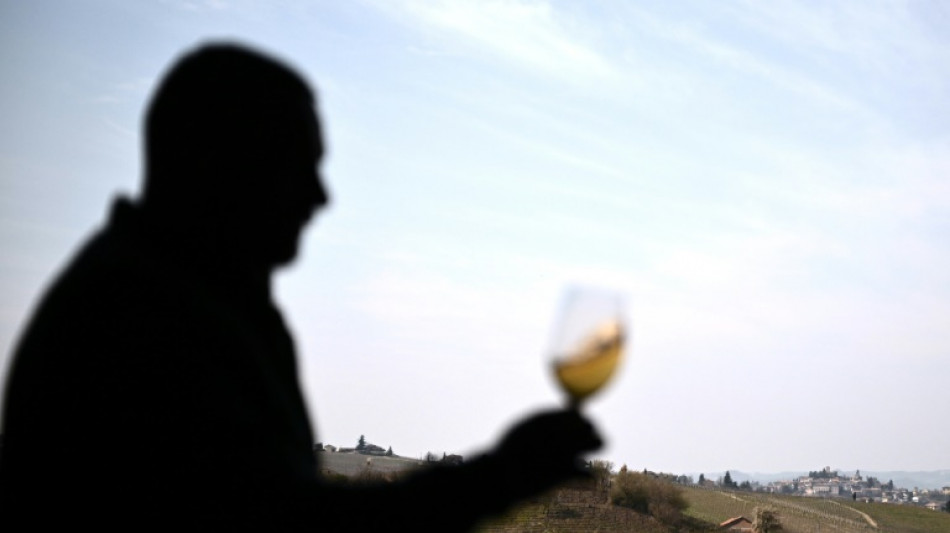
Its sweet bubbles made Asti Spumante a favourite in Russia -- but the Ukraine war threatens to cripple Italy's producers, with sales of millions of bottles now at risk.
Vineyards stretch as far as the eye can see below the Caudrina estate, nestled among rolling hills in the picturesque Langhe region.
The peaceful scene belies the stress gripping this family business, now urgently seeking a new market for its wine.
And it is not the only one. Italy is the leading supplier of wine to Russia and Ukraine -- far ahead of rival France -- and is already suffering a fallout.
Russia's invasion has "hit us hard", said Marco Dogliotti, whose father owns the vineyard in Castiglione Tinella, near Turin in northern Italy.
"Since 2017, we have exported some 4,000 bottles a year to Ukraine, 80 percent of which was Asti Spumante, with a good turnover," he told AFP.
"Unfortunately this market, which was booming in 2021, is now totally lost."
Two pallets of the popular sparkling wine were ready to go to Ukraine when Russia invaded its neighbour in late February.
"The day of the invasion, our importers were calm, they didn't imagine it would be a disaster. But the next day they fled," he said.
Founded in the 1940s by Dogliotti's grandfather, the company exports almost 40 percent of its wine. As well as the spumante, it also produces Muscat and Barbera on its 25 hectares (62 acres).
The Ukraine conflict is now forcing Dogliotti, 39, to speed up and widen his search for new buyers, from Australia to Japan or Nigeria.
- 14 million bottles -
Production of sweet Asti Spumante in Piedmont was up 12 percent in 2021, with over a quarter of bottles exported going to Russia and Ukraine.
"We hope that the war will end as soon as possible," Flavio Scagliola, vice-president of the Asti DOCG consortium, told AFP.
"The Russian, Ukrainian and Belarusian markets represent 14 million bottles per year," he said.
The European Union banned certain luxury products in March from being exported to Russia, as part of sanctions against the country for the invasion.
But while Asti Spumante joined other wines and champagnes on the list, it is largely unaffected -- the average bottle costs five euros ($5.50), and the ban only affects those worth over 300 euros.
"Very few Italian wines fall into this category, apart from the great vintages such as Super Tuscans, Brunello di Montalcino or Barolo from Piedmont, which are sold at very high prices," said Denis Pantini, head of food and wine at the Nomisma observatory.
As far as Asti Spumante is concerned, "the risk is not so much linked to an export blockade, but rather to the problem of payments after Moscow's exclusion from the SWIFT banking messaging network, the collapse of the rouble and the difficulties that have arisen in transport", he told AFP.
But some Italian wine exporters are managing to reach Russia via Belarus or Latvia, and by using the few Russian banks that are not excluded from SWIFT, according to industry sources.
- 'Barolo Boys' -
Problems sourcing raw materials, already expensive and in short supply after the pandemic, have also worsened since the outbreak of the war, particularly cardboard, glass and aluminium -- of which Russia is the third largest producer in the world, and which is used to make bottle capsules.
"We were very close to stopping sales last week because of a lack of cardboard for packaging, but at the last minute our supplier was able to provide us with some," says Giovanni Correggia, 29, who heads up an organic wine producer in the Roero region, which borders the Langhe.
His father, Matteo Correggia, was one of the "Barolo Boys" who in the 1980s and 1990s revolutionised the wines of the region and made them famous throughout the world, starting with the United States.
The company, founded in 1985, has already run into trouble with Russia, with its Moscow importer forced to close down in 2018 amid allegations of money laundering, leaving large unpaid bills behind.
O.Ortiz--AT