Historic German 'rail bridge' aids war-ravaged Ukraine

 'Nowhere to run': Indonesian quake survivors plead for help
 Belgium fire makes 'limited' spread overnight, more help on way

 Vingegaard brings curtain down on season

 Dickwella, Dinusha hit fifties as Sri Lanka fight back
 Bangladesh Test cricket reboot delivers in style with historic win

 Virgin moves closer to launching Eurostar rival in 2030

 Indian marble waste dump becomes unlikely tourist attraction

 Coach says Australia 'let standards slip' in shock Bangladesh loss

 Hawaii recovery efforts begin as Lala downgraded, moves west

 Food safety crackdown snares Mumbai's famed restaurants
 Trump says US scaling back military drills with Seoul hours before start

 Nearly 13,000 displaced after deadly Indonesian quake

 Axe hangs over Australian batters after Darwin 'disaster'

 Is this cave in Turkey where Homer wrote 'The Odyssey'?

 Winning back walls from gangs, artists fill El Salvador's towns with color

 Opening arguments expected in Tupac murder trial

 As machinery removes rubble, hopes for survivors from Colombian quake dwindle

 InterContinental Hotels Group PLC Announces Transaction in Own Shares - August 17

 HM Exploration Commences Borehole & Surface EM Surveys at Lewis Pilley's
 SEG Announces 2026 Interim Results

 Banyan Gold Intersects 13.03 g/t Au Over 14.2m at Powerline North, AurMac, Yukon, Canada

 Emerging Growth Research Releases Flash Report on First Phosphate; Reiterates Buy Rating and C$4.94 Price Target Following Nasdaq Uplisting

 Guardian Metal Resources PLC Announces Warrant Exercise

 Top-ranked Scheffler powers to PGA St. Jude Championship victory

 Jacquet scores on Liverpool debut in friendly win over Como

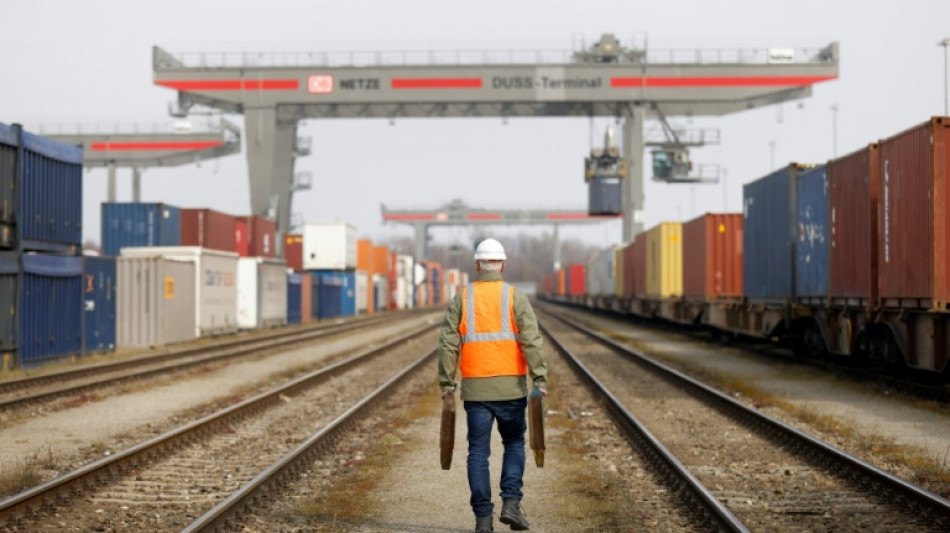
The convoy rolls slowly out of the heart of Berlin, its eight cars tethered to a bright red locomotive. Destination: Ukraine, thanks to a historic "rail bridge" delivering humanitarian aid to the besieged country.
Four days' journey, more than 1,000 kilometres (600 miles) travelled and at the end of the line, tonnes of food and other essentials delivered to people in need.
The operation of the Deutsche Bahn (DB), the German rail company, echoes the famous Allied airlift -- known as the "air bridge" in German -- during the Cold War to help the city of Berlin during a Soviet blockade.
"It only took four days" to set up this cooperation with the Polish and Ukrainian railways which now allows this "rail bridge" to operate regularly, explains Sigrid Nikutta, head of DB Cargo, the freight service of the public company.
Every other evening, a convoy leaves the German capital after having collected donations from companies and individuals throughout the country, at dedicated points or directly from manufacturers and supermarket chains.
Pallets of baby food, boxes of sanitary pads and tampons, small electrical appliances, medical equipment, floor mattresses, blankets... the outpouring of generosity is so overwhelming that the containers fill up rapidly.
"Each container is a message to Ukrainians: 'We aren't leaving you on your own!'," Nikutta says.
Among the DB staff, morale is high. Employees take convoys to Poland where they then hand off to local drivers.
The containers must later be unloaded and transferred because the width of the rails in Ukraine is different.
When the train arrives in Ukraine, the national railway takes over.
- 'Respect' -
The unfailing commitment of the employees of the Ukrainian national company to transport food and refugees from one end of the country to the other has earned the admiration of their colleagues to the west.
"They have my respect but also my concern because we all know that this is dangerous," Nikutta says.
However the risks for the "rail bridge" are limited, says DB Cargo spokesman Michael Schmidt.
"We do not transport weapons, no oil", he stresses, noting that since the start of the Russian offensive, attacks on the Ukrainian rail network have been rare because "the Russians need to keep this infrastructure in good condition".
All the convoys, sent to various Ukrainian cities and towns, have so far arrived safely, Nikutta says with pride.
She even received a photograph of the arrival of the containers in Kyiv sent by the mayor of the capital, the charismatic ex-boxer Vitali Klitschko.
"Many Ukrainians feel today, after four long weeks of war, what the Berliners felt at the time of the blockade by the Soviets" in 1948-1949, says the Ukrainian ambassador to Germany, Andriy Melnyk, who attended the departure of a convoy this week.
"Without the enormous effort of the Allies at the time, what would this beautiful city have become?" he asks.
"We now need other solid bridges, including political ones, and the most important would be a prospect of EU membership for Ukraine", says the ambassador, giving the starting signal to the locomotive stamped with the slogan "We stand with Ukraine".
F.Wilson--AT