Power blackouts, soaring fuel prices shut Nigerian businesses

 Bangladesh Test cricket reboot delivers in style with historic win

 Virgin moves closer to launching Eurostar rival in 2030
 Indian marble waste dump becomes unlikely tourist attraction
 Coach says Australia 'let standards slip' in shock Bangladesh loss

 Hawaii recovery efforts begin as Lala downgraded, moves west

 Food safety crackdown snares Mumbai's famed restaurants
 Trump says US scaling back military drills with Seoul hours before start
 Nearly 13,000 displaced after deadly Indonesian quake
 Axe hangs over Australian batters after Darwin 'disaster'

 Is this cave in Turkey where Homer wrote 'The Odyssey'?

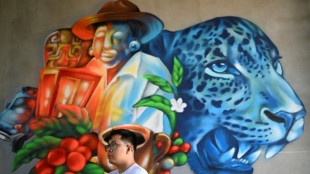 Winning back walls from gangs, artists fill El Salvador's towns with color

 Opening arguments expected in Tupac murder trial

 As machinery removes rubble, hopes for survivors from Colombian quake dwindle
 Gold Roth IRA: How It Works, Rules, Taxes, Fees, and What Investors Should Know in 2026 (Guide Released)
 HM Exploration Commences Borehole & Surface EM Surveys at Lewis Pilley's
 SEG Announces 2026 Interim Results

 Trump says US scaling back military drills with South Korea

 Zambia's Hichilema takes early lead in reelection bid
 Sabalenka squeezes out a win on sixth match point in Cincinnati

 Duplantis dominant, Hunt hits four and Asher-Smith makes history

 Spanish soldier dies in Aragon wildfire

 PSG beaten by Lens in French Champions' Trophy

 Rybakina, Andreeva race into Cincinnati third round

 Amy Hunt bags fourth Euro gold as Britain win 4x100m mixed relay

 Spanish soldier dies in Aragon wildfire: regional leader
For eight years, Nigeria hairdresser Damy Idowu ran her business in a commercial district of Lagos, surviving growing inflation, recession and the global pandemic.
Last week, she closed up shop, victim to soaring diesel costs and the country's latest spate of prolonged power shortages.
Blackouts are common in Africa's top petroleum producer, where dilapidated infrastructure often fails to distribute even insufficient electricity supplies.
But extended collapses of the power grid over the last several weeks have combined with a global hike in diesel prices to create one of the country's worst recent energy crises.
Many businesses rely on diesel generators to keep the lights on when power is out, and since Ukraine's crisis doubled fuel prices in Nigeria, operating costs are sky-high.
"My business depends largely on electricity and I could no longer afford the price of diesel to power my generator," Idowu told AFP, explaining she had started offering home visit hairdressing as an alternative.
In Lagos, the commercial capital of Africa's largest economy, some small businesses are struggling to stay open and offices now often operate for several hours without power.
In the north, some factory owners say they have wound down from operating limited shifts to closing up completely as generator costs make business financially untenable.
The power struggles came just after weeks of fuel shortages caused lines at filling stations, angering Nigerians struggling with the weak naira and high cost of living.
At home, Nigerians operate small petrol generators to provide light when the power is off, even if only for a few hours. In wealthier neighbourhoods, buildings run larger, diesel generators.
Last week, the national grid collapsed twice in 48 hours.
- Markets by torchlight -
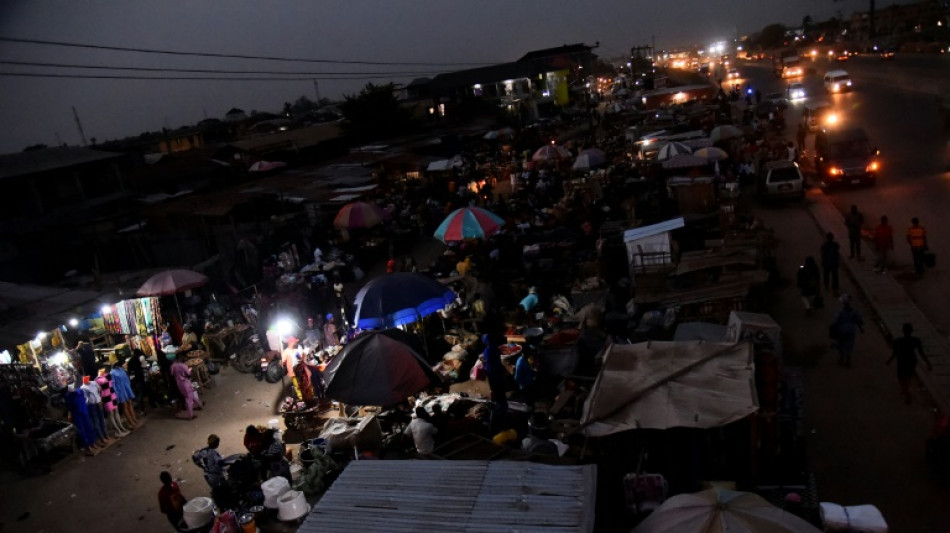
Some major streets in Lagos were without light at night this week while market traders in some parts of the city sold at night by torch and the light of their mobile phones.
After 20 years in business, guest house owner Femi Afolabi has almost had enough. He was about to sell up or convert his building to a residence as the diesel hike and power crashes increased his operating costs 200 percent.
"Regular electricity has been a mirage. Supply has been so abysmal that we now run the business on 24-hour generator," he told AFP, at the southwest town of Ota, outside Lagos.
"We can no longer cover our costs not to talk of making profits."
- Structural problems -
Nigeria's President Muhammadu Buhari has apologised over the fuel shortages and on Monday he summoned his minister of power to discuss the electricity crisis.
Hitting out at Buhari's ruling APC party less than a year before 2023 elections, the opposition Peoples Democratic Party warned the power crisis may lead to popular protests.
But many energy problems are structural.
Nigeria produces 1.4 million barrels of crude a day, but it refines little. It relies almost completely on fuel imports, making the local market vulnerable to disruptions.
With a population of 210 million people, Nigeria has seen a boom in commercial and industrial activities in the last decade that relies extensively on electric power.
Though the power sector was privatised in 2013, over the years, demand for electricity has outpaced generation, transmission and distribution capacity.
Six generation companies and 11 distribution companies are run by private investors while the state manages transmission. But the reforms failed to resolve power problems.
According to the state-run Transmission Company of Nigeria (TCN), generation companies blame current outages on poor gas supply, faults in generating units and maintenance.
In the last two months, 14 gas-powered generating stations were either not generating at all or had limited generation.
The Socio-Economic Rights and Accountability Project (SERAP), a lobby body, on Sunday urged Buhari to probe corruption in the sector.
"The staggering amounts of public funds alleged to have been stolen over the years in the electricity sector have had catastrophic effects on the lives of millions of Nigerians," SERAP said in a letter to Buhari.
- Factories shutting -
Power costs are clear to Umar Sani Marshall, the owner of Marshall Biscuits, a factory based in the northern commercial hub of Kano.
The factory normally operates two shifts, but he was forced to cut back to one using two thirds of his 300 work force. Now he has left the factory idle until the situation improves.
"The situation now is beyond comprehension," he told AFP. "We have stopped production in the last two weeks because there is no way we can break even."
He said his business was missing high demand for products expected for the Muslim holy month of Ramadan in April.
Ali Madugu, owner of Dala Foods, a food-processing factory in Kano and Vice President of Nigeria's manufacturers' union (MAN) said his plant also shut.
Part of the power supply issue was the water levels at the Shiroro Dam's hydropower plant, he said. But fuel was key.
"The major headache is the unbelievable increase in the cost of diesel," he said. "It is killing us."
P.Smith--AT