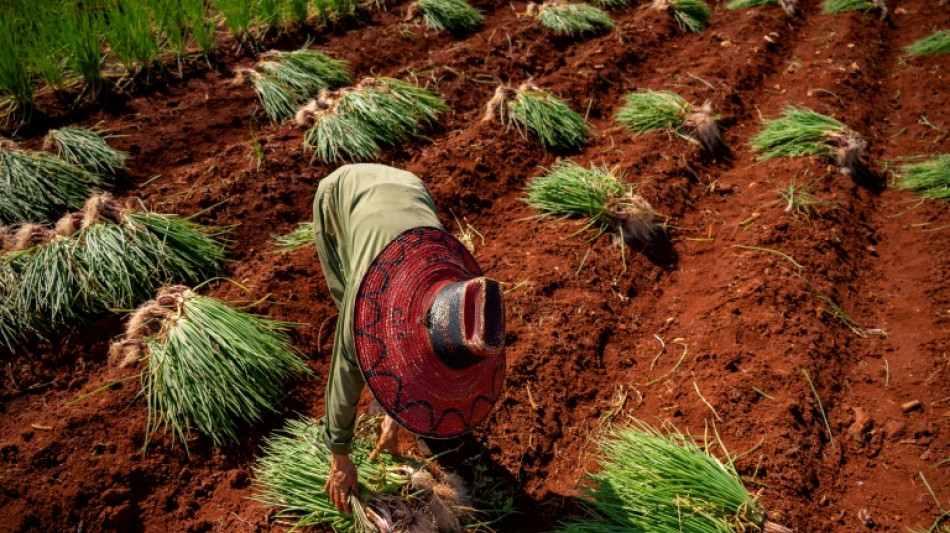
Fertile Cuba relies on food imports as farmers lack seeds, fuel / Photo: Yamil LAGE - AFP

 Macron, Carney to visit French islands after Trump's map post

 اليورو يستقر في البنوك المصرية وأعلى سعر للبيع 59.85 جنيه

 فليك يضم حمزة عبد الكريم إلى قائمة برشلونة بعد أربعة أهداف في الإعداد

 Myanmar says UN envoy illegitimate ahead of credentials decision

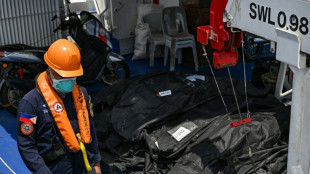 Philippine rescuers pull more victims from charred ferry
 ستاندرد آند بورز تثبت تصنيف السعودية عند A+
 Crash and burn: Pakistan cricket at a new low after England humiliation

 'Second life': Nepal tunnel survivor recalls ordeal

 Hong Kong homes flattened for US$28 bn high-tech hub
 'Be careful what you wish for': 'Obsession' director and star reflect on success

 Messi scores but Miami held by Nashville
 US Open champ Rybakina on top of world after injury scare

 Rybakina reigns serene as new world number one

 Defiant Sabalenka motivated by US Open defeat

 Houthis say hit Saudi base after renewed fighting with Yemeni govt forces

 Akron fan's honorary play-calling stint ends with opening-drive fumble

 Japanese floating parking platform is designed to lift cars above floodwater

 Anthropic details Claude misuse as US targets major illicit online marketplace

 Fifth Circuit upholds dismissal of Jackson residents' constitutional water claims

 Winston County trash-debt prosecutions face challenge from civil-rights lawyers

 Marmot research gains over $140,000 from meme-coin fees alongside wildlife contest

 Cristian Mungiu's Fjord examines a family's conflict with Norwegian child authorities

 United States beats Spain 76-66 to set up World Cup final against France

 Christa Pike seeks clemency before September 30 execution in Tennessee

 Utah hosts Arkansas as both programs begin seasons under new coaches

Crop production has plummeted in fertile Cuba as aid for farmers from a government grappling with tough sanctions and the worst economic crisis in decades has dried up.
The country today imports almost all its basic foodstuffs, up from an already high 80 percent before the coronavirus pandemic, according to official figures.
In Artemisa, an agricultural province, a farmer in his 60s told AFP his land was "splendid" but a lack of fertilizer and seeds made his task impossible.
The farmer, who asked not to be named in a country where the government does not take kindly to criticism, belongs to a cooperative that used to receive all its basic materials from the state.
But now "we have nothing, they don't give anything," he said.
"We have bad tractors. We have no resources. There is no fuel. We are not receiving oil or tires. We have to till the land with a team of oxen," said the farmer.
Artemisa was formerly a breadbasket of the island nation, where most sectors are still under the control of the one-party state.
In the past, each of Artemisa's municipalities had a center to store crops and market them, but these are now "all but non-existent. There is no way to market or transport the crops," said the farmer.
According to official figures, Cuban agricultural production fell 35 percent between 2019 and 2023.
Production of sugar, once the country's emblematic product, plummeted from 816,000 tons in the 2020-2021 season to 470,000 in 2021-2022, and most of the rice and beans -- Cuban staples -- are arriving from abroad.
- Importing 'practically 100 percent' -
In September, Economy Minister Alejandro Gil said the government now imports "practically 100 percent of family food essentials."
Adding to the structural weaknesses of the Cuban economy is a slow recovery for tourism -- the second source of foreign currency earnings before the pandemic -- and the tightening of US sanctions since 2021.
The government already distributes much of the food on the island at subsidized prices through a rationing system for Cuba's 11 million people.
Elsewhere in Artemisa, small-scale farmer Jesus, who did not want to give his full name either, said the yield of malanga, a tuber highly favored by Cubans, has fallen by half.
This plantation "gives four to six bags per furrow, before it was double. But now the harvest is truly a matter of luck," said Jesus, standing barefoot in the field he has worked for 40 years.
- 'There is a risk' -
World Food Program (WFP) representative Etienne Labande told AFP the threat of food insecurity is real.
"There is a shortage of locally-produced food and it is well known that importing to Cuba is very complicated" due to the US embargo in force since 1962. "So there is a risk," he said.
The problems have worsened since a monetary reform in 2021 saw inflation rise to 45.8 percent between January and May that year and 39 percent in 2022, according to official figures.
Some analysts say inflation has likely reached triple digits.
A recent WFP report said higher prices of basic goods and services have increased "households’ vulnerability to food insecurity."
According to the UN's Food and Agriculture Organization, "a person is food insecure when they lack regular access to enough safe and nutritious food for normal growth and development and an active and healthy life."
When he took power in 2008, then-president Raul Castro initiated an agricultural reform to stimulate food production.
It allowed farmers to till idle lands that did not belong to them, shuttered unproductive state farms and authorized direct food sales to the tourist sector.
But Pavel Vidal, a Cuban economist and academic at the Pontificia Universidad Javeriana in Cali, Colombia, said that if the government "does not rely on market logic (the reforms) will not bear fruit."
Official figures show that imports in the first half of 2023 reached $4.3 billion, of which $1.6 billion was for food and a large part of the rest spent on oil. Exports were worth only $1.28 billion.
"We cannot, with available land and the capacity to produce, (wait) for the rice ship to come from abroad, nor the bean ship," Gil, the economy minister, warned in July.
In early October, the Cuban agency Prensa Latina announced that eggs and coffee would be arriving soon from Costa Rica.
Ch.P.Lewis--AT