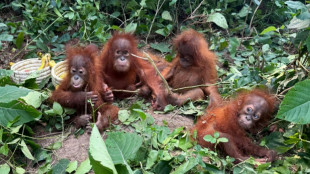
For sale on Facebook: monkeys, rhino horn and dead pangolins / Photo: STR - AFP

 IOC president impressed by 'beautiful' Asian Games wooden huts

 First Asian Games gold goes to Japan as China's 13-year-old Yu lights up pool

 Data centre command hub keeps AI up and running

 Pope Leo in France: the issues on the table

 Packing for a pope: behind the scenes on foreign trips

 Republicans find transgender issues a powerful political weapon in midterm campaigning

 German state elections threaten new shock waves for Merz

 Chile's Bachelet quits race to be next UN chief

 Raphinha treble fires perfect Barca to win at Sevilla

 Thiam makes winning heptathlon return at Decastar meet

 Czechs beat USA to qualify for Davis Cup finals

 Dortmund sink Stuttgart to climb to Bundesliga summit

 Trump says will not tolerate attempts to slow AI growth

 'It has to stop': runners protest women's murders in S.Africa district

 Fire erupts near Riyadh airport as Houthis claim strikes

 Cuba works to restore power after another blackout

 England thrash Sri Lanka again to return to top of T20 rankings

 Arsenal thrashed by Brighton, sorry Spurs lose again

 South Korea, Austria qualify for Davis Cup finals

 Seare shocks Ingebrigtsen to win world 5km gold

 Brigitte Bardot widower slams sale of star's belongings

 Aston Villa compound Tottenham's misery despite late rally

 Asian Games offer 'deepest apologies' for South Korea anthem blunder

 Inter Milan and Italy icon Mazzola dies aged 83

 Saudi capital issues first air raid alert since renewed fighting in Yemen

The ghostly white creature curled up on a weighing scale is almost unrecognisable in the Facebook post offering it for sale. Only closer inspection reveals it to be a dead pangolin.
The animal, one of the world's most endangered and trafficked mammals, has been stripped of its scales and is being advertised by a Thai account selling "seasonal wild delicacies".
The post is one of dozens reviewed by AFP that illustrate what conservationists call rampant illegal wildlife trafficking across social media platforms, particularly those belonging to Facebook parent company Meta.
A report by several NGOs released Monday accuses Meta of hosting the world's "largest single known illegal wildlife trade market" and effectively encouraging the trade by sharing advertising revenues with users and allowing them subscription models.
The report follows recent research by the Global Initiative Against Transnational Organized Crime (GI-TOC), which warned Facebook is now "the central public infrastructure through which online wildlife trafficking is being concentrated, discovered and scaled".
Meta declined to respond to questions from AFP, and pointed to policies that restrict the sale of endangered species on its platforms.
But conservationists say those policies have done little to prevent Meta's platforms being used for the illegal wildlife trade.
The GI-TOC research found over 20,000 adverts for more than 260,000 wildlife products on social media platforms between April 2024 and March 2026.
Nearly three-quarters were on Facebook, and many remained up even after being reported, said Russell Gray, a data scientist and ecologist who co-authored GI-TOC's April report.
"Even the unredacted accounts and groups we reported on publicly in the report are still live and active," he told AFP.
- 'Mindboggling' -
Conservationists and wildlife experts said that was common.
"I have not once received a response or seen any action taken," said Tom Taylor, chief operating officer of Wildlife Friends Foundation Thailand.
"Accounts that are openly breaking the law should be closed, and investigations into the criminal activities behind them should be launched."
Conservationists argue Meta is not only failing to remove content that violates its policies, but may effectively be encouraging it by allowing popular accounts to monetise content through advertising revenue and subscription models.
"This content monetisation that Facebook and Instagram push is actually incentivising people to commit illegal acts," said Daniel Stiles, an independent wildlife trafficking investigator.
"The more interaction and engagement they get on their account, the more money they can make," added Stiles, who co-authored the report released Monday by NGOs including Freeland, Education for Nature Vietnam and International Wildlife Trust.
Meta does not make public which accounts are in its content monetisation programmes.
But those enrolled in its subscription programme are publicly identifiable, and include an account apparently in Laos purporting to show poaching of wildlife including pangolins.
"How Meta can allow that is mindboggling," said Stiles.
- 'Lip service' -
Animals and wildlife products are offered across Meta platforms, including Facebook, Instagram and WhatsApp, research shows.
But other platforms, including TikTok and Snapchat -- popular because of its disappearing post settings -- are also increasingly used by traffickers.
AFP reviewed examples offering everything from chimpanzees intended as pets to rhino horn for traditional medicine and pangolins for consumption.
Some of the content is oblique -- vendors often post images of animals or parts for sale without any price or explanation. Interested commenters are told to message them directly.
But much of the content is clear, including a public Facebook account offering dead pangolins, monitor lizards and other protected wildlife for consumption in Thailand.
The algorithmic nature of social media platforms means that users who engage with wildlife trafficking accounts are offered up more.
After reviewing just a handful of public accounts advertising illegal wildlife trade, an AFP journalist's Facebook feed began routinely displaying posts selling wildlife and endangered animal parts.
Meta was among 11 tech firms that announced this month they would work to eliminate wildlife trafficking on their sites.
But the company has been a member of the Coalition to End Wildlife Trafficking Online since 2018, and the problem has continued to grow, said Steve Galster, founder of Freeland.
He warned the latest announcement risked being "more lip service".
"Until Meta is compelled to rid its platforms of illegal wildlife trade, and prove that it is not profiting from it, the online wildlife trade will only get worse."
H.Gonzales--AT