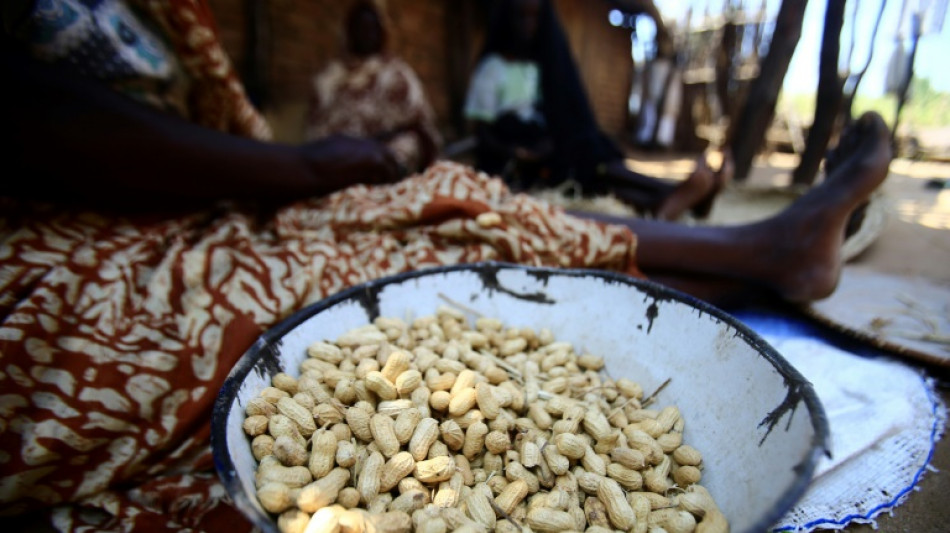
Adding peanuts to young children's diet can help avoid allergy: study

 Hurricane Isaias makes landfall in Florida

 Brazil prosecutors sue Shell for $108 mn over deadly 2024 floods

 Major earthquake destroys buildings, roads in Panama

 Anthropic AI model sent fake murder tip to Philadelphia police

 7.7-magnitude quake rocks Panama, triggers tsunami warning

 Prince Harry booed at English rugby match

 Kiplimo and Feysa seek repeat Chicago Marathon wins

 Fuellkrug halts Dortmund after late goal flurry

 Injured Ravens quarterback Jackson ruled out of Falcons clash

 Brewers aim to take down two-time defending champion Dodgers in NLCS rematch

 Tsunami alert after major earthquake rocks Panama

 Outer bands of Hurricane Isaias lash US Gulf Coast

 Hope, Rutherford fire West Indies to record T20 chase of 250

 Farhan leads Pakistan to T20 win over Sri Lanka

 Turkey sack coach Montella after Nations League woe

 US announces sanctions on ICC, hours after Nobel award to former judge

 Montenegro expels popular Russian war blogger wanted by US

 Rubio calls on all Venezuela opposition figures to join talks with govt

 Australia struggle against South Africa quicks in first Test

 Stocks advance as Trump rules out pre-vote Iran attack

 Australia struggle against South Africa's fast bowlers

 Massive debt puts France in a bind as investor doubts deepen

 Arteta urges 'respect' for process after Man City financial verdict

 'Human-authored' book labels gain ground amid AI scandals

 Man City whistleblower Pinto to stay under police protection

Including peanuts in children's diets early in life could help stave off allergies against the legume, which can be fatal and affect swathes of youngsters globally, according to a new study Friday.
Researchers found that introducing peanut products to babies and infants, and gradually increasing exposure, led to greater tolerance for the common allergen.
The peer-reviewed study, published in The Lancet, involved 146 peanut-allergic children aged between zero and three over two-and-a-half years.
Of the group, 96 were given peanut protein powder every day, with the dose increasing progressively to the equivalent of six peanuts. The other children received a placebo of oat flour.
Twenty of the children who received peanut powder showed allergy remission, meaning no allergic reaction occurred six months after the therapy ended.
One child in the placebo group showed remission.
Six months after the treatment, the children in remission could tolerate a dose equivalent to 16 peanuts.
An additional 20 children who received peanut powder were considered 'desensitised', meaning they had a higher allergic threshold but were not considered in remission.
These children could tolerate a dose equivalent to between six and 12 peanuts six months after the treatment ended.
The youngest children in the study experienced remission the most often, and the best results were in those under 12 months.
"Very early interventions may provide the best opportunity to achieve remission", said co-author Stacie Jones.
- 'Considerable burden' -
Peanut allergies affect two percent of children in Western countries, according to the study, and can last a lifetime.
Affected children must avoid eating peanuts and have self-injectable adrenaline available to fight allergic shocks, which can be fatal if they are accidentally exposed.
Exposure can even occur when a child hugs someone who has just consumed peanuts.
"There are no treatment options, resulting in a considerable burden on allergic children and their caregivers to avoid accidental exposure," said co-author Wesley Burks.
"In severe cases, this can restrict peanut-allergic children's freedoms, particularly when it comes to navigating daycare or schools and public spaces where access to a safe diet is in jeopardy," he added.
Previous studies have produced similar results but the length of the latest studies makes it unique.
Although it provided important results, it may not reflect the behaviour of the children's bodies in real-world conditions.
The study was conducted under close medical supervision, and adrenaline injections were administered on 21 children during the trial.
W.Morales--AT