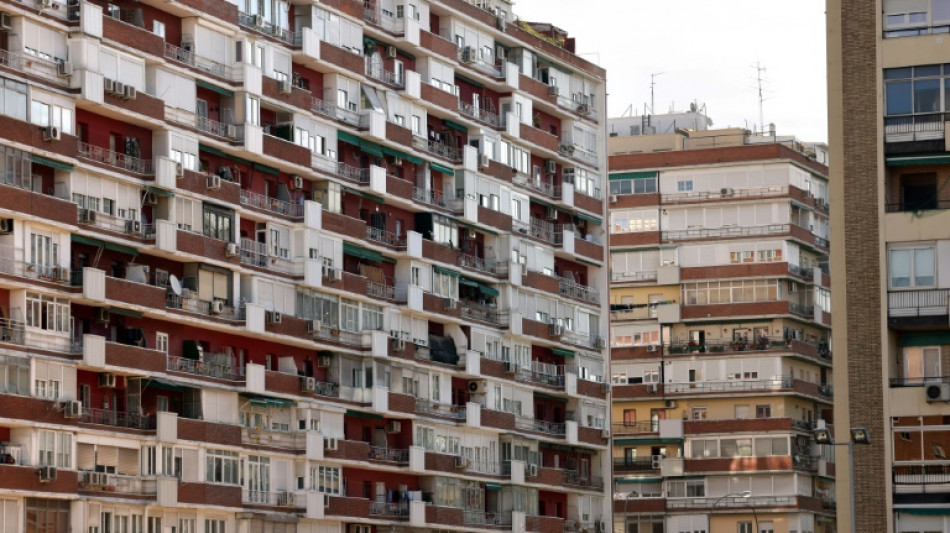
Spain lawmakers pass key housing law ahead of elections / Photo: Thomas COEX - AFP

 Mahomes makes triumphant return as Chiefs rout Broncos 31-10

 Belgium completes outer structure of offshore energy island

 Video documents rescue of injured US airman from Iran

 Asian Games: Bigger than Olympics, young stars and a cruise ship

 Asian Games set for liftoff but will have everyone have a bed?

 Most markets drop as oil extends gains ahead of expected US rate hike

 Kate Beckinsale challenges assumptions about her beauty routine

 Sri Lanka's famed beach shack battles demolition

 Drone shot down by NATO over Lithuania

 Vserv targets ₹1,000 crore revenue by 2030 through AI expansion

 India prohibits bank fees on UPI payments up to ₹2,000

 Air India CEO summoned over alleged departure immigration lapse

 New Zealand agencies missed red flags in child kidnapping case: inquiry

 Brazil's Amazon defender Raoni has cancer

 HFCL expands planned fibre investment to ₹1,800 crore

 Emmy Awards begin as 'Widow's Bay' and 'The Pitt' vie for top prizes

 PRAAMS Launches AI Co-Investor 5.0, Expanding Its Institutional Research, Risk Management, and Portfolio Management Platform

 Himalayan glacier study warns of flood and water-supply risks

 Kuwait schools restore classroom routines after remote learning

 US designer Bob Mackie, known for Hollywood glamour, dies at 87

 BIS flags debt and profitability risks in AI-driven market rally

 Qatar Chamber and Maltese envoy consider business forum

 Spanish PM denies being blackmailed by Morocco

 Doha Islamic finance forum names AlRayan firms as co-lead partners

 Leeds thrash Newcastle to go third in the Premier League

Spanish lawmakers on Thursday approved a housing bill aimed at capping soaring rents and addressing dire social housing shortages as the government seeks to bolster the right to affordable homes.
The proposal, which passed with 176 votes in favour to 167 against and one abstention in the 350-seat chamber, seeks to cap rent hikes, increase help in high-demand areas, boost protection for those facing eviction and sanction landlords for leaving properties empty.
It will now go before the Senate before returning to Congress for a final vote, likely in mid-May.
Flagged by Prime Minister Pedro Sanchez as the "first-ever housing law" since Spain's return to democracy in 1975, the bill is part of a reform promised to Brussels in exchange for EU recovery funds.
"With this housing law... and the push we're giving to social housing in the coming years, we're going change the paradigm so what is today a luxury will become a basic resource for young people," Sanchez said outside parliament.
Spain's left-wing government wants to fast-track the bill into law before regional and local polls on May 28.
The government says the legislation aims to meet the needs of those struggling to afford housing while limiting property speculation.
"Spain has a huge, very serious problem with housing," Sanchez said last week, saying average rents had risen 45 percent between 2014 and 2021, making housing "unobtainable for many people, especially youngsters".
Soaring rents have sparked bitter debate in a country traumatised by the collapse of its housing sector following the 2008 financial crisis, when thousands of families were evicted after being unable to pay their mortgages.
Ahead of Thursday's vote, Sanchez unveiled plans to add 113,000 homes to Spain's depleted social housing stock.
But the move was rubbished by the right-wing opposition Popular Party (PP) claiming it failed to address long-term housing problems.
"A fantastic opportunity for squatters," the PP said, denouncing the bill as making the eviction process "harder and slower", claiming squatting had "risen by 50 percent in recent years".
- Rental caps risks -
Under the proposal, rental rises will be decoupled from the consumer price index and permanently capped at 3 percent in 2024, with a new index due to be set by 2025.
It will allow regional authorities to designate as "stressed areas" neighbourhoods where particularly high prices are driving out tenants and cap rental prices.
The text also penalises landlords for leaving homes empty if they own more than 10 properties -- or five in stressed areas.
It also obliges them to inform those facing eviction of the exact date and time they must leave and lengthens the grace period for vulnerable tenants.
But Spain's Exceltur tourism association warned that capping rents in high-demand areas could backfire.
"It could end up further aggravating the problem, giving a strong incentive to transfer properties from the residential market to the tourist rentals where there are no ceilings," it said.
Although the government has made affordable housing one of its priorities, Sanchez admitted more was needed to address the crisis in a country with one of the smallest percentages of social housing in the EU.
"We know this law is not enough, which is why we need to increase the supply of public housing from the shameful three percent of total housing stock to the 20 percent of the most advanced countries," he said.
Experts agree more social housing is urgently needed.
R.Chavez--AT