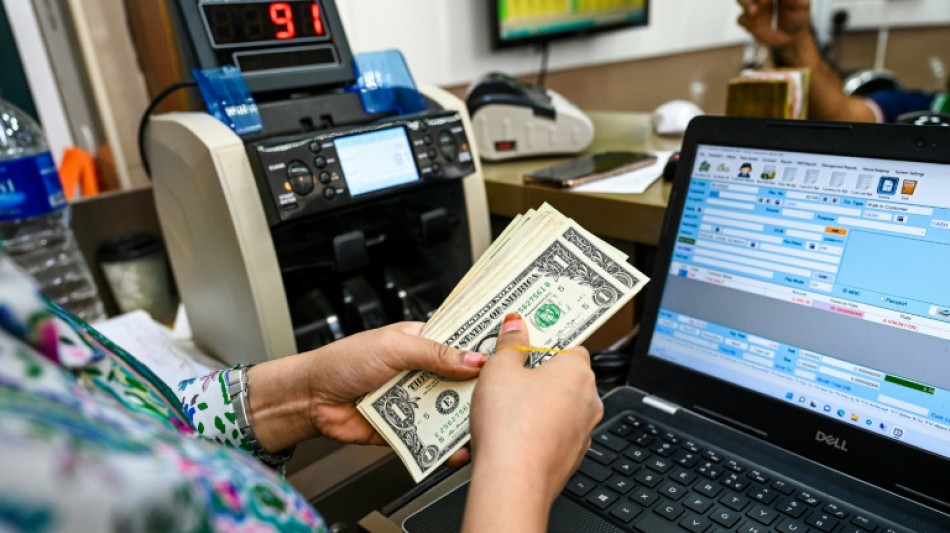
Dominant US dollar faces challenge from emerging currencies / Photo: Roslan RAHMAN - AFP

 Hong Kong unveils plan to align economy with China's goals
 Brazilian voters the latest to eye Bukele security model with envy

 EU chief hosts Canada's Carney in push to 'deepen' alliance

 EU chief to unveil social media, gaming curbs for under-15s
 Saudi says Houthis target Mecca, warn of 'red line'

 Asian stocks stutter as traders prepare for Fed decision

 US touts its power, avoids Iran war at G20 Energy meeting

 Dead animals, barren fields, and hunger - El Nino chokes Central America
 In hydropowered Bhutan, solar starts to rise

 InterContinental Hotels Group PLC Announces Transaction in Own Shares - September 16

 Tocvan Expands Near-Surface Gold at El Mezquite: 47.7 m of 0.8 g/t Au Including 2.8 m of 8.4 g/t Au and 54 g/t Ag

 Physical Gold IRA Investing Guide Released by Experts (2026 Update)

 Capitals say hockey star Ovechkin 'was asked' to film Putin ad

 Spurs in 'tough moment' after League Cup exit as De Zerbi says sorry

 Arteta salutes 'unbelievable' Dowman after Arsenal's teen star sinks Ipswich

 Empty seats as schools reopen in Venezuela's quake-hit Guaira

 Messi set for Argentina farewell in Benin friendly

 Ton-up Brook leads from the front as England hammer Sri Lanka in 1st T20

 AI giants pursue self-regulation as safety fears mount

 Argentina begin life after Messi with Bolivia friendly

 Helen Mirren delves into Patricia Highsmith's mind in 'A Talent for Murder'

 Sanders, Bannon warn of AI dangers in rare US left-right alignment

 US Senate crypto bill collapses amid partisan deadlock
 Raptors confirm Leonard return after Clippers salary cap scandal

 Empty benches as schools reopen in Venezuela's quake-hit Guaira
As the top global currency, the US dollar has enjoyed decades as the cash of choice for investors -- but it is now facing a growing challenge to that status.
The greenback has been used for almost everything in terms of international trade and global finance, from ordering planes, buying oil, or issuing debt.
But a number of developing economies, particularly China, have been leading a drive against over-reliance on the US currency.
"In many developing countries there is desire to be less dependent on the dollar, particularly on the trade side," said Paola Subacchi, professor of International Economics at the Global Policy Institute at Queen Mary University of London.
On a visit to China in April, Brazilian President Luiz Inacio Lula da Silva asked why "all countries are forced to trade based on the dollar", before signing an agreement with Beijing to provide commercial contracts denominated in yuan and reals.
And Bangladesh announced recently it paid Russia for a nuclear power plant in Chinese yuan, as well as using its own currency for a delivery of liquefied natural gas from France's TotalEnergies.
- Sanctions -
The widely-used dollar gives the United States a big competitive advantage.
Emerging and developing countries are dependent on the movements of the US currency, which influences the price of their imports and their exports.
US-set interest rates also influence the cost of dollar-denominated debt.
But the dollar's dominance has come under the spotlight since the war in Ukraine, which saw Washington and western countries impose sweeping sanctions on Moscow after it invaded Ukraine last year.
"The US uses its dollar hegemony to sanction Russia," said Larry Yang, chief economist at Shenzhen-based First Seafront Fund Management.
"Other countries feel concerned that they might be sanctioned by the US as well, and hence they have decided to opt for more currencies for payment and settlement," he added.
"This change is good for the stability of international trade and it is definitely a long term trend."
China, the world's second-largest economy and Washington's great political rival, has been internationalising its currency for several years.
But its currency is still largely restricted and regulated by the Chinese authorities.
Yang said the internationalisation of the Chinese yuan, also known as RMB, will mean more countries choose the currency for international deals in the future.
"With China's trade volume on a long term rapid ascending trajectory ... the level of RMB internationalisation will increase and there will be more trading partners opt for RMB payment and settlement," he told AFP.
- Politics vs economics -
But others warn any significant move away from the dollar would require a number of key factors to be in place, including a transparent government framework, independent central bank, and investor security.
"Clearly, we're entering a very delicate moment for the world economy, with lots of geopolitical tension and the world splitting into two large poles," said Alessandra Ribeiro, an economist at the Tendencias Consultoria consultancy in Sao Paulo.
But she said proposals against the dollar are often "more political than economic".
Ribeiro also noted that China doesn't have a full market economy.
"Depending on the government's interests, it could artificially devalue the yuan. And if I'm getting paid in yuan, that creates problems for me."
Political or not, the level of foreign exchange reserves held in dollars in central banks has been gradually decreasing.
Reserves of the greenback fell from 71 percent of the total in 1999 to 59 percent in 2021, according to a report from the International Monetary Fund last year.
This was partly down to an increase to 10 percent of reserves in "smaller" currencies, outside of the euro, the yen or the pound.
But the dollar was still the currency used in 42 percent of international trade in April, followed by 33 percent which used the euro, according to international payment system Swift.
The Chinese yuan was used in just two percent of transactions, showing that there is still a long way to go for it to rival the dollar.
"Can we move toward an alternative currency? Yes," said Ribeiro.
"But the entire structure the United States offers in terms of security and institutionality would have to be offered somewhere else."
M.O.Allen--AT