Plastic pollution is scourge of English coastal region / Photo: Ben Stansall - AFP

 British PM says to make 'difficult decisions' as inflation rises

 TotalEnergies pumps up controversy in France with cut-price gas
 Global fuel price demos: a round-up

 Leverate Launches MCP for Traders to Connect AI Assistants With Trading Platforms

 MEXC Launches $1M "Discover Your Wall Street DNA" Campaign to Help Traders Find Their Market Fit
 Emporio Armani names Dario Vitale new creative director
 Maresca defends VAR officials after Man City benefit from error

 Courts jails LGBTQ activists as Turkey crackdown widens
 French court to hear Depardieu's appeal against rape trial order: sources

 The German state premier hoping to halt far-right surge
 Lebanon wants Israel security deal as prelude to peace: president to AFP

 England's Brook keen to learn from 'hero' Pietersen after stunning ton
 Saudi says Houthis target Mecca, warns of 'red line'

 Phillippines ex-leader Duterte makes first appearance at ICC
 Lebanon wants Israel security deal, Hezbollah disarmament without confrontation: president to AFP
 BASIS.pro Expands On-Chain Infrastructure with XDC Network Partnership and Zypher DAO as Auto Earn Goes Live

 Samson relishing battle with teen star Sooryavanshi for India spot
 Pickle-flavoured tart? AI inspires Japan's convenience stores
 Macau holds first closed-door national security trial
 Bank of Japan set to raise rates under pressure from inflation, US

 Zverev, Shelton back on court for Davis Cup qualifiers
 Peace is a 'dangerous' word in Russian city heading to polls

 Meta chief pushes back on AI slowdown calls

 'Resident Evil' film brings video game's ethos to the big screen
 Court orders N. Korea pay Seoul $32.5 mn for blowing up office
On an early spring afternoon, Tregantle Beach is bathed in a dazzling light reminiscent of a painting by British landscape artist JMW Turner as sea, sky and sun merge.
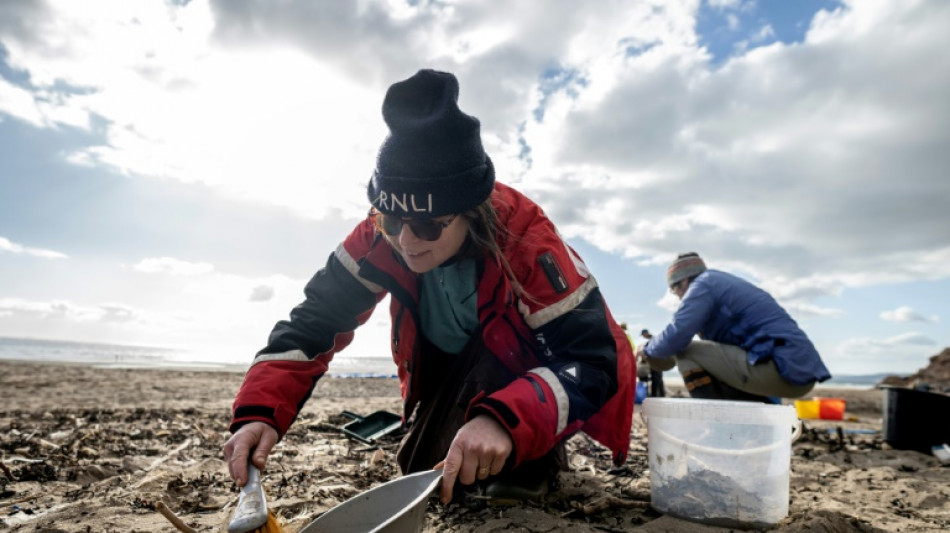
"It's beautiful, right? But look at your feet," says Rob Arnold, 65, an environmental activist and artist, crouching down to pick tiny plastic balls, or "nurdles", sometimes nicknamed "mermaids' tears", out of the Cornwall sand.
The size of a lentil, the tiny bits of plastic are used by industry to manufacture plastic products.
But when spilt at industrial facilities, they can be swept into drains and then out into the sea.
Some 11.5 trillion nurdles end up in the ocean each year, according to UK charity Fauna & Flora International.
Once released into the natural environment, the nurdles circulate on ocean currents and often wash up on beaches and other shores.
Due to their resemblance to fish eggs, birds and other sea life will eat the tiny pellets -- which also absorb toxic pollutants -- adversely affecting the entire food chain, Arnold says.
He is among about 10 people taking part in a clean-up on the beach in England's southwestern Cornwall region, using a device he invented made from a plastic basin, a large grid and a set of tubes.
"It separates plastic waste from natural waste and sand thanks to a filtering and water floating system," the former engineer says.
He then uses the collected nurdles and other microplastics -- tiny bits of plastic that have broken off larger pieces -- in artworks.
- Unearthing 'layers of plastic' -
Jed Louis, 58, wearing a khaki hoodie bearing the name of the local beach clean-up association, says several factors add to the beach's vulnerability.
"This beach is particularly polluted because of its geographical location, the sea currents that affect it and its very open shape," he says.
"In autumn and winter we find the most microplastics because of the weather: storms, thunderstorms and winds, it brings them to the surface.
"Unfortunately the plastic remains, it does not disappear," he says.
Another volunteer Claire Wallerstein, 53, says "sometimes it's a bit like doing archaeology.
"If you dig in the sand, you'll find different layers of plastic."
Some of the nurdles go to Arnold for his artistic creations while others are used to raise awareness in schools.
The rest, which cannot be recycled, end up in the rubbish and are incinerated.
After three hours, the volunteers have cleaned just a few square metres of the beach.
Arnold looks at his loot -- a large tarp several metres (feet) high filled with nurdles and other microplastics.
Once dried and re-sorted, he can add them to the 20 million nurdles he has collected in six years and which he stores in a friend's garage.
- Like a meteorite -
Arnold's most notable work using the nurdles is a 1.7-metre (5.5-foot) high sculpture, similar to the Moai statues of Easter Island with a mysterious past.
The work is on display at the National Maritime Museum Cornwall in the coastal town of Falmouth under the title "A Lesson from History".
"It's a metaphor to what we are doing here to our planet earth. We are polluting our planet, using its resources. If we destroy it, we have nowhere to go, this is our only home," Arnold says.
For his next creation, he wants to mould the tiny plastic pellets into a meteorite headed towards Earth, in a nod to the one that caused the extinction of the dinosaurs and the fragility of our planet.
After cleaning up the beach and packing his nurdle-filled bags away, Arnold looks disillusioned.
"Sometimes I think about throwing all my bags of nurdles into the river from a bridge. It would be so shocking that maybe, finally, people would realise," he adds.
A.Taylor--AT