In Spain, brotherhood set up by slaves marches at Easter
/ Photo: CRISTINA QUICLER - AFP

 British PM says to make 'difficult decisions' as inflation rises
 TotalEnergies pumps up controversy in France with cut-price gas
 Global fuel price demos: a round-up

 Leverate Launches MCP for Traders to Connect AI Assistants With Trading Platforms

 MEXC Launches $1M "Discover Your Wall Street DNA" Campaign to Help Traders Find Their Market Fit

 Emporio Armani names Dario Vitale new creative director
 Maresca defends VAR officials after Man City benefit from error

 Courts jails LGBTQ activists as Turkey crackdown widens

 French court to hear Depardieu's appeal against rape trial order: sources
 The German state premier hoping to halt far-right surge
 Lebanon wants Israel security deal as prelude to peace: president to AFP
 England's Brook keen to learn from 'hero' Pietersen after stunning ton

 Saudi says Houthis target Mecca, warns of 'red line'
 Phillippines ex-leader Duterte makes first appearance at ICC

 Lebanon wants Israel security deal, Hezbollah disarmament without confrontation: president to AFP
 BASIS.pro Expands On-Chain Infrastructure with XDC Network Partnership and Zypher DAO as Auto Earn Goes Live
 Samson relishing battle with teen star Sooryavanshi for India spot
 Pickle-flavoured tart? AI inspires Japan's convenience stores
 Macau holds first closed-door national security trial

 Bank of Japan set to raise rates under pressure from inflation, US
 Zverev, Shelton back on court for Davis Cup qualifiers

 Peace is a 'dangerous' word in Russian city heading to polls

 Meta chief pushes back on AI slowdown calls
 'Resident Evil' film brings video game's ethos to the big screen
 Court orders N. Korea pay Seoul $32.5 mn for blowing up office

For centuries, African slaves and emancipated men marched in Seville's Easter parades, carrying statues of Christ and the Virgin on their shoulders as part of a unique brotherhood that remains active today.
Founded more than 600 years ago, the Black Brotherhood is the oldest religious brotherhood still active in this southern city, which is widely seen as the centre of Holy Week celebrations in Spain.
Officially known as the "Most Holy Christ of the Foundation and Our Lady of Angels", the brotherhood has for centuries been known as "La Hermandad de los Negritos", a name its members chose themselves.
It is one of 70 brotherhoods and voluntary associations involved in staging multiple Easter week processions when Christians remember the death and resurrection of Jesus.
What's unique about this brotherhood is that it emerged in the late 14th century, made up of Africans -- both slaves and freedmen -- who were barred from similar organisations, says Isidoro Moreno, a retired anthropologist from Seville University.
The example was later "exported" to the Americas where "dozens of black brotherhoods (were set up) in the 16th century," says Moreno, author of a book called "The ancient brotherhood of the black people of Seville".
It was only at the end of the 19th century that the Brotherhood began admitting white people.
- Black and African saints -
Inside the Chapel of Our Lady of Angels, which was built in 1550 on a plot of land owned by the Brotherhood, there are icons of black saints such as Benedict the Moor from Sicily and Martin de Porres of Peru.
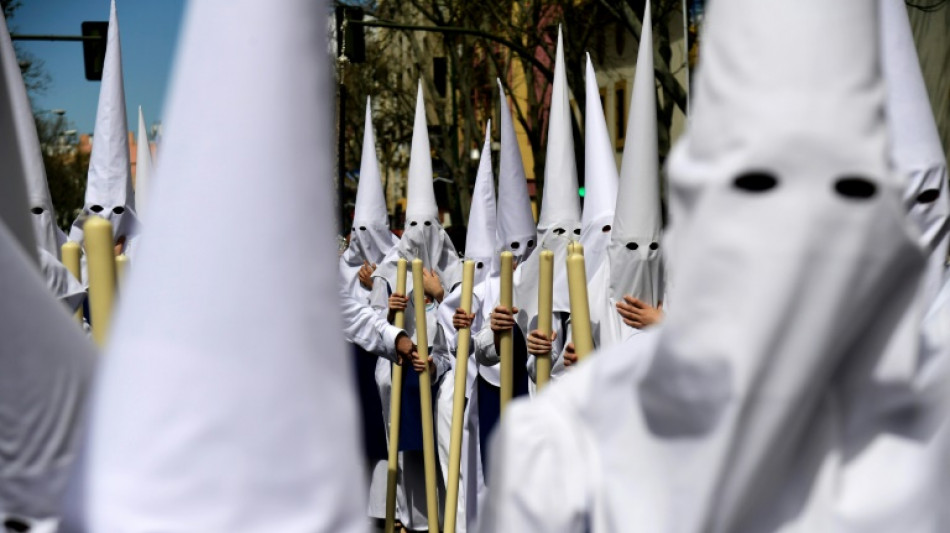
It was from here that the brothers and Nazarene "penitents" with their long robes and distinctive pointed hoods set out on Maundy Thursday for their annual procession to Seville Cathedral.
The pointed 'capirote' hoods originated in the 15th century when they were put over the heads of those condemned by the Inquisition.
They were later adopted by southern Spain's Catholic brotherhoods for use at Easter as a symbol of penitence, with white symbolising purity.
Shouldering heavy floats depicting scenes from the Passion but also adorned with the faces of Ethiopian saints Elesban and Ephigenia, the Brotherhood's "costaleros" slowly made their way through the streets.
Among them is Raul de Lemos, a 19-year-old student and one of the few black members of the Brotherhood.
Being in the Brotherhood "is a good thing, a way of remembering the past," the bearded teen told AFP during rehearsals ahead of Holy Week.
- Slavery -
The Brotherhood emerged out of a refuge set up in the 1390s by Seville's archbishop Gonzalo de Mena for African slaves who were abandoned by their owners through advanced age or illness.
Slaves were allowed to join, "with their owners' permission", along with others who managed to buy their freedom or won it after their owners' died, Moreno said.
Following Europe's discovery of the Americas, there was rising demand for cheap labour which saw a growing number of Africans shipped into the Iberian Peninsula.
So great was the influx that Seville became one of Spain's biggest slavery centres, with Africans accounting for 12 percent of the city's population in the 16th and 17th centuries.
With most of the Brotherhood's members from the poorest sectors of society, they were subject to "much stricter" supervision by the Catholic Church with white ruling classes fearful of an uprising, Moreno says.
- Saved by a papal edit -
In 1604, a Maundy Thursday standoff saw its members come to blows with a brotherhood of nobles, leaving several people injured, Moreno says.
Several members were whipped, and the Brotherhood was forbidden to participate in the rest of the Holy Week processions.
The Brotherhood might have disappeared altogether without being saved by a papal edict in 1625, ratifying its existence and protecting it.
By the mid-18th century, it formally adopted "the Black Brotherhood" as its name, as it had long been known colloquially, Moreno says.
In the 19th century, when Seville's black population dwindled, the Brotherhood began admitting white people, little-by-little becoming a local institution for residents.
"What the Brotherhood is most proud of... is that we are the successors of those black people who fought so hard" to preserve the organisation over time, said Alfredo Montilla, one of its leaders.
H.Gonzales--AT