Britain's fresh produce shortages serve up blame game / Photo: Daniel LEAL - AFP

 AI looms large ahead of Xi, Trump summit

 Smith still haunted by 'Sandpapergate' as he prepares for South Africa Tests

 UK-Sudanese author pens book to give children 'African history of Africa'

 Boehly and Walter sell Chelsea stake to Clearlake Capital

 US House backs data center power cost bill amid midterm backlash

 US Congress passes sweeping Russia sanctions bill

 Barca hit Racing for seven as Atletico crush Osasuna

 US Fed raises rates to tackle 'too high' inflation, irking Trump

 Man Utd misery mounts after League Cup collapse against Brighton

 Turkey releases 106 protesters, jails more LGBTQ activists

 US Fed raises rates to tackle 'too high' inflation in move sure to rile Trump

 England were 'waiting for death' in World Cup semi-final defeat: Tuchel

 NFL star fined for displaying name of slain Palestinian girl
 Witsel retires from internationals after 18-year Belgium career

 US Fed raises rates to battle inflation in move likely to rile Trump

 Fitzpatrick 'not comfortable' over Dubai golf finale

 Gaza apartment block collapse kills 21, including 12 children

 Gaza apartment block collapse leaves 21 dead

 US House targets data centers as midterm backlash grows

 French ex-minister Dati goes on trial in Renault-Nissan corruption case

 'Being Heumann' captures joy in fight for disability rights

 Retired great Nadal to play in exhibition matches

 IR-MED and Dice Technologies Announce collaboration to Evaluate and Advance Pressure-Injury Prevention Platform in Japan

 Watts, Pitt, Cruz to light up Spain's top film festival
 Sweden expels Iran embassy employee over anti-Jewish threats
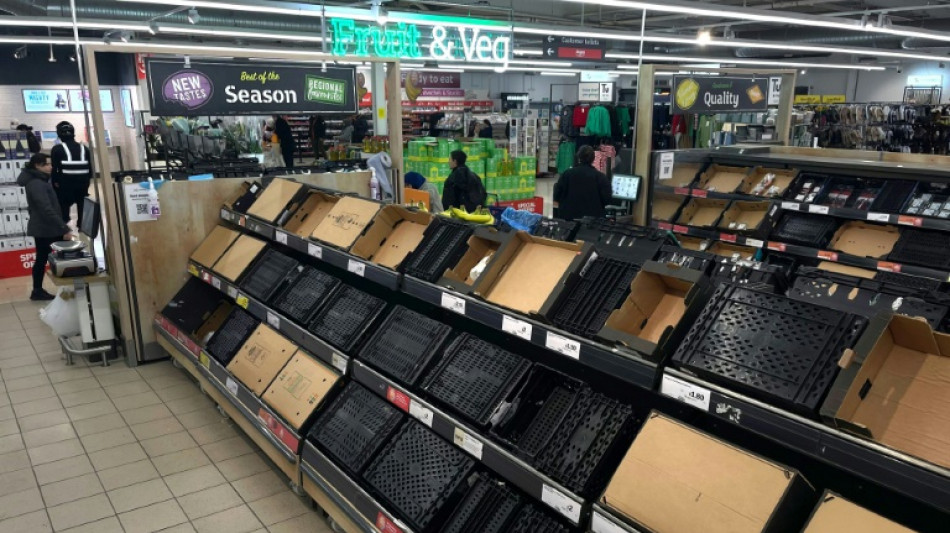
Shortages of fruit and vegetables -- from broccoli, cucumbers and lettuce, to tomatoes, peppers and raspberries -- have served up a blame game in Britain.
Are sparse shop shelves due to Brexit, bad weather in Spain, supermarket price wars, soaring energy bills on Ukraine war fallout, or the UK government?
Faced with low stock, an increasing number of retailers are rationing, with some allowing no more than three purchases per customer for certain items.
The weekly shop for millions of Britons has also been blighted for months by a lack of eggs because of bird flu.
The government insists bad weather hit harvests in southern Europe and northern Africa, while authorities and supermarket chains warn that shortages of fresh produce will continue for weeks.
- Turnips row -
London dismisses claims that Brexit is to blame, insisting it can gain control of agricultural policy after its departure from the European Union at the start of 2021.
Spain's Agriculture Minister Luis Planas also told the Financial Times that Brexit was not the cause of shortages, while conceding that rising costs had forced some smaller producers to curb exports.
Mark Spencer, Britain's junior minister with responsibility for food, has urged supermarket bosses to explain what they are doing to replenish shelves.
Environment Minister Therese Coffey, called on Britons to eat more local seasonal produce such as turnips rather than imported foodstuffs in short supply.
That triggered a row over the suggestion that Britons -- already facing a cost-of-living crisis sparked by rampant inflation -- embrace turnips, generally considered a boring root vegetable.
Experts meanwhile believe the problem runs deeper than merely bad growing conditions in key fruit and vegetable producers Spain and Morocco.
- 'Broken' food system -
"No one is really admitting that our current food system is completely broken," chef Thomasina Miers told BBC television.
"The way we farm is incredibly oil intensive and it contributes to 30 percent of global greenhouse gas emissions," she added.
"So, the way we farm not only contributes to (global) warming but also it's degrading our soils."
Miers called on producers to use modern technology to help improve both output and biodiversity.
Minette Batters, president of the National Farmers Union (NFU) in Britain, heaped praise on the UK system that produces cheap food but warned it faced huge cost inflation -- particularly for vital elements such as animal feed, energy and fertilisers.
Record-breaking temperatures last summer also weighed heavily on UK farming production, driving up prices in the long term.
UK food-price inflation soared above 17 percent last month, according to a survey from data provider Kantar.
Batters has called on the government to implement a strategy to help UK farmers boost production, protect the environment and manage volatility.
"We need a radical restructure of what these relationships look like from farm to fork," Batters said.
- 'Along came Brexit' -
The Guardian newspaper's influential food critic Jay Rayner has also condemned the UK government's stance.
"It isn't just a blip," he said of the current crisis. "It's a symptom of a dysfunctional food system."
He blamed supermarket giants for having squeezed costs as they slash prices to compete for customers.
"For decades the supermarket sector had been given a free run at our food supply chain by governments of both stripes," Rayner wrote in a comment piece.
"Our self-sufficiency... withered."
The farming of much fresh produce had become "economically unviable" due to soaring energy costs and Brexit fallout -- including extra red tape and labour shortages, he argued.
Britons, he said, would have to accept paying more for their food.
P.A.Mendoza--AT