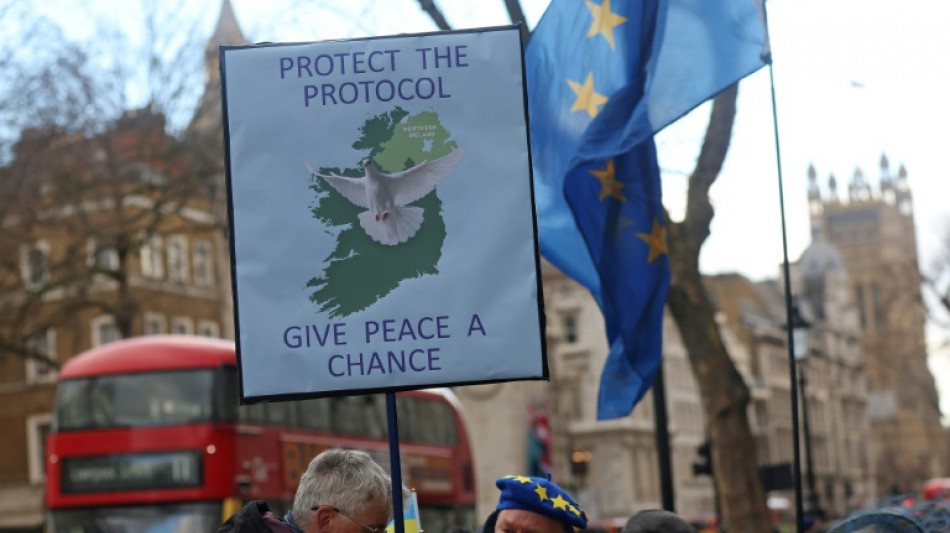
Northern Ireland Protocol: why the changes? / Photo: ISABEL INFANTES - AFP

 Where the US-China tariff row stands ahead of White House summit
 Croc-habitat gets green light for 2032 Olympic rowing
 Indonesia cash-for-photos scheme turns animal hunters into protectors
 'Left-field' life: Briton becomes Thailand's top foreign monk
 India's transgender amendment leaves many in limbo
 Trump to host Xi amid pomp, low expectations
 Harry set for UK public outings with security, royal status hazy
 NFL Chiefs' Kelce among investors bilked in Ponzi scheme
 Trump threatens EU over 'hostile' Canada association plan
 Argentine judge orders suspension of Falklands oil project
 Carrick takes the blame as troubled Man Utd suffer League Cup misery
 Barcelona hit seven in Racing Santander rout
 Amorim's Milan beaten by Benfica, Sunderland make dream European return
 US stocks fall, dollar gains after Fed lifts interest rates
 Seahawks rule out Darnold for Sunday game at Arizona
 Mbappe explains Ceuta shirt stance after criticism
 Improving Atletico cruise to comfortable win over Osasuna
 Candidate for UN chief calls for AI regulation akin to nuclear weapons
 O'Neill expects Celtic recovery after Old Firm misery
 Man City midfield trio backed to emulate Rodri and Silva
 'We're losing control,' AI pioneer Yoshua Bengio tells AFP
 WHO eyes 'encouraging' signs in DRCongo fight against Ebola
 Liga boss criticises Real Madrid trio for Ceuta shirt incident
 WTA Finals moved to Charlotte from 2027

 Almost 8,000 excess deaths in France's scorched summer: statistics

Britain and the EU struck a deal Monday to re-fashion a post-Brexit trade agreement with Northern Ireland that has become a significant political problem.
The original "Northern Ireland Protocol" was crafted so as to not have physical border checks between the province, which is part of the United Kingdom, and neighbouring Ireland, which remains in the European Union.
The border is a delicate issue that was part of a 1998 peace deal to end decades of armed conflict in Northern Ireland.
However, the trade deal reached in 2020 ultimately led to political troubles in Northern Ireland and threats from London to unilaterally overhaul it.
Here are some of the key issues on the protocol:
- Why no checks? -
The UK and EU agreed that despite Brexit, a vital plank of the Good Friday Agreement had to be preserved -- the elimination of physical border infrastructure on the island of Ireland.
But checks had to happen somewhere -- so the UK agreed a de facto trade border in the Irish Sea to ensure goods coming from England, Scotland and Wales did not enter the EU free market unchecked via Northern Ireland.
That infuriated unionists, fearing a weakening of their ties to the rest of Britain, and led to certain foods being unavailable in the province.
- What's in the protocol? -
To keep the border open, Northern Ireland effectively remained in the EU's single market for goods.
That meant it had to stay in line with certain EU rules on tax and product standards, unlike the rest of the UK.
Supporters have said that gives Northern Ireland the best of both worlds, with access also to the UK's single market.
But the UK accused Brussels of applying the protocol too zealously and said the deal should be renegotiated.
- What have the EU and UK agreed? -
Relations between London and Brussels have improved drastically in recent months with the UK government putting on ice legislation to drastically overhaul the protocol unilaterally.
The new agreement will create "green lanes" for goods destined for Northern Ireland, and "red lanes" for goods at risk of moving on to the EU via Ireland.
Goods, including food and parcels sent to households, can travel through the green lane "without red tape or unnecessary checks", said the UK government.
"This means if food is available on supermarket shelves in Great Britain, then it will be available on supermarket shelves in Northern Ireland," said British Prime Minister Rishi Sunak.
"We have removed any sense of a border in the Irish Sea," he added.
Paving the way for such a scheme, London agreed in January to share UK data with Brussels on the flow of goods.
Sunak also announced a new settlement on medicines, so any drugs approved for use by the UK regulator will automatically be available in Northern Ireland.
- Will power-sharing resume?
Sunak faces a tough sell in getting unionists to agree to the deal and reform the executive, with DUP leader Jeffrey Donaldson warning there were still "key issues of concern".
Sunak announced that the new agreement would provide an "emergency brake" that, if agreed by both sides of the power-sharing executive, would give London a veto over the application of new laws in Northern Ireland.
But Donaldson highlighted the continuing role, under the new deal, of the EU's European Court of Justice (ECJ) in policing any trade disputes involving Northern Ireland.
European Commission president Ursula von der Leyen confirmed that the ECJ will still have the "final say on EU law and single market issues" under the new deal, branded the Windsor Framework.
Sunak promised a UK parliamentary vote in due course on the new deal, with Brexit hardliners in his Conservative party threatening a revolt over the ECJ's role.
- What about the US? -
The United States has been watching closely. It helped broker the Good Friday Agreement and is one of its guarantors.
The administration of Irish-American President Joe Biden had warned that London could forget about a post-Brexit trade deal with the US if its actions in Northern Ireland threatened the still-fragile peace.
Y.Baker--AT