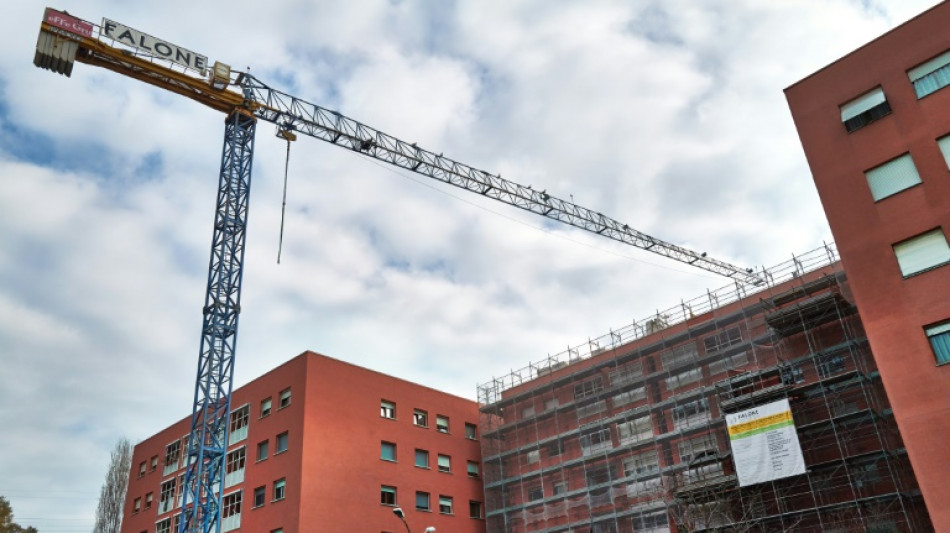
How Italy's generous green homes scheme turned 'wicked' / Photo: Andreas SOLARO - AFP

 Where the US-China tariff row stands ahead of White House summit
 Croc-habitat gets green light for 2032 Olympic rowing

 Indonesia cash-for-photos scheme turns animal hunters into protectors
 'Left-field' life: Briton becomes Thailand's top foreign monk

 India's transgender amendment leaves many in limbo

 Trump to host Xi amid pomp, low expectations
 Harry set for UK public outings with security, royal status hazy

 NFL Chiefs' Kelce among investors bilked in Ponzi scheme
 Trump threatens EU over 'hostile' Canada association plan
 Argentine judge orders suspension of Falklands oil project
 Carrick takes the blame as troubled Man Utd suffer League Cup misery

 Barcelona hit seven in Racing Santander rout
 Amorim's Milan beaten by Benfica, Sunderland make dream European return

 US stocks fall, dollar gains after Fed lifts interest rates

 Seahawks rule out Darnold for Sunday game at Arizona
 Mbappe explains Ceuta shirt stance after criticism

 Improving Atletico cruise to comfortable win over Osasuna

 Candidate for UN chief calls for AI regulation akin to nuclear weapons

 O'Neill expects Celtic recovery after Old Firm misery
 Man City midfield trio backed to emulate Rodri and Silva

 'We're losing control,' AI pioneer Yoshua Bengio tells AFP

 WHO eyes 'encouraging' signs in DRCongo fight against Ebola

 Liga boss criticises Real Madrid trio for Ceuta shirt incident
 WTA Finals moved to Charlotte from 2027

 Almost 8,000 excess deaths in France's scorched summer: statistics

An Italian scheme to make homes more energy efficient has been wildly popular, but the government is seeking to rein in its "out of control" costs amid fears it could send the deficit soaring.
The "superbonus" scheme, which can be used for anything from insulation to solar panels, new boilers and windows, was introduced in May 2020 to boost the economy after the coronavirus lockdown.
Environmentalists were sceptical about its benefits but Italians rushed to take advantage of the programme, in which the state paid 110 percent of the cost of making homes greener, with the subsidy delivered via a tax credit or tax reduction.
As intended, it boosted the construction sector -- but it has so far cost the state 61.2 billion euros ($64.8 billion), according to the finance ministry.
Prime Minister Giorgia Meloni, whose coalition government took office in October, said last weekend the situation was "out of control".
She said the scheme had led to fraud worth nine billion euros, while the tradeable nature of the tax credits had "generated a sort of parallel currency, and that parallel currency risks having a devastating impact on the budget".
Finance Minister Giancarlo Giorgetti went further, describing it as a "wicked policy".
Lorenzo Codogno, a former chief economist at the Treasury, told AFP that attempts now to quantify the impact of the scheme on Italy's strained public finances could be "a wake-up moment for financial markets".
He warned Italy's deficit could be revised up substantially, while both the construction sector and the government "could have liquidity problems".
Italy's deficit was an estimated 5.6 percent of GDP last year and set to fall to 4.5 percent in 2023, but revised figures potentially incorporating the superbonus scheme are due out on March 1.
- Construction boom -
The superbonus scheme was introduced by former premier Giuseppe Conte, whose populist, environmentalist Five Star Movement led the coalition government at the time.
It allowed homeowners to either deduct the cost of work from their taxes over several years or sell the tax credit to their builder, who would sell it to a bank, which would then claim the money from the state.
Angelica Donati, the president of national constructors' association ANCE, told AFP the bonus had been "fundamental in the aftermath of Covid-19, both for reviving the Italian economy as well as restarting the construction industry".
The construction sector grew by 21.6 percent in 2021, helping fuel Italy's post-pandemic boom.
But the scheme generated much more work than originally forecast and banks stopped buying credits last year, leaving some construction companies in the lurch.
Meloni's government has already sought to restrict the subsidies, reducing the superbonus from 110 percent to 90 percent last year.
Then last week it put a sudden stop to the use of the tax credits as it tries to work out how to unfreeze existing credits for an estimated 19 billion euros' worth of work that has been carried out but not yet paid for.
ANCE said some 25,000 construction companies were at risk of folding.
Superbonus users can now only receive money back from the state via tax breaks -- but that mostly benefits those on higher incomes.
- Wasted opportunity -
The government is looking into possible alternatives to the credit system. Climate campaigners hope it will also change the bonus' scope.
Experts have lamented what they see as a wasted opportunity to engineer a cultural shift towards properly green housing.
In a study last year, the Bank of Italy said the superbonus was "not a cost-effective way" to tackle climate change.
Matteo Leonardi, co-founder of Italian climate change think tank ECCO, said it lacked "ambition".
"It has not been linked to climate targets, which is what would have justified the costs," he told AFP, adding that renovations had only to boost efficiency by two energy classes.
It also did not sufficiently promote innovative but less familiar technologies, such as heat pumps.
But Leonardi said for all its faults, the superbonus had value if radically revised to meet more ambitious targets.
With the tax credits gone, the government is now "just giving a lot of money to high-income families to install gas boilers".
M.King--AT