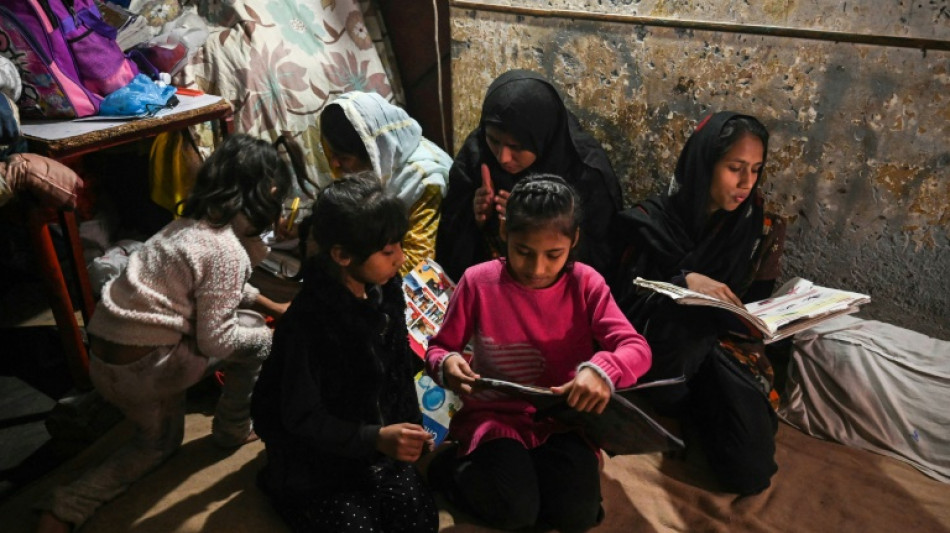
Crumbling Pakistan economy puts children's futures on hold / Photo: Arif ALI - AFP

 Where the US-China tariff row stands ahead of White House summit
 Croc-habitat gets green light for 2032 Olympic rowing
 Indonesia cash-for-photos scheme turns animal hunters into protectors

 'Left-field' life: Briton becomes Thailand's top foreign monk

 India's transgender amendment leaves many in limbo

 Trump to host Xi amid pomp, low expectations
 Harry set for UK public outings with security, royal status hazy

 NFL Chiefs' Kelce among investors bilked in Ponzi scheme

 Trump threatens EU over 'hostile' Canada association plan
 Argentine judge orders suspension of Falklands oil project

 Carrick takes the blame as troubled Man Utd suffer League Cup misery

 Barcelona hit seven in Racing Santander rout
 Amorim's Milan beaten by Benfica, Sunderland make dream European return

 US stocks fall, dollar gains after Fed lifts interest rates

 Seahawks rule out Darnold for Sunday game at Arizona
 Mbappe explains Ceuta shirt stance after criticism

 Improving Atletico cruise to comfortable win over Osasuna

 Candidate for UN chief calls for AI regulation akin to nuclear weapons

 O'Neill expects Celtic recovery after Old Firm misery
 Man City midfield trio backed to emulate Rodri and Silva

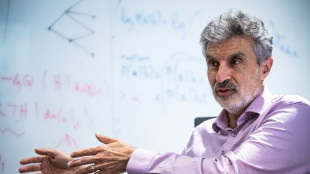 'We're losing control,' AI pioneer Yoshua Bengio tells AFP
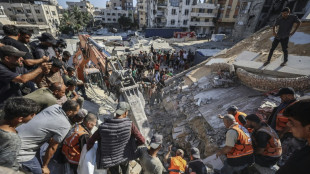
 WHO eyes 'encouraging' signs in DRCongo fight against Ebola
 Liga boss criticises Real Madrid trio for Ceuta shirt incident
 WTA Finals moved to Charlotte from 2027
 Almost 8,000 excess deaths in France's scorched summer: statistics

Sixteen-year-old Nadia makes the one-hour journey to and from her employer's house on foot each day, stopping frequently along the congested streets of Lahore so her mother can rest her weary legs.
The teenager still had seven years of schooling left to complete, but was forced to drop out last year to help boost family finances by joining her mother as a maid.
"She's my daughter, but we had no other choice," says Muhammad Amin, her father, who earns 18,000 rupees a month (around $65) working as a security guard.
"It's up to God what happens next."
The pair walk to work each day to save on transport costs -- a familiar story in Pakistan, where millions of families are feeling the brutal effects of an economy on the brink of collapse.
Pakistan's finances have been wrecked by years of financial mismanagement and political instability -- a situation exacerbated by a global energy crisis and devastating floods that left a third of the country under water last year.
The South Asian country is deeply in debt, and needs to introduce tough tax and utility price increases to unlock another tranche of a $6.5 billion International Monetary Fund bailout and avoid defaulting.
This week the government raised taxes on luxury imports and services -- saying only the rich elite would be affected. However, it also slashed fuel subsidies and increased a general sales tax, both of which will hit low-income families.
"We aren't able to make ends meet when we have to pay for gas, electricity and household expenses, so how can we put Nadia in school?" her mother Miraj explains.
- 'Cannot make ends meet' -
Pakistan consistently ranks near the bottom of global gender parity indexes, and girls are often viewed as a financial burden because of the bride-price parents pay when they are married.
Amin wanted his six daughters to be educated, hoping they would lift the family out of generational poverty.
The household began to struggle in 2015, when Amin was injured in a road accident, forcing him to give up a relatively good wage as a labourer and take up a more sedentary, low-paying job.
He then told his wife she could work for the first time, but even with the extra income the family could not manage in the face of skyrocketing inflation.
"We had to force Nadia to drop out after completing fifth grade," he says, his voice cracking with emotion.
As the eldest, Nadia was often tasked with helping care for her younger siblings, which left her unable to keep up with homework and she was ordered to repeat school years, a not uncommon situation in Pakistan.
The nominal school fees for the other five daughters are paid for by Miraj's employer, but with finances precarious there is a risk that Nadia's 13-year-old sister could be next to leave school.
Clearing up after making dinner for the family, Nadia collapses from exhaustion on the floor of a humble two-roomed rented home, as her sisters go about their homework.
"We cannot make ends meet. That's why I give whatever salary I get to my mother," Nadia says, adding that by shouldering some of the burden for her parents she may help her sisters have a brighter future.
Pakistan's president on Wednesday said half of the country's children aged between five and 16 were at risk of entering the workforce or of begging.
- Entrenched wealth inequality -
More than a fifth of Pakistan's 220 million people live below the national poverty line, according to the Asian Development Bank and IMF, and with inflation running at nearly 30 percent the problem is deepening.
The wealth gap is enormous, and tax avoidance by the rich rampant. Revenue collection is just nine percent of gross domestic product, compared to an Asia average of 20 percent.
Earlier this month, social media was abuzz with pictures of wealthy Lahore residents queueing for hours to buy 700-rupee flavoured coffee from newly opened Canadian outlet Tim Hortons. That is more than the daily wage of most labourers.
Nadia's family, meanwhile, eat only twice a day, have stopped buying milk, and consider meat an unobtainable luxury.
"We won't buy flour for the house but we make sure we buy the children's school books... and other things like uniforms," she said.
By World Bank and IMF metrics, the Amin family still live on more than the poorest in the country, but life is a constant struggle.
Even if the country secures an IMF deal and subsequent loans from friendly nations, it could be months before the economy stabilises.
For Miraj, jeopardising her daughter's future has left her in despair.
"This eats a mother from the inside," she says tearfully.
R.Garcia--AT