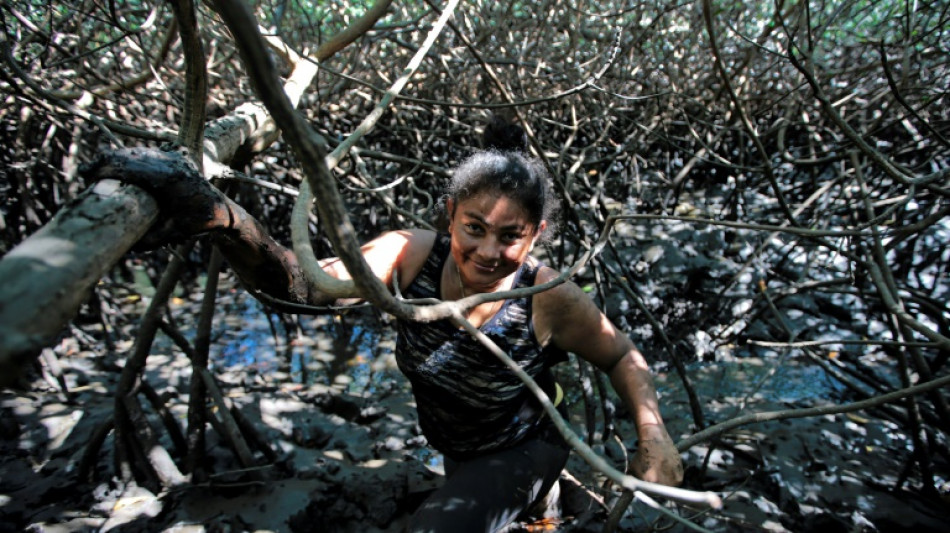
When men won't 'get dirty', Nicaraguan women dig for cockles / Photo: OSWALDO RIVAS - AFP

 Where the US-China tariff row stands ahead of White House summit

 Croc-habitat gets green light for 2032 Olympic rowing

 Indonesia cash-for-photos scheme turns animal hunters into protectors

 'Left-field' life: Briton becomes Thailand's top foreign monk

 India's transgender amendment leaves many in limbo

 Trump to host Xi amid pomp, low expectations

 Harry set for UK public outings with security, royal status hazy

 NFL Chiefs' Kelce among investors bilked in Ponzi scheme

 Trump threatens EU over 'hostile' Canada association plan

 Argentine judge orders suspension of Falklands oil project

 Carrick takes the blame as troubled Man Utd suffer League Cup misery

 Barcelona hit seven in Racing Santander rout

 Amorim's Milan beaten by Benfica, Sunderland make dream European return

 US stocks fall, dollar gains after Fed lifts interest rates

 Seahawks rule out Darnold for Sunday game at Arizona

 Mbappe explains Ceuta shirt stance after criticism

 Improving Atletico cruise to comfortable win over Osasuna

 Candidate for UN chief calls for AI regulation akin to nuclear weapons

 O'Neill expects Celtic recovery after Old Firm misery

 Man City midfield trio backed to emulate Rodri and Silva

 'We're losing control,' AI pioneer Yoshua Bengio tells AFP

 WHO eyes 'encouraging' signs in DRCongo fight against Ebola

 Liga boss criticises Real Madrid trio for Ceuta shirt incident

 WTA Finals moved to Charlotte from 2027

 Almost 8,000 excess deaths in France's scorched summer: statistics

From a young age, Elena Martinez and other female residents of Aserradores, a small fishing community in eastern Nicaragua, learn to navigate the dense mangrove forest to extract a black mollusc from deep under the mud.
Every few days, they leave home at dawn to row about two kilometers (1.2 miles) in a fishing boat to the mangroves, where they crawl through gnarly branches knee-deep in mud, digging for the delicacy by hand.
While keeping food on the table, the women also help conserve the mangrove forest -- a natural barrier that harbors countless animal species and protects coastal settlements from floods, tidal waves and hurricane winds.
It is hard, back-breaking work that leaves the women covered in mud from head to toe. But 40-year-old Martinez and her companions laugh and joke as they go about the task of finding mangrove cockles.
In several hours they each gather a small pile of the mollusc known to science as Anadara tuberculosa -- some for home consumption, but most to sell in town.
The cockle is a popular menu item in Nicaragua and famed for purported aphrodisiac qualities.
Restaurants can resell a dozen cockles for as much as 120 cordobas (about $3.30), but the women only get about a quarter to a sixth of that price.
"Only women" do this job "because men don't like to get dirty, they don't like to get scratched" by the mangrove branches, said Martinez.
"We have to do it because of our children, for our children's studies. We have to find a way to feed them," she explained.
The men of Aserradores make a living mainly from fishing for the table and to sell. But the fish are getting fewer.
- 'We plant, we reforest' -
The work of Martinez and her colleagues is also important for conservation.
While digging for cockles in the Aserradores estuary more than 150 kilometers (93 miles) northwest of Managua, they deposit seedlings provided by environmental authorities and NGOs to repopulate the mangrove forest.
"What we do is protect the mangrove... we plant, we reforest," said Martinez as she deftly dug into the mud, removed a cockle, and placed it in a bag hanging from her waist.
"It is for our own sake, that of our children and the rest" of the community, she said.
Martinez was 10 when she first started to gather cockles, at a time the finite nature of the resource was not appreciated, she said.
"Growing up, I did not consider how valuable it was... we took large amounts of shells without thinking that maybe one day they will run out and we won't have anything with which to sustain our children."
Martinez is a mother of three youngsters in their twenties engaged in fishing.
Juana Izquierdo, 50, recalls that as a child, the cockles were so plentiful she scooped them up from the surface of the mud but over the years, "they started decreasing because there were more collectors."
Nowadays, she returns smaller cockles to the mud to grow, "to protect and save our mangrove."
About 100 women in the municipality of El Viejo, which includes Aserradores, are involved in cockle harvesting and mangrove reforestation.
"We work three days and rest three or four days, then we return," said Izquierdo.
"We support our family. In the sea, sometimes they catch fish, sometimes not, sometimes the poor things (men) only earn enough for fuel. And since we row, we don't spend anything on fuel, we just spend our energy," she said.
F.Wilson--AT