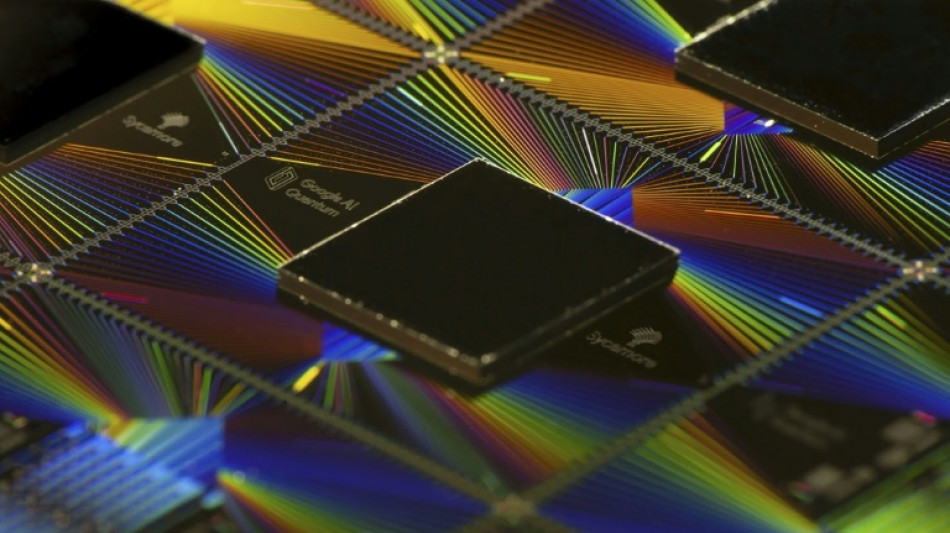
Google hails 'key milestone' in quantum computing / Photo: HO - GOOGLE/AFP/File

 Where the US-China tariff row stands ahead of White House summit

 Croc-habitat gets green light for 2032 Olympic rowing

 Indonesia cash-for-photos scheme turns animal hunters into protectors

 'Left-field' life: Briton becomes Thailand's top foreign monk

 India's transgender amendment leaves many in limbo

 Trump to host Xi amid pomp, low expectations

 Harry set for UK public outings with security, royal status hazy

 NFL Chiefs' Kelce among investors bilked in Ponzi scheme

 Trump threatens EU over 'hostile' Canada association plan

 Argentine judge orders suspension of Falklands oil project

 Carrick takes the blame as troubled Man Utd suffer League Cup misery

 Barcelona hit seven in Racing Santander rout

 Amorim's Milan beaten by Benfica, Sunderland make dream European return

 US stocks fall, dollar gains after Fed lifts interest rates

 Seahawks rule out Darnold for Sunday game at Arizona

 Mbappe explains Ceuta shirt stance after criticism

 Improving Atletico cruise to comfortable win over Osasuna

 Candidate for UN chief calls for AI regulation akin to nuclear weapons

 O'Neill expects Celtic recovery after Old Firm misery

 Man City midfield trio backed to emulate Rodri and Silva

 'We're losing control,' AI pioneer Yoshua Bengio tells AFP

 WHO eyes 'encouraging' signs in DRCongo fight against Ebola

 Liga boss criticises Real Madrid trio for Ceuta shirt incident

 WTA Finals moved to Charlotte from 2027

 Almost 8,000 excess deaths in France's scorched summer: statistics

Google scientists said Wednesday they have passed a major milestone in their quest to develop effective quantum computing, with a new study showing they reduced the rate of errors -- long an obstacle for the much-hyped technology.
Quantum computing has been touted as a revolutionary advance that uses our growing scientific understanding of the subatomic world to create a machine with powers far beyond those of today's conventional computers.
However the technology remains largely theoretical, with many thorny problems still standing in the way -- including stubbornly high error rates.
In new research published in the journal Nature, the Google Quantum AI lab described a system that can significantly decrease the error rate.
That could give the US tech giant a step up on its rivals such as IBM, which is also working on superconducting quantum processors.
While traditional computers process information in bits that can be represented by 0 or 1, quantum computers use qubits, which can be a combination of both at the same time.
This property, known as superposition, means that a quantum computer can crunch an enormous number of potential outcomes simultaneously.
The computers harness some of the most mind-boggling aspects of quantum mechanics, including a phenomenon known as "entanglement" -- in which two members of a pair of bits can exist in a single state, even if far apart.
- 'Magic' -
But a problem called decoherence can cause the qubits to lose their information when they leave their quantum state and come into contact with the outside world.
This fragility causes high error rates, which also increase with the number of qubits, frustrating scientists wanting to ramp up their experiments.
However Google's team said it had demonstrated for the first time in practice that a system using error-correcting code can detect and fix errors without affecting the information.
The system was first theorised in the 1990s, however previous attempts had just thrown up more errors, not less, said Google's Hartmut Neven, a co-author of the study.
"But if all components of your system have sufficiently low error rates, then the magic of quantum error correction kicks in," Neven told a press conference.
Julian Kelly, another study co-author, hailed the development as "a key scientific milestone", saying that "quantum error correction is the single most important technology for the future of quantum computing".
Neven said the result was still "not good enough, we need to get to an absolute low error rate".
He added that "there are more steps to come" to achieve the dream of a useable quantum computer.
Google claimed in 2019 it had passed a milestone known as "quantum supremacy", when the tech giant said its Sycamore machine executed a calculation in 200 seconds that would have taken a conventional supercomputer 10,000 years to complete.
However the achievement has since been disputed, with Chinese researchers saying last year that a supercomputer could have beaten Sycamore's time.
F.Ramirez--AT