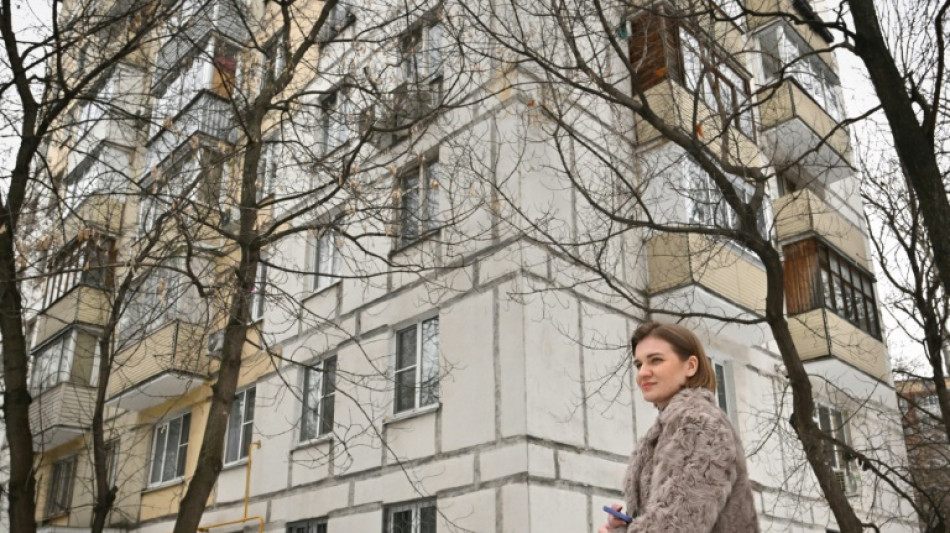
Russians adapt to 'nerve-wracking' life under sanctions / Photo: Yuri KADOBNOV - AFP

 Ukrainian fashion designer debuts art between air raids

 Gambian businesses struggle under prolonged blackouts
 Fiji declares national HIV crisis
 Australia to cut migration to fix housing crisis: minister

 NASA scan discovers new, 'once in a century' Moon crater
 Most stocks rise as Fed hikes and indicates drive to curb inflation
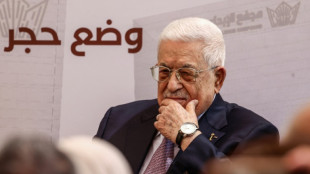 US again denies Palestinian leader Abbas visa to attend UN assembly
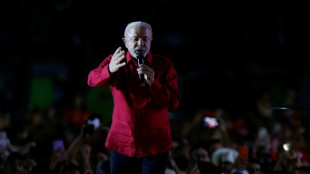 Lula says he will go to UN to tell Trump to 'stay out' of Brazil's elections
 Messi heads Inter Miami to Campeones Cup triumph

 AI looms large ahead of Xi, Trump summit

 Smith still haunted by 'Sandpapergate' as he prepares for South Africa Tests
 UK-Sudanese author pens book to give children 'African history of Africa'

 Boehly and Walter sell Chelsea stake to Clearlake Capital
 US House backs data center power cost bill amid midterm backlash
 US Congress passes sweeping Russia sanctions bill
 Barca hit Racing for seven as Atletico crush Osasuna

 US Fed raises rates to tackle 'too high' inflation, irking Trump
 Man Utd misery mounts after League Cup collapse against Brighton
 Turkey releases 106 protesters, jails more LGBTQ activists

 US Fed raises rates to tackle 'too high' inflation in move sure to rile Trump

 England were 'waiting for death' in World Cup semi-final defeat: Tuchel

 NFL star fined for displaying name of slain Palestinian girl
 Witsel retires from internationals after 18-year Belgium career
 US Fed raises rates to battle inflation in move likely to rile Trump
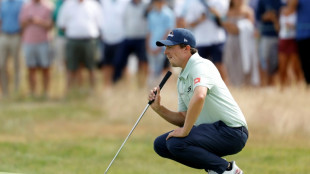 Fitzpatrick 'not comfortable' over Dubai golf finale

When Vladimir Stetsenko put his apartment on the market in October, he thought the ad for the newly renovated property in southern Moscow would generate some interest. It did not.
"There was not a single phone call for two or three weeks," the 61-year-old, who has lived in the Czech Republic for the past two years, told AFP.
That could be because Stetsenko listed the property not long after President Vladimir Putin deployed troops to Ukraine, sparking an unprecedented wave of Western penalties against Moscow and economic uncertainty.
To make matters worse, the apartment hit the market right after Putin mobilised hundreds of thousands of reservists for the fight, adding to an exodus of Russians already selling their homes, moving abroad and creating a huge real estate surplus.
Stetsenko, who has no plans to live in Russia anytime soon, had to knock off about 20 percent from the asking price, and then three people came to view it.
By December, he had offloaded the flat for an equivalent of about 200,000 euros, the same amount he paid for it around a decade ago.
"Selling the apartment was a bit nerve-wracking," he conceded.
Stetsenko's experience mirrors that of many Russians, not only in the property market but in the broader economy after the start of Moscow's offensive in Ukraine, and reflects turmoil in a country hit by multiple rounds of sanctions.
Putin insists Russia is weathering the Western penalties.
A home-grown brand has replaced McDonald's and supermarkets are offering Russian-made drinks to replace foreign brands like Coca-Cola, which left Russia last year.
Imports from the European Union have fallen but China's trade with Russia reached a record $190 billion last year, Beijing customs data shows.
In another positive signal for the Kremlin, the International Monetary Fund last month improved its forecast for Russia's economy, projecting 0.3 percent growth this year, up from an estimated contraction of 2.3 percent.
- Rollercoaster ride -
The housing market appears to reflect trends in the overall economy, which has been pounded but remains afloat.
Real estate analysts say the housing market has been on a rollercoaster ride since Russians panicked when sanctions hit and then adjusted to their new reality.
First, prices spiked in Moscow as homeowners sought to secure their savings.
They then dropped as tens of thousands of Russians opposed to the conflict and worried for their futures packed up and left.
"There is a lot of supply," said Vadim Orekhov, co-founder of Rio Lux, a real estate agency in Moscow.
"And that leads to strong competition among sellers."
Real estate agent Anastasia Chichikina said that prices in Moscow, Russia's capital of more than 12 million people, peaked in March and April.
"People wanted to save as much of their assets as possible," she said.
"Then a gradual decline began."
She said the average price per square metre for a flat in Moscow dropped from around 270,000 rubles (3,400 euros) last spring to around 251,000 rubles now.
Oleg Repchenko, who heads the analytical firm Real Estate Market Indicators, sees parallels now with 2014-2015 when the West began slapping sanctions on Russia for annexing Crimea and destabilising Ukraine.
"At the time, after a short-term peak and spike in prices, the cost of housing began to decline," he said.
- 'No prospects' -
While authorities insist that the economy has largely adapted a year after the start of the Kremlin's assault on Ukraine, economists are much less optimistic.
They say problems are mounting as the West is building on its sanctions program with a 10th EU package looming.
Hundreds of foreign companies have exited, emptying shopping malls, while inflation, which stands at around 12 percent, has undermined the purchasing power of Russian wages.
Foreign tourism has collapsed and supply problems are impacting a slew of industries including car manufacturing.
Several Russian economic observers wrote in a recent analysis that "abnormally" high energy revenues had cushioned the blow from sanctions last year.
But 2023 will be harder, they said in the report published by the independent analysis website Re: Russia, as the budget shrinks and the Kremlin's economic priorities shift.
"The crisis associated with a massive outflow of capital and the isolation of the Russian economy from a significant part of international markets and the financial system is not behind but ahead," the analysis concluded.
"After February 24, 2022, the Russian economy has no prospects."
E.Flores--AT