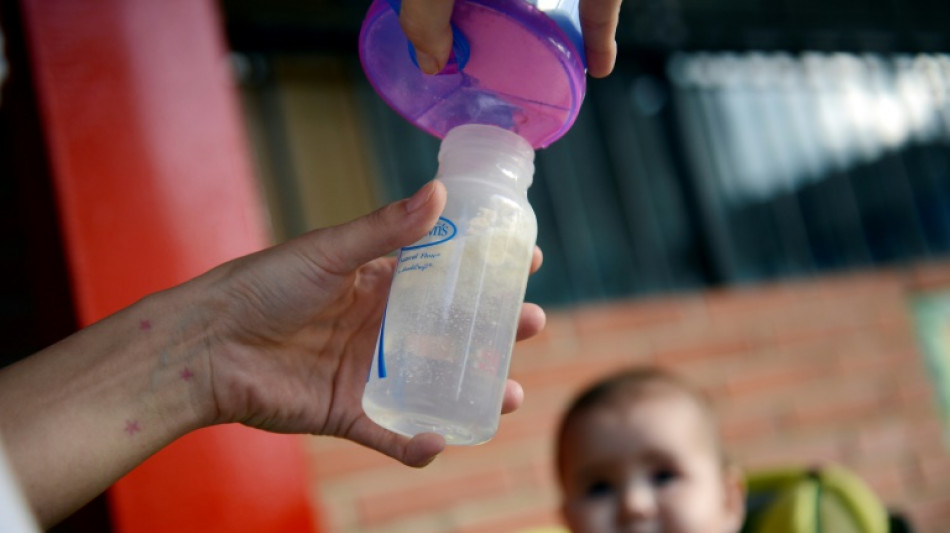
Most baby formula health claims not backed by science: study / Photo: LEO RAMIREZ - AFP/File

 Ukrainian fashion designer debuts art between air raids

 Gambian businesses struggle under prolonged blackouts

 Fiji declares national HIV crisis

 Australia to cut migration to fix housing crisis: minister

 NASA scan discovers new, 'once in a century' Moon crater

 Most stocks rise as Fed hikes and indicates drive to curb inflation

 US again denies Palestinian leader Abbas visa to attend UN assembly

 Lula says he will go to UN to tell Trump to 'stay out' of Brazil's elections

 Messi heads Inter Miami to Campeones Cup triumph

 AI looms large ahead of Xi, Trump summit

 Smith still haunted by 'Sandpapergate' as he prepares for South Africa Tests

 UK-Sudanese author pens book to give children 'African history of Africa'

 Boehly and Walter sell Chelsea stake to Clearlake Capital

 US House backs data center power cost bill amid midterm backlash

 US Congress passes sweeping Russia sanctions bill

 Barca hit Racing for seven as Atletico crush Osasuna

 US Fed raises rates to tackle 'too high' inflation, irking Trump

 Man Utd misery mounts after League Cup collapse against Brighton

 Turkey releases 106 protesters, jails more LGBTQ activists

 US Fed raises rates to tackle 'too high' inflation in move sure to rile Trump

 England were 'waiting for death' in World Cup semi-final defeat: Tuchel

 NFL star fined for displaying name of slain Palestinian girl
 Witsel retires from internationals after 18-year Belgium career

 US Fed raises rates to battle inflation in move likely to rile Trump

 Fitzpatrick 'not comfortable' over Dubai golf finale

The vast majority of health claims used to advertise baby formula worldwide are not supported by rigorous scientific evidence, a study said Thursday, leading researchers to urge the breast milk substitutes be sold in plain packaging.
The study comes a week after a group of doctors and scientists called for a regulatory crackdown on the $55-billion formula industry for "predatory" marketing which they said exploits the fears of new parents to convince them not to breastfeed.
Breastfeeding is widely recognised to have huge health benefits for babies. The World Health Organization and the US CDC recommend breastfeeding exclusively during the first six months of a newborn's life.
However that recommendation is followed for less than half of infants globally, according to the WHO.
Daniel Munblit, an honorary senior lecturer at Imperial College London and an author of the new study, said researchers were not on a "crusade" against infant formula, which should remain an option for mothers who cannot or choose not to breastfeed.
"But we are very much against inappropriate infant formula marketing, which provides misleading claims not backed up by solid evidence," Munblit told AFP.
Munblit and an international team of researchers looked at the health claims made for 608 products on the websites of infant formula companies in 15 countries, including the United States, India, Britain and Nigeria.
The most common claims were that formula supports brain development, strengthens immune systems and more broadly helps growth.
Half of the products did not link the claimed health benefit to a specific ingredient, according to the study published in the BMJ journal.
Three quarters did not refer to scientific evidence supporting their claims.
Of those that provided a scientific reference, more than half pointed to reviews, opinion pieces or research on animals.
Just 14 percent of the products referred to registered clinical trials on humans. However 90 percent of those trials carried a high risk of bias, including missing data or the finding not supporting the claim, the study said.
And nearly 90 percent of the clinical trials had authors who received funding from or had ties to the formula industry, it added.
- 'Distressing' -
The most commonly cited ingredient was polyunsaturated fatty acids, which is in breast milk and is considered important for brain development.
However there is no evidence of any added benefit when the ingredient is added to baby formula, according to a Cochrane systematic review.
Munblit said the health claims were mostly used to advertise premium formula products, which could be "distressing" for parents who are misled into believing the ingredients are essential but cannot afford them.
When asked what he thinks needs to be done to address the problem, Munblit was concise.
"Plain packaging," he said.
The study comes after a series of papers were published in the Lancet journal last week calling for global policy makers to end exploitative formula marketing.
WHO infant health specialist Nigel Rollins, an author of one of the Lancet papers, said busy parents "lack the time to properly scrutinise claims" about infant formula.
The new study showed that "governments and regulatory authorities must commit the necessary time and attention to review the claims of formula milk products," Rollins said in a linked BMJ editorial.
M.O.Allen--AT