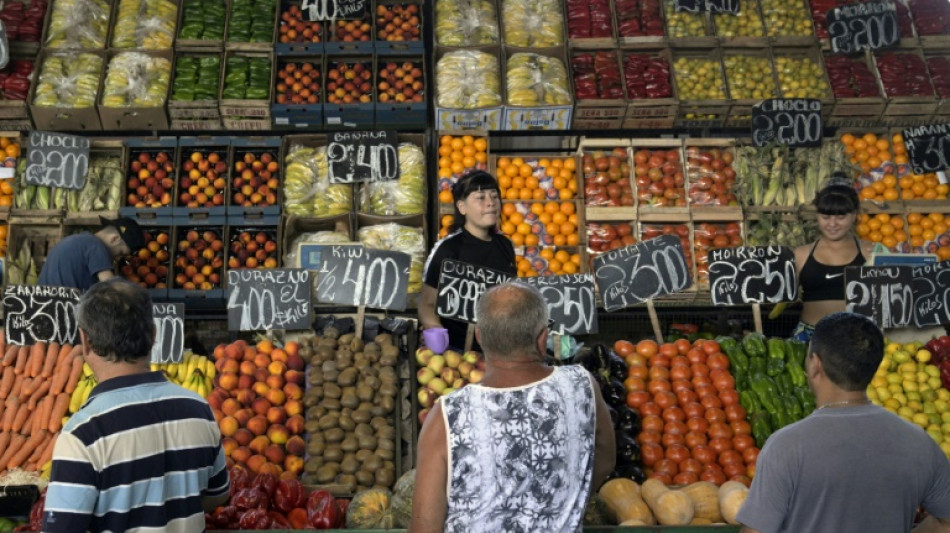
'Like James Bond,' Argentine price spies fight inflation / Photo: JUAN MABROMATA - AFP

 'Vande Mataram': Why is India's freedom song in spotlight?

 Counterculture pop artist Peter Max dies at 88: US media

 Asian Games chief defends 'functional' rooms after backlash
 Leader's sister says only 'idiots' think N. Korea to give up nukes
 World's water cycle becoming more unpredictable, UN warns

 Where the US-China tariff row stands ahead of White House summit
 Croc-habitat gets green light for 2032 Olympic rowing

 Indonesia cash-for-photos scheme turns animal hunters into protectors
 'Left-field' life: Briton becomes Thailand's top foreign monk

 India's transgender amendment leaves many in limbo

 Trump to host Xi amid pomp, low expectations
 Harry set for UK public outings with security, royal status hazy

 NFL Chiefs' Kelce among investors bilked in Ponzi scheme

 Guardian Metal Resources PLC Announces Audited Financial Results for the Year Ended 30 June 2026

 Trump threatens EU over 'hostile' Canada association plan

 Argentine judge orders suspension of Falklands oil project

 Carrick takes the blame as troubled Man Utd suffer League Cup misery

 Barcelona hit seven in Racing Santander rout
 Amorim's Milan beaten by Benfica, Sunderland make dream European return

 US stocks fall, dollar gains after Fed lifts interest rates

 Seahawks rule out Darnold for Sunday game at Arizona
 Mbappe explains Ceuta shirt stance after criticism

 Improving Atletico cruise to comfortable win over Osasuna

 Candidate for UN chief calls for AI regulation akin to nuclear weapons

 O'Neill expects Celtic recovery after Old Firm misery
Like a veritable undercover agent, Monica Schenone tries to pass unnoticed through the aisles of a supermarket in Buenos Aires, sneaking photographs of price tags.
The 52-year-old homemaker is part of a group of ordinary Argentines who volunteer their time to police stores' adherence to price limits suggested by the government to curtail spiraling inflation.
She feels "like James Bond," Schenone says, as she tries to blend in with shoppers in the capital of Argentina -- which in 2022 recorded its highest inflation rate in three decades at 94.8 percent -- one of the highest in the world.
Prices for daily staples rose monthly, even weekly in 2022, with milk prices climbing more than four-fold and those for cooking oil and sugar more than five-fold, according to the Abeceb economic consultancy.
In a bid to rein in galloping price rises, the government's "Precios Justos" (Fair Prices) program applies a 3.2-percent monthly price hike limit to some 2,000 essential products including flour, rice, milk and sunflower oil.
"I am in shock," Schenone told AFP as she exited a supermarket in the San Cristobal neighborhood where she had executed a covert price check she said left her horrified.
"A bar of soap that went from 231.40 pesos to 496 pesos, that does not seem to me to be a three percent increase," she said.
"It seems to me that we are still being taken for fools."
Precios Justos runs from February to the end of June, and covers food and medicines but also soap, clothing, shoes, and school gear, among other items.
Joining is voluntary, but producers and vendors who do sign up to the price agreement risk fines for non-compliance of up to 71 million pesos (some $370,000 at Tuesday's exchange rate) from Argentina's ministry of commerce.
Precios Justos, states the government, "aims to reduce inflationary expectations and... recover the purchasing power of the population’s income."
All major supermarket chains as well as Argentina's massive COPAL food and drinks producers' group have signed up to the program.
But most smaller, independent stores which serve millions of Argentines remain outside of the framework, sometimes charging prices double the suggested rate, according to consulting firm Nielsen IQ.
- 'Impotence' -
Schenone and about two dozen others members of an activist group called "La Dignidad" (Dignity) have taken it upon themselves to check up on Precios Justos compliance in Buenos Aires.
She said they regularly observe serious breaches.
Most often, price-controlled products are simply not stocked, but there are also many cases of prices above the agreed limit, she said.
"What I feel is a lot of impotence, a lot of anger. I feel that, as always, those of us in the lower classes continue to be screwed," Schenone told AFP.
The price checker and her peers submit their findings to La Dignidad, which publishes periodic reports.
There is also a government-sponsored app for consumers to report violations.
But opponents of the government's plan question the efficacy of price freezes, calling instead for macroeconomic measures such as slashing money printing and public spending.
Argentina has been grappling with an economic crisis for years, registering double-digit inflation in each of the last 12 years.
The causes are multiple, including persistent deficit spending, constant currency devaluation, successive droughts and external factors like the war in Ukraine that affected energy and grain prices.
Economy Minister Sergio Massa has said inflation is the "biggest poverty factor" in Argentina and "one of the main issues to fight."
For the month of January, inflation came in at 6.0 percent from December, and at 98.8 percent compared to the same month a year ago, according to data released Tuesday by the INDEC statistics institute.
For food and non-alcoholic drinks, prices rose 6.8 percent from December to January, and by 98.4 percent from a year earlier.
O.Ortiz--AT