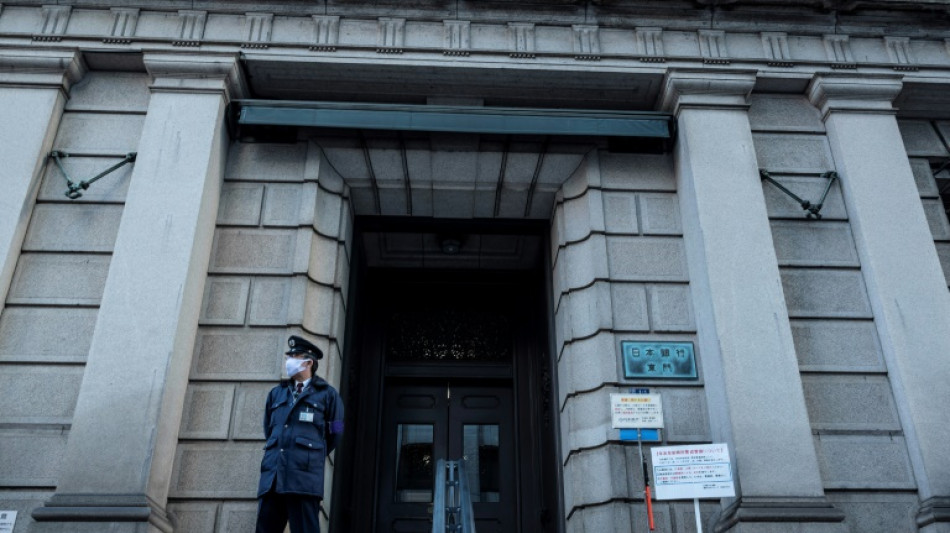
Kazuo Ueda nominated next Bank of Japan governor / Photo: Richard A. Brooks - AFP

 'Vande Mataram': Why is India's freedom song in spotlight?

 Counterculture pop artist Peter Max dies at 88: US media

 Asian Games chief defends 'functional' rooms after backlash

 Leader's sister says only 'idiots' think N. Korea to give up nukes
 World's water cycle becoming more unpredictable, UN warns
 Where the US-China tariff row stands ahead of White House summit
 Croc-habitat gets green light for 2032 Olympic rowing

 Indonesia cash-for-photos scheme turns animal hunters into protectors
 'Left-field' life: Briton becomes Thailand's top foreign monk

 India's transgender amendment leaves many in limbo

 Trump to host Xi amid pomp, low expectations
 Harry set for UK public outings with security, royal status hazy
 NFL Chiefs' Kelce among investors bilked in Ponzi scheme

 Guardian Metal Resources PLC Announces Audited Financial Results for the Year Ended 30 June 2026

 Trump threatens EU over 'hostile' Canada association plan

 Argentine judge orders suspension of Falklands oil project
 Carrick takes the blame as troubled Man Utd suffer League Cup misery

 Barcelona hit seven in Racing Santander rout
 Amorim's Milan beaten by Benfica, Sunderland make dream European return

 US stocks fall, dollar gains after Fed lifts interest rates

 Seahawks rule out Darnold for Sunday game at Arizona
 Mbappe explains Ceuta shirt stance after criticism

 Improving Atletico cruise to comfortable win over Osasuna

 Candidate for UN chief calls for AI regulation akin to nuclear weapons

 O'Neill expects Celtic recovery after Old Firm misery
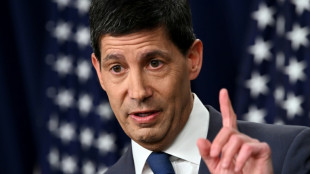
Economics professor Kazuo Ueda was nominated Tuesday as the Bank of Japan's next governor, tasked with navigating a way forward after a decade of extraordinary monetary easing.
The respected economist, described as careful and cautious, was a surprise pick for the change of guard after the outgoing governor's deputy reportedly turned down the job.
The position will likely be tough going, with Ueda facing pressure to join international peers in tightening while avoiding panic by suddenly unwinding the bank's decade-old monetary policy.
In another example of the headwinds facing Japan's economy, data released Tuesday morning showed that GDP expanded just 0.2 percent in the last quarter of 2022, a smaller rebound than expected despite the long-awaited reopening of the country to tourists.
Ueda was nominated by Prime Minister Fumio Kishida, according to a government document handed to reporters, a decision that must be approved by lawmakers.
But that is expected to be largely a formality given that Kishida's ruling coalition commands a healthy parliamentary majority.
A former BoJ policy board member, Ueda will take the reins from governor Haruhiko Kuroda, the central bank's longest-serving leader and the architect of its ultra-loose policies.
Since Kuroda became governor in 2013, his attempts to boost Japan's moribund economy have ranged from a negative interest rate to spending vast sums on government bonds.
In the past year, he has held firm, even as other central banks hiked rates to tackle inflation, with the resulting policy gap causing the yen to slump against the dollar.
Kuroda, 78, is due to step down on April 8 when his second term ends.
He leaves Ueda, 71, the challenge of working out the bank's next steps, said Saori N. Katada, an international relations professor at the University of Southern California.
"This is probably the hardest job at the worst time to take up. Professor Ueda is very brave to accept it," she told AFP.
Japan's easy-money policies have become "extreme... and no one knows how to get out of it", as sudden policy pivots could "jeopardise fiscal sustainability", Katada said.
"In the next five years, though, the BoJ has to change course", because rising inflation, the weak yen and high government spending are unsustainable.
- 'Cautious' approach -
The yen tumbled from around 115 against the dollar in February 2022 to a three-decade low of 151 yen in October.
The Japanese currency has since recovered to about 132 against the dollar, and briefly strengthened when Japanese media outlets first reported Ueda would be nominated instead of Kuroda's dovish deputy Masayoshi Amamiya.
Amamiya, who reportedly turned down the job, had been seen as a continuity candidate likely to keep the BoJ's stimulus policies.
But that does not mean Ueda -- who has a PhD in economics from the Massachusetts Institute of Technology and served on the BoJ's policy board between 1998 and 2005 -- should be viewed as a hawk, analysts said.
"The current BoJ policy is appropriate, and I think it's important to maintain monetary easing policy for now," Ueda told reporters on Friday.
Katada described him as "one of the most respected macroeconomists in Japan" and a good communicator who is "relatively cautious".
Kazuo Momma, executive economist at Mizuho Research and Technologies and a former assistant governor at the Bank of Japan, told AFP that Ueda had "never been hawkish with regard to the BoJ's monetary policy."
The bank's ultra-loose monetary policy dates to the era of former prime minister Shinzo Abe, whose "Abenomics" plan aimed to stimulate growth and banish the deflation that plagued Japan's economy from the end of the 1980s boom.
Inflation hit a multi-decade high of four percent in Japan in December -- above the BoJ's longstanding two-percent target -- fuelled partly by soaring energy bills.
But because the trend has not been driven by demand or steady wage increases, the BoJ has said it sees no reason to abandon its dovish policies.
So Ueda "will assess very carefully whether the two-percent inflation target will be achieved in any reasonable time horizon, and take a cautious position in terms of possible policy changes going forward", Momma said.
F.Wilson--AT