In northern Nigeria, fuel, cash crisis taints election campaign / Photo: PIUS UTOMI EKPEI - AFP

 Kids and social media: what would change under new EU law
 Modi pitches India as global chipmaking hub
 Ukraine plans record defence spending in 2027
 Klopp calls up 44 players in huge first Germany squad
 STARPRIME Responds to Diverging Gold Market Demand with AM/PM Fixing and XAU24/7
 Ukrainian fashion designer debuts art between air raids

 Gambian businesses struggle under prolonged blackouts
 Fiji declares national HIV crisis
 Australia to cut migration to fix housing crisis: minister

 NASA scan discovers new, 'once in a century' Moon crater
 Most stocks rise as Fed hikes and indicates drive to curb inflation
 US again denies Palestinian leader Abbas visa to attend UN assembly
 Lula says he will go to UN to tell Trump to 'stay out' of Brazil's elections
 Messi heads Inter Miami to Campeones Cup triumph
 AI looms large ahead of Xi, Trump summit
 Smith still haunted by 'Sandpapergate' as he prepares for South Africa Tests
 UK-Sudanese author pens book to give children 'African history of Africa'
 Boehly and Walter sell Chelsea stake to Clearlake Capital
 Guardian Metal Resources PLC Announces Audited Financial Results for the Year Ended 30 June 2026
 Trybe Spirits Announces Sponsorship of The San Diego Spirits Festival
 Trump threatens EU over 'hostile' Canada association plan
 Argentine judge orders suspension of Falklands oil project
 Carrick takes the blame as troubled Man Utd suffer League Cup misery

 Barcelona hit seven in Racing Santander rout
 Amorim's Milan beaten by Benfica, Sunderland make dream European return

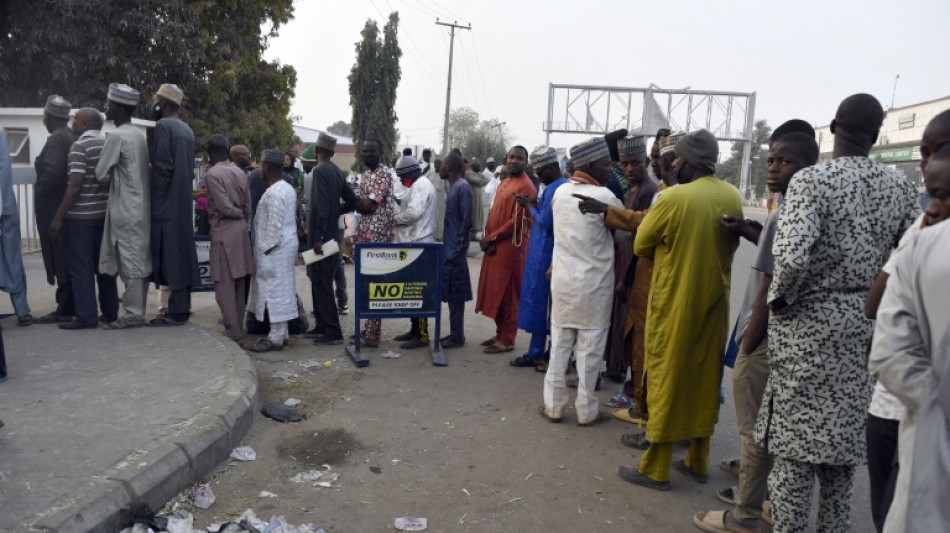
It was just after dawn and tempers were fraying outside the First Bank in the northern Nigerian town of Kano, where scores of customers jostled to get on a waiting list to withdraw money.
Long before the branch had opened its doors, crowds had formed of people desperate to take out cash, which was being limited to 10,000 naira -- just $20 -- per person.
The reason: a government plan to swap old banknotes for a new design has run into chaos, limiting the number of bills in circulation and creating a cash shortage.
Near the bank, hundreds of cars, motorbikes and rickshaw taxis had sat since early morning outside filling stations waiting to fill their tanks because of another shortage: petrol.
Little more than two weeks before an election to pick President Muhammadu Buhari's successor, the twin shortages in Africa’s largest economy are overshadowing campaigning, angering voters and causing jitters over vote preparations.
Riots erupted in frustration over the cash crunch last week when Buhari visited Kano state, one of his power bases and a key election battleground with the second largest number of registered voters.
Independent National Electoral Commission (INEC) Chairman Mahmood Yakubu on Wednesday reassured Nigerians the February 25 ballot would happen, with three major presidential candidates in a tight race.
But watching the lines outside Kano's banks, market trader Mohammed Ali Danazumi said elections were far from his mind. He was on a second hours-long wait to get cash after failing to get naira the day before.
"Today, I am number 290, what can I do?" he asked after joining the waiting list to get access to the cash machine.
"We need change, we need some serious change."
- Conspiracy theories -
The fuel and cash crunches have already soured the mood ahead of the February 25 presidential vote.
Buhari's ruling All Progressives Congress (APC) party and main opposition Peoples Democratic Party (PCP) are trading accusations of plots and sabotage -- or of hoarding new banknotes in order to buy votes.
Some APC stalwarts even blame "fifth columnist" enemies in the presidency for creating the shortages to undermine their man, former Lagos governor Bola Tinubu.
Buhari, who steps down after two terms, last week asked Nigerians to give him seven days to resolve the shortages, which he blamed on inefficiencies and hoarding in distribution of new notes.
Buhari holds an emergency meeting on the cash shortage with top officials on Friday. But APC governors already warned him they are worried about the impact on the election.
Government officials defend the cash swap to replace old 1,000, 500 and 200 naira notes as a way to clear counterfeit bills and a large amount of cash held outside banks.
But for many Nigerians, already coping with widespread insecurity and the inflationary fallout from the Ukraine war, the dual cash and fuel shortage is fast becoming too much.
Traders have been quick to profit. Street vendors sell cash via a bank card transaction on mobile POS machines, but with a hefty charge of 1,000 naira for 5,000 naira, Lagos and Kano residents say.
"You pay cash for your own cash," said a Lagos business administrator after a transaction.
For Kano auto mechanic Sayo Ade, who left his car overnight in a line outside a petrol station, patience was beyond thin.
"There is no cash in Nigeria now. You can’t get any at the ATM (cash machine). But in here, the POS machines (for electronic transactions) don’t work, so they are asking for cash,” he said waving his bank card at the gasoline station.
"Who has cash in Nigeria now?"
Nigeria is one of Africa's largest crude oil producers, but has almost no refining capacity and must import fuel from Europe and elsewhere.
- Northern stronghold -
Since the end of military rule in 1999, Nigeria's elections were often marred by violence, vote buying or logistical problems. The 2019 vote was delayed by a week.
Kano state has long played an important part in Nigeria elections. Buhari was elected in 2015 and re-elected in 2019 thanks in large part to a block of ballots from the northwestern state.
But in Kano city, the country's second largest and commercial heart of the mostly Muslim north, frustrations are growing, even among those who voted twice for Buhari.
Protests have also broken out in the southwestern cities of Ibadan and Abeokuta, where police said rioters attacked local banks.
Outside a Kano bank, civil servant Dauda Yusuf was focussed on finances not politics.
"We don't know why the government is treating us like this," he said. "We are heading into an election and they want us to vote? Look at what is going on here."
Despite its status as a major oil producer, fuel lines recently reappeared in Lagos and other cities.
Perched on his yellow rickshaw taxi, Adamu Isyaku said he spent hours to fill up at a station where fuel is sold at the regular subsidised price. Black market fuel would save him time but cost him double.
Now even some customers have little cash.
"Sometimes we are like a charity. Sometimes people just say, 'this all I have,' and you have no choice but to accept," he said.
"I was going to vote. I have my voter card with me. But with all this suffering, I’ve changed my mind."
Others took a pragmatic view in a country where coping with "wahala" -- a widely used Hausa phrase for Nigeria’s daily struggles -- is seen as a necessary skill.
"We are Nigerians, we will survive," said Kayode Gabriel, 46, a salesman, waiting for his turn to fill up his car tank in Kano. "No, it's not normal, but God gave us a resilient spirit. Someday, somehow we will get it right."
T.Wright--AT