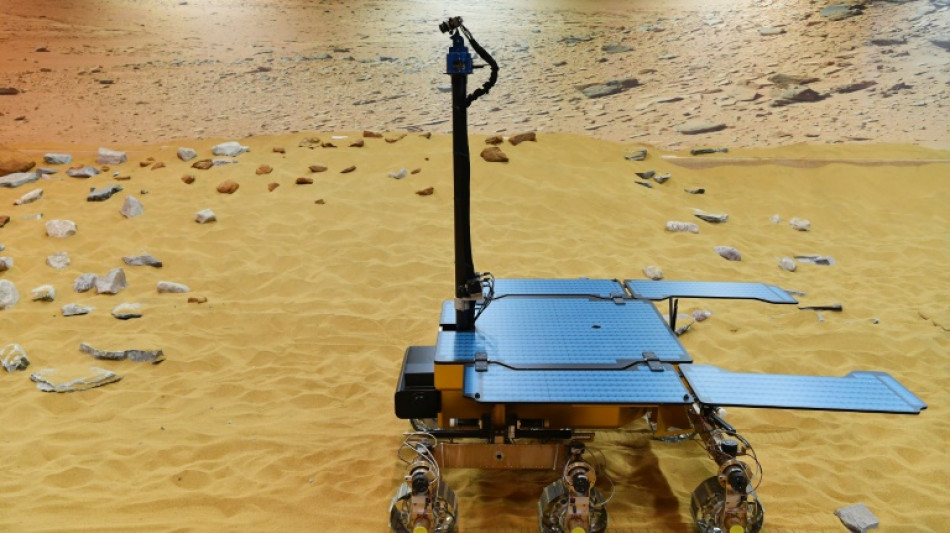
Long-delayed ExoMars mission still dreams of 2028 launch / Photo: BEN STANSALL - AFP/File

 Kids and social media: what would change under new EU law

 Modi pitches India as global chipmaking hub
 Ukraine plans record defence spending in 2027

 Klopp calls up 44 players in huge first Germany squad

 STARPRIME Responds to Diverging Gold Market Demand with AM/PM Fixing and XAU24/7

 Ukrainian fashion designer debuts art between air raids

 Gambian businesses struggle under prolonged blackouts
 Fiji declares national HIV crisis
 Australia to cut migration to fix housing crisis: minister

 NASA scan discovers new, 'once in a century' Moon crater

 Most stocks rise as Fed hikes and indicates drive to curb inflation
 US again denies Palestinian leader Abbas visa to attend UN assembly

 Lula says he will go to UN to tell Trump to 'stay out' of Brazil's elections

 Messi heads Inter Miami to Campeones Cup triumph

 AI looms large ahead of Xi, Trump summit

 Smith still haunted by 'Sandpapergate' as he prepares for South Africa Tests

 UK-Sudanese author pens book to give children 'African history of Africa'

 Boehly and Walter sell Chelsea stake to Clearlake Capital

 Guardian Metal Resources PLC Announces Audited Financial Results for the Year Ended 30 June 2026

 Trybe Spirits Announces Sponsorship of The San Diego Spirits Festival

 Trump threatens EU over 'hostile' Canada association plan

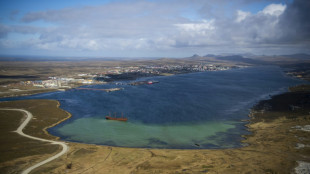 Argentine judge orders suspension of Falklands oil project

 Carrick takes the blame as troubled Man Utd suffer League Cup misery

 Barcelona hit seven in Racing Santander rout

 Amorim's Milan beaten by Benfica, Sunderland make dream European return

War, budget cuts, a pandemic and a crash: For all its trials, Europe's ExoMars mission might be more deserving of the name Perseverance than NASA's Martian rover.
But the European Space Agency still hopes the mission can launch in 2028 on its long-delayed quest to search for extraterrestrial life on the Red Planet.
This time last year, the ESA's Rosalind Franklin rover was all ready for a September launch from the Baikonur Cosmodrome in Kazakhstan, planning to catch a ride on a Russian rocket and descend to the Martian surface on a Russian lander.
Then Moscow invaded Ukraine in March, and sanctions imposed by the ESA's 22 member states led to Russia pulling out and the mission being suspended.
It was just the latest blow for the hundreds of scientists who have been working on the project for more than two decades.
First conceived in 2001, the ambitious programme quickly proved too expensive for Europe, which has still to land a rover on Mars.
The United States' space agency NASA stepped in to fill the funding gap in 2009. But three years later, budget cuts led to NASA pulling out.
Help then came from an unexpected source: Russia's space agency Roscosmos.
Together, the ESA and Roscosmos launched the Schiaparelli EDM module in 2016 as a test run for ExoMars.
But when Schiaparelli arrived at Mars, a computer glitch caused it to crash into the surface and fall silent.
That failure pushed back the launch of the joint Russian-European ExoMars mission to July 2020.
The Covid-19 pandemic pushed that date back to 2022, when it was again delayed by the invasion of Ukraine.
- Tricky Russian negotiations -
Late last year, the ESA's ministerial council agreed to kept the mission alive with an injection of 500 million euros ($540 million) over the next three years.
David Parker, the ESA's director of human and robotic exploration, said last week that one of the arguments they put forward for continuing the mission was "that this is a unique piece of European science.
"It's like James Webb," he said referring to the space telescope that has been sending back astonishing images of distant galaxies since 2022.
"But it's for Mars -- it's that scale of ambition.
"This is the only mission that is foreseen that can actually find evidence of past life."
But some significant hurdles remain that could make a 2028 launch difficult -- including that the ESA needs a new way to land its rover on Mars.
The ESA will first have to recover European components, including an onboard computer and radar altimeter, from Russia's Kazachok lander, which is still at its assembly site in Turin, Italy.
However only Russia can extract the components from the lander.
Difficult negotiations have been underway for Russian experts to come and dismantle the lander.
"We expected them in mid-January, but they didn't come," ESA ExoMars programme team leader Thierry Blancquaert told AFP.
"We asked them to have everything done by the end of March," he added.
- NASA to the rescue? -
To get off the ground, the new mission will depend on support from NASA, which has so far indicated it is happy to help.
For its new lander, the ESA hopes to take advantage of US engines used to get NASA's Curiosity and Perseverance rovers onto the Martian surface.
It will also have to rely on NASA for radioisotope heater units, after losing access to Russia's supply. These units keep the spacecraft warm.
NASA has not yet voted on a budget that would support such efforts, but "we are preparing the collaborative work together and things are progressing well," Blancquaert said.
Francois Forget, an astrophysicist at France's CNRS scientific research centre, said that "this new impetus for cooperation is linked to the fact that this time, the US has a joint project with Europe: Mars Sample Return."
The mission, planned for around 2030, is intended to return to Earth samples collected from Mars by both ExoMars and Perseverance, which touched down on the planet in July 2021.
Unlike Perseverance, the Rosalind Franklin rover can drill up to two metres (6.5 feet) below the surface of Mars, where traces of possible ancient life could be better preserved.
ExoMars' planned landing site is also in an area of Mars expected to have been more favourable to hosting past life.
"We think there was a lot of water there," said Forget.
"There is another Mars to explore, so even in 10 years' time the mission will not be obsolete," he added.
N.Walker--AT