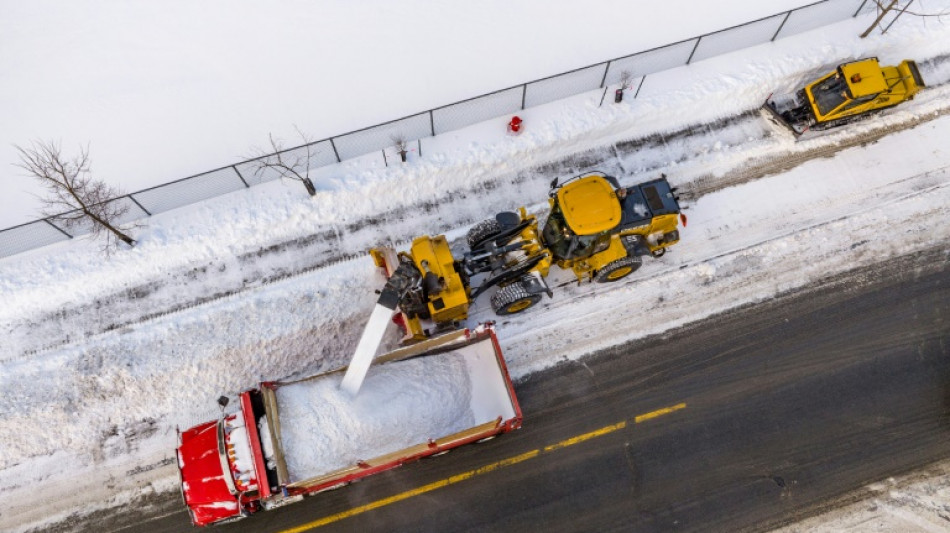
Montreal snow-clearing: good for traffic, bad for environment / Photo: Sebastien ST-JEAN - AFP

 Real Madrid fan group wants Mbappe apology over Ceuta shirt snub

 Nepal floods among 'most challenging' disasters: WFP

 Doubts as Italy eyes electric future for steel plant

 'One of the kindest people': Taraneh, 21, facing execution in Iran

 Japan eyes changing prostitution law to punish sex buyers

 After record rain, typhoon threatens new challenge to Asian Games

 Kids and social media: what would change under new EU law
 Modi pitches India as global chipmaking hub

 Ukraine plans record defence spending in 2027

 Klopp calls up 44 players in huge first Germany squad

 STARPRIME Responds to Diverging Gold Market Demand with AM/PM Fixing and XAU24/7

 Ukrainian fashion designer debuts art between air raids

 Gambian businesses struggle under prolonged blackouts

 Fiji declares national HIV crisis

 Australia to cut migration to fix housing crisis: minister

 NASA scan discovers new, 'once in a century' Moon crater

 Most stocks rise as Fed hikes and indicates drive to curb inflation

 US again denies Palestinian leader Abbas visa to attend UN assembly

 Lula says he will go to UN to tell Trump to 'stay out' of Brazil's elections

 Messi heads Inter Miami to Campeones Cup triumph

 AI looms large ahead of Xi, Trump summit

 Smith still haunted by 'Sandpapergate' as he prepares for South Africa Tests

 UK-Sudanese author pens book to give children 'African history of Africa'

 Boehly and Walter sell Chelsea stake to Clearlake Capital

 Banyan Gold Intersects 1.05 g/t Gold over 52.8 metres and Bonanza-Grade Gold at Powerline Deposit, AurMac, Yukon, Canada

A choreographed ballet of massive trucks, snowplows and snowblowers takes over the streets of Montreal whenever it snows, an enormous logistical effort with a significant environmental cost.
Hundreds of snow-clearing vehicles are deployed across the frigid Canadian city for 100 or more days each year on average, dusting the road with salt and belching emissions into the air.
"The snow challenge in Montreal is colossal," says city spokesperson Philippe Sabourin.
If the city's streets and sidewalks were put end to end, they would total 10,000 kilometers (6,200 miles) or the equivalent of the distance from Montreal to Beijing, he said.
Some 3,000 employees and 2,200 vehicles go into action day and night every time it snows, helping make the streets passable.
In Montreal alone, the equivalent of 150,000 tons of salt is spread on roads and sidewalks over the winter.
"It has an impact on ecosystems," Florent Barbecot, a professor of hydrogeology at the University of Quebec in Montreal, told AFP.
"We have seen for a few years the level of salt which is rising a little bit everywhere in the environment."
Some of it stays on the roads, dries and evaporates when temperatures warm, "ending up in the atmosphere... which will affect future precipitation," he said.
The city recognizes that salt is bad for the environment, but despite ongoing research, no effective substitute has been found.
It is "a material that does us a great service," by lowering the freezing temperature of ice and melting icy patches, Sabourin explained.
With almost two meters (six feet) of snowfall in Montreal each year, the city simply cannot go without massive snow management.
- People 'not happy' -
As a substitute, "we tried coffee grinds, it smelled good, but it was not a success," Sabourin added.
Beetroot juice has also been tried, which is less corrosive than salt, "but it stained floors a lot, people were not happy," he said.
Until the late 1990s, snow soiled by waste and pollution was dumped directly into the St. Lawrence River, before the practice was banned.
Some of it is now poured into snow chutes connected to the sewer system.
But the majority (75 percent) is stored in quarries, where the snow is piled high. One mound on the city's south side stretches the width of several football fields and rises ten storeys high.
At the foot, trucks appear tiny in comparison as they dump snow, most of it looking more grey than white.
In a few months, the spring thaw will melt the snow, and waste and gravel will be separated from the water, which is treated before being discharged into the river.
- 'Societal choice' -
According to Barbecot, the city should simply use less salt, but that would require changing "the way we live" by limiting urban sprawl and driving less.
"That's a societal choice," he said.
In the streets, locals do not seem ready to embrace such a massive shift.
According to Charles Drolet, who was working behind the wheel of a city snowblower, residents mostly just want to see more frequent ploughing of streets.
For resident Francine Lalonde, salting roads and snow removal "is a necessary evil," despite the negative environmental impacts.
O.Brown--AT