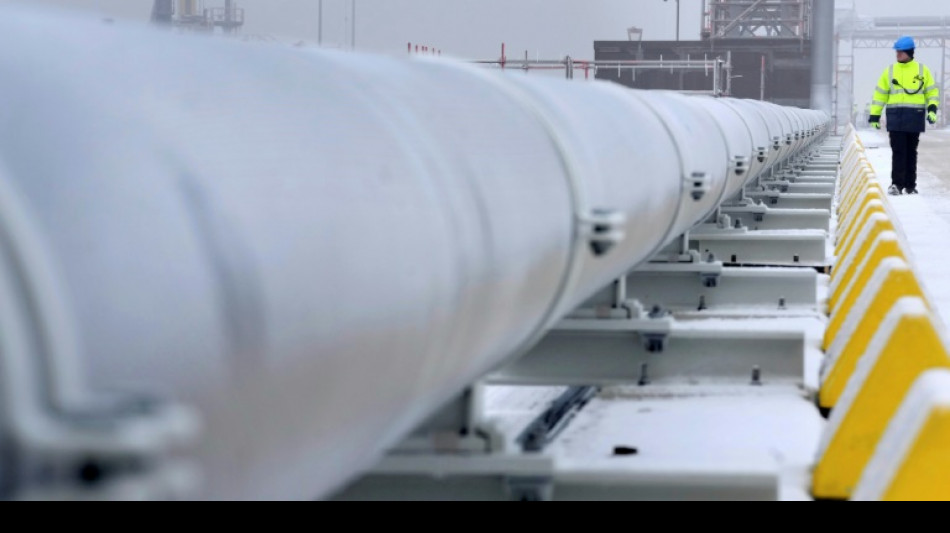
Winter not over, but Europe braces for the next one / Photo: Michael Sohn - POOL/AFP/File

 Real Madrid fan group wants Mbappe apology over Ceuta shirt snub

 Nepal floods among 'most challenging' disasters: WFP
 Doubts as Italy eyes electric future for steel plant
 'One of the kindest people': Taraneh, 21, facing execution in Iran

 Japan eyes changing prostitution law to punish sex buyers

 After record rain, typhoon threatens new challenge to Asian Games

 Kids and social media: what would change under new EU law

 Modi pitches India as global chipmaking hub
 Ukraine plans record defence spending in 2027

 Klopp calls up 44 players in huge first Germany squad
 STARPRIME Responds to Diverging Gold Market Demand with AM/PM Fixing and XAU24/7

 Ukrainian fashion designer debuts art between air raids

 Gambian businesses struggle under prolonged blackouts
 Fiji declares national HIV crisis
 Australia to cut migration to fix housing crisis: minister

 NASA scan discovers new, 'once in a century' Moon crater

 Most stocks rise as Fed hikes and indicates drive to curb inflation

 US again denies Palestinian leader Abbas visa to attend UN assembly

 Lula says he will go to UN to tell Trump to 'stay out' of Brazil's elections

 Messi heads Inter Miami to Campeones Cup triumph

 AI looms large ahead of Xi, Trump summit

 Smith still haunted by 'Sandpapergate' as he prepares for South Africa Tests

 UK-Sudanese author pens book to give children 'African history of Africa'

 Boehly and Walter sell Chelsea stake to Clearlake Capital

 Banyan Gold Intersects 1.05 g/t Gold over 52.8 metres and Bonanza-Grade Gold at Powerline Deposit, AurMac, Yukon, Canada

Europe has weathered the energy crisis that followed Russia's invasion of Ukraine so far, but businesses and households are already thinking about how to get through the next winter.
Mild weather, government aid, gas storage facilities at full capacity and energy imports from other regions have helped Europe limit the economic damage caused by the war.
Outside the western industrial city of Dortmund in Germany, brewery Veltins adapted by using reuseable bottles, partially converting its gas oven to use fuel oil and spending 30 million euros ($32.5 million) to stock up on raw materials.
"We did not have to lower our production," Veltins spokesman Ulrich Biene told AFP.
Germany, which relied heavily on Russian gas imports before the war, provided massive aid to consumers, scrambled to fill up its storage facilities and found new sources of energy as Moscow turned off the taps.
The government said last week it expects Europe's biggest economy to avoid recession this year, though data on Monday showed a contraction in the last three months of 2022.
To beef up winter supplies, Germany and its EU neighbours bought LNG from Qatar and the United States, which is more expensive than Russian gas that was brought in via pipelines.
LNG imports in Europe jumped by 60 percent in 2022 compared to the previous year, according to the Institute for Energy Economics and Financial Analysis (IEEFA).
As a result "the worst case scenarios for 2022/2023 winter did not happen," said Fabian Skarboe Ronningen, senior analyst for power markets research at Rystad Energy.
- 'Absolutely extraordinary' -
European gas stocks are currently at 72 percent of capacity -- double this time last year.
With temperatures so far this winter more clement than usual, European consumers turned the heating on later -- keeping bill rises in check, ensuring reserves stay high.
Demand for natural gas receded 12 percent in 2022 after the Russian invasion in late February compared with the 2019-2021 average, according to the Bruegel think tank in Brussels.
"That was absolutely, I think, extraordinary," said Bruegel researcher Simone Tagliapietra.
Supply received another boost from the progressive return on stream of several French nuclear reactors that had been taken offline.
After Russia's invasion, European energy prices hit record levels -- surpassing 300 euros per megawatt hour in August before a falloff after governments rushed to boost storage.
Europe's main futures contract has now settled at around 55 euros -- still around double what it was prior to the Covid-19 pandemic.
But the drop has yet to be seen on household bills as wholesalers buy months in advance, leaving consumers struggling to pay as inflation soars.
"Even next month will be a struggle," said Dora Jesus, a 42-year-old Londoner on state benefits whose bill has risen past 100 pounds ($123) from 82 pounds previously.
- 'Race for gas' -
Some analysts say a return to typical prices could take years.
"All eyes are already on 2023/2024 winter already," said Ronningen, noting that Russian supplies will remain out of the equation.
"Europe will rely even more on LNG in 2023, as this is the first full year with very low volumes coming from Russia," he said.
And if Asian demand rebounds, "the competition between Europe and Asia for LNG will get even harder, which could result in higher prices than we see now."
For Tagliapietra, "Europe is in a better position vis a vis the last year, because last year, Europe managed to find a new energy equilibrium after the shock of cutting the Russian gas supplies."
He said demand must be kept in check as far as possible while more renewables are added into the system.
"I think it will be very important for European countries to coordinate" on filling storage tanks as "we need to avoid this race for gas that we've seen in the summer", Tagliapietra said.
"The more we coordinate, the more we can save money."
J.Gomez--AT