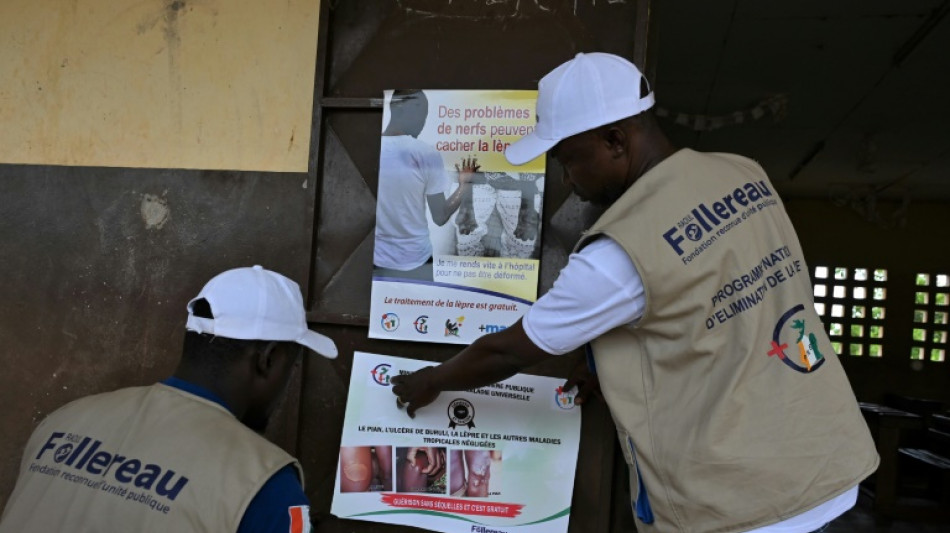
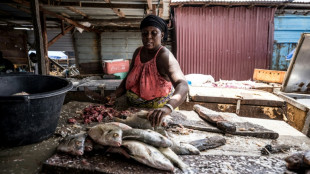
WHO urges investment in neglected tropical diseases / Photo: Issouf SANOGO - AFP

 AFP photo shows Trump examining image of Kennedy Center apparent demolition

 Andersson vows to take Sweden in 'new direction' after election win
 Turkey's Erdogan to run again in early 2028 vote, top adviser says

 Sweden's Andersson: a trusted, no-nonsense political operator

 Canada's Carney pushes 'new alliance' with EU despite Trump threats
 Ireland to boycott Eurovision 2027 over Gaza

 India's Tata Sons reappoints N. Chandrasekaran as chairman

 Sweden's left-wing wins election thriller

 Germany urges EU action against China to defend carmakers
 Stocks mostly rise after US Fed rate hike, oil eases
 Palestinians turn rugged caves into homes after Israeli demolitions

 Two unseen Monet paintings to be sold in Paris: auction house

 Klopp wants German team to help reclaim national pride from far-right

 Ninth woman found dead in South Africa killing spree

 Smog scuppers Japan force helping fight Indonesia wildfires
 King Charles to call on tech giants for 'reassurances' over AI

 Lebanon security talks in Paris focus on replacing UN mission

 Most stocks rise as Fed hikes and oil prices drop

 'Vande Mataram': Why is India's freedom song in spotlight?

 Counterculture pop artist Peter Max dies at 88: US media
 Asian Games chief defends 'functional' rooms after backlash
 Leader's sister says only 'idiots' think N. Korea to give up nukes

 World's water cycle becoming more unpredictable, UN warns
 Where the US-China tariff row stands ahead of White House summit
 Croc-habitat gets green light for 2032 Olympic rowing

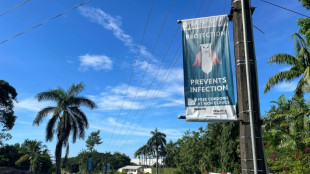
The World Health Organization on Monday called for greater investment in combating neglected tropical diseases, which left more than 1.6 billion people, often in least-developed countries, requiring treatment in 2021.
NTDs are a diverse group of conditions, found mainly in tropical regions, that include dengue, leprosy and rabies.
They are deemed neglected diseases because they are largely overlooked and benefit from only limited funding.
The WHO said NTDs disproportionately affect the poorest, primarily in areas where water safety, sanitation and access to health care are inadequate.
Soce Fall, director of the WHO's NTDs department, said they had been neglected precisely because they did not affect developed countries.
By comparison, he cited the funding plunged into Mpox last year once it began spreading outside Africa.
"The level of investment needed -- we are far from reaching it," he told a press briefing.
"We need to protect people wherever they are, and whatever their social condition."
- Millions 'liberated' -
In 2021, around 1.65 billion people were estimated to require treatment for at least one NTD, of which 857 million were in southeast Asia and 584 million in Africa.
The figure was down by 80 million from 2020 and has fallen consistently from 2.19 billion in 2010, the WHO said in a progress report released on World NTD Day.
But 16 countries account for 80 percent of the global NTD burden. They include the Democratic Republic of Congo, Egypt, Ethiopia, India, Nigeria, Pakistan, the Philippines, and Tanzania.
As of December, 47 countries had eradicated at least one NTD, with eight certified as having eliminated one in 2022 alone.
"Around the world, millions of people have been liberated from the burden of neglected tropical diseases," said WHO director-general Tedros Adhanom Ghebreyesus.
"We still have a lot of work to do. The good news is, we have the tools and the know-how not just to save lives and prevent suffering, but to free entire communities and countries of these diseases."
- Guinea worm almost eradicated -
NTDs are caused by a variety of pathogens including viruses, bacteria, parasites, fungi and toxins.
They include bilharzia, Chagas disease, dengue, Guinea worm, sleeping sickness, leishmaniasis, leprosy, river blindness, rabies, scabies, snakebite envenoming and trachoma.
"These diseases cause devastating health, social and economic consequences, and when they aren't deadly, they very often cause life-long social stigma and consequent economic hardship," the WHO said.
Fall said leprosy persisted in 139 countries and dengue in 129, "so we are far from elimination".
Formerly endemic, Guinea worm is poised to become the second human disease in history to be eradicated, following smallpox, and the first without a medicine or vaccine.
About 3.5 million human cases occurred in 1986 -- but just 13 were recorded in 2022.
Ghanaian President Nana Akufo-Addo said the west African country had eliminated trachoma and Guinea worm, and was on the brink of doing likewise with sleeping sickness and leprosy.
"Investing in NTD elimination programmes creates a ripple effect in society. It leads to better education, health and employment outcomes. It transforms lives and our communities," he said in a statement.
"An Africa free from NTDs is possible."
W.Moreno--AT